A wrestling mask is a fabric-based mask that some professional wrestlers wear as part of their in-ring persona or gimmick. The wrestling mask is considered "sacred", so much so that the intentional removal of a mask is grounds for disqualification.
If a wrestler is unmasked during the match, his top priority is to cover up his face and they usually get help from people at ringside to do so. Most masked wrestlers wear their masks for any and all public appearances, using the mask to keep their personal life separate from their professional life; because of the mask, most Mexican wrestlers enjoy a higher degree of anonymity about their personal lives.
Here we will explore the evolution of wrestling masks, their cultural significance, and modern protective gear used in wrestling.
Masks in Pro Wrestling & Lucha Libre [History/Traditions]
History of Wrestling Masks
The use of masks in wrestling dates back to the 19th century. At the 1865 World's Fair, Theobaud Bauer debuted the mask, wrestling as "The Masked Wrestler" in Paris, France.
December 14, 1874, The Charlotte Democrat reported on an interesting story from Bucharest Romania about an open challenge made by local wrestler, Jules Rigal being accepted by a gentleman wishing to remain anonymous. The gentleman was a masked wrestler named "The Great Unknown," and rumored to have been Prince Stourja, a Moldavian nobleman with a reputation of Herculean strength. The success of this match lead to the several successful nightly rematches between the two opponents.
Read also: Next Fight Prospects for Canelo
Until one night a talkative member of the troupe let it slide that "The Great Unknown" was another clown from this circus. The Bucharest crowd became aware of this and lead to a disturbance that cause "The Great Unknown," the manager, and their troupe to narrowly escape being torn apart by the crowd. The police succeeded in suppressing, what seemed, to be a serious riot brewing that night.
February 21, 1891, San Antonio's "The Light" reported on an upcoming wrestling event being held at San Antonio's historic Washington Theatre. In 1915, Mort Henderson started wrestling as the "Masked Marvel" in the New York area making him the second earliest North American wrestler to perform with such a gimmick.
In the subsequent years many wrestlers would put on a mask after they had been used in an area, or territory, that their popularity and drawing ability diminished, it would be an easy way for a wrestler to begin working in a new area as a "fresh face".
Many wrestlers have had very successful careers while masked such as The Destroyer/Dr. X, Mr. Wrestling, Masked Superstar and the Spoiler. In the days where professional wrestling was more regional, with less national television coverage, it was not uncommon for more than one person or team to use the same gimmick and mask, and there have at times been several masked "Interns", "Assassins" and "Executioners" working simultaneously.
Tag team wrestling has seen more masked teams, using identical masks to create unity between wrestlers. One of the best-known North American masked wrestlers was Big Van Vader, who was also known for his in-ring agility despite his large frame during the 1980s and 90s.
Read also: A Look at Wrestling Masks
Today, masked wrestlers are not a common sight in the United States and Canada, but masked wrestlers have a long history in that region, dating back to 1891. A mask sometimes will be used by a well known wrestler in a storyline where they must get around various "stipulations" or betray a trust without revealing their true identity.
For instance wrestlers who are suspended in a storyline return under a mask under another name, usually with it being very obvious who is under the mask. Examples of this include: Hulk Hogan as Mr. America, Dusty Rhodes as The Midnight Rider, André the Giant as Giant Machine, Brian Pillman as The Yellow Dog, The Miz as The Calgary Kid, Dan Marsh as Mr. X and Bo Dallas as Mr. NXT. Jimmy Valiant once returned under a mask as Charlie Brown from Outta Town after losing to Paul Jones in a "Loser Leaves Town" match (a stipulation where the loser of the match must resign from the organization for which he worked).
Usually with the mask on, everything is positive. Without the mask I'm a normal being who has his problems, who cries, who sometimes suffers. I could tell you that I really admire El Hijo del Santo. But do you know who I admire more ? The human being. Thanks to him, El Hijo del Santo has a life. "The mask is the luchador's identity, both in and out of the ring.
WWE hall of famer El Santo is one of the most iconic luchadores. He “helped fuel the growth and reputation of lucha libre throughout the world”.[7] “WWE Hall of Famer Eddie Guerrero once wrote that ‘Calling him a legend doesn’t even do justice to how big he was.
The Mexican fanbase quickly took to the mystery of the masked man and soon after, Mexican wrestlers themselves started wearing masks, becoming "enmascarados". Early masks were simple with strong, basic colors designs that could be recognized even in the back row of the arena. Over the years, the masks evolved to become very intricate and colorful, drawing on Mexico's rich history.
Read also: Wrestling Mask of Kane
Lucha Libre is still an incredibly popular sport in Mexico, with souvenir masks being sold at events and online. Masks are colorfully designed to evoke the images of animals, gods, ancient heroes, and other archetypes, whose identity the luchador takes on during a performance.
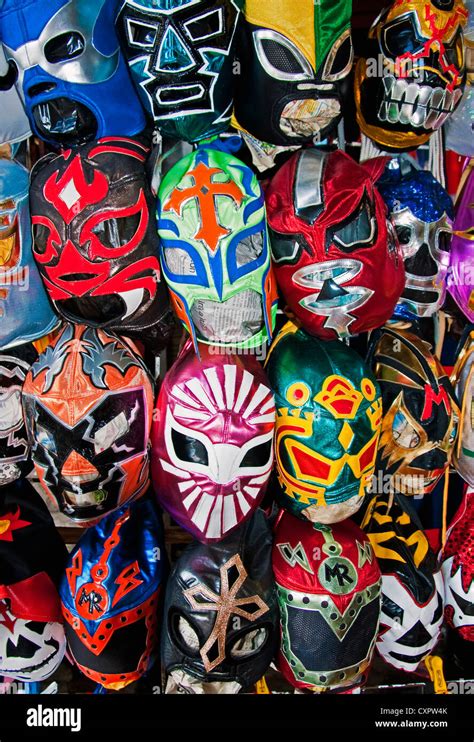
Lucha Libre masks representing various characters and archetypes.
Luchas de Apuestas
Most wrestlers in Mexico start their career wearing a mask, but over the span of their careers, a substantial number of them will be unmasked. Sometimes, a wrestler slated for retirement will be unmasked in one of his final bouts or at the beginning of a final tour, signifying loss of identity as that character.
In lucha libre, the highest achievement is not winning a championship but winning the mask of an opponent in a luchas de apuestas, a "bet fight" where each wrestler bets their mask. The luchas de apuestas is usually seen as the culmination of a long and heated storyline between two or more wrestlers, with the winner getting the "ultimate victory".
It is customary for the loser of such a match to reveal his real name, where he's from and how long he has been a wrestler before taking the mask off to show his face. Unmasked wrestlers will wager their hair instead, risking having his or her head shaved bald in case of defeat.
There can be several reasons to book a luchas de apuestas beyond the obvious purpose of elevating the winner. If the loser is a younger wrestler, then the loss of the mask can sometimes lead to a promotional push after unmasking, or the wrestler being given a new ring persona.
The first luchas de apuestas match was presented on July 14, 1940 at Arena México. The defending champion Murciélago was so much lighter than his challenger Octavio that he requested a further condition before he would sign the contract: Octavio would have to put his hair on the line.
Examples of High-Profile Luchas de Apuestas:
- El Santo winning the mask of Black Shadow
- Los Villanos winning the masks of all three Los Brazos (El Brazo, Brazo de Oro and Brazo de Plata)
- Atlantis winning the mask of Villano III
- La Parka unmasking both Cibernético and El Mesias
- Villano V taking Blue Panther's mask
- Último Guerrero winning the mask of Villano V
Masks in Other Cultures
The Destroyer, an American, was the first masked wrestler to work in Japan during the 1960s but remained a novelty with very few Japanese wrestlers choosing to wear a mask. The first Japanese masked wrestler is considered to be Shozo Kobayashi, who briefly competed under a mask as Fukumen Taro ("Masked Taro").
In the 1970s Mil Máscaras became the first Mexican Luchador to work on a regular basis and became very popular with the fans. The original Tiger Mask, Satoru Sayama was inspired by Mil Máscaras to create the masked "Tiger Mask" persona.
After the success of Tiger Mask several wrestlers have adopted the mask, mainly lighter wrestlers who like Sayama had a more high flying and flashy style. The wrestling mask is held in more regard by the Japanese fans than the North American fans but isn't as "sacred" as the Mexican mask, meaning that the wrestler can perform both masked one day and unmasked another if he so wishes.
Although at live shows, masked wrestlers were as prolific in British wrestling as its American counterpart, they were largely kept off ITV's television coverage until the late 1960s. Successful masked wrestlers up until this point included Count Bartelli (Geoff Condliffe), the White Angel (Judo Al Hayes) and Doctor Death (promoter Paul Lincoln as the top villain of his own major independent promotion).
The most famous masked wrestler in British history, Peter Thornley, the original British version of Kendo Nagasaki, made his professional debut - complete with masked Samurai gimmick - in 1964 but did not appear on television until 1971. Nagasaki's first big victory was a win over mentor (and real life trainer) Bartelli in a 1966 mask vs mask match.
His own mask was pulled off by opponent Big Daddy during a televised match in December 1975, an important turning point in Daddy's rise in popularity. Nagasaki later voluntarily unmasked in a ceremony in the ring on TV in December 1977.
At Christmas 1979, Big Daddy defeated and unmasked Mr. X on television. Subsequently, during the 1980s in Joint Promotions, masked wrestlers were generally built towards being fodder for Daddy to defeat, unmask and humiliate in headline tag matches on ITV, such as the Spoiler (Drew McDonald) King Kendo (aka Red Devil), Battle Star (Barry Douglas), El Diablo, the Black Baron, the Masked Marauders tag team and The Emperor.
Meanwhile in All Star Wrestling - apart from Nagasaki - they were mostly treated as short lived reflections of recent fads in popular culture. Bauer as the Masked Wrestler of Paris in the 1860s, would be followed by more masked wrestlers in his home country.
A wrestling mask was known in France as a "cagoule" (hood) and fans would often chant "he he la cagoule" to encourage the babyface to unmask a masked heel. Doing so, however, was banned under French wrestling rules - if unmasked, a wrestler would crouch on the mat face-down until the referee restored his mask.
One of the earliest successes of televised wrestling in France was the feud between babyface masked wrestler L'Ange Blanc,[13] and black clad heel masked wrestler Le Bourreau de Bethune[13] Another successful masked heel of the 1960s was L'Homme Masqué (The Masked Man).
Spanish wrestler Angelito initially wore a silver mask in France before taking it off midway through a 1971 televised match with Jacky Richard. Another Spaniard, Oscar "Crusher" Verdu, who wrestled under a mask as Der Henker, would win the French Heavyweight Championship in 1983.[14] Der Henker was previously played in the early 1970s by Remy Bayle. British wrestler Dave Larsen wrestled in France under a mask as Zarak.
In the 1980s, masks were primarily worn as a component of more outlandish characters such as the tag teams Les Piranhas and Les Maniaks (a team of evil masked clowns) and Mambo Le Primitiv, based on the film character of King Kong.
Evolution of Mask Design and Materials
The original wrestling masks were often masks attached to a top that snapped in the groin making it very uncomfortable for the people wearing it. If the masks were not attached to the top, then they were made from uncomfortable material such as brushed pig skin, leather or suede.
In the 1930s, a Mexican shoe maker called Antonio Martinez created a mask on request from Charro Aguayo that became the standard for wrestling masks created since then. The basic design consists of four pieces of fabric sewn together to create the basic shape that covers the entire head. The mask has openings for the eyes, nose and mouth with colorful trim around the open features, known as "Antifaz" in Spanish.
The back of the mask is open with a "tongue" of fabric under laces to keep it tight enough to not come off accidentally during a match. The first variation in style came when the jaw and mouth area was removed from the mask to expose the skin.
Originally being made from fabric, masks have evolved and are now made from a variety of materials from cotton to nylon to various vinyl polymers in many different colours and patterns. Several additions have been made to the mask decorations over the years with the most prevalent and visually striking being foam horns and artificial hair attached to the mask.
Modern Protective Face Guards
Beyond the traditional masks used for character portrayal, modern wrestling also utilizes face guards for protection. Your safety matters. Our Wrestling Face Guard is engineered from advanced materials, providing unmatched protection against impacts, scratches, and potential injuries on the mat. Wrestle confidently, knowing your face is shielded by technology designed to withstand wrestling's demands.
Enhance your tactical advantage with unobstructed vision. Our face guard offers crystal-clear visibility, ensuring you never miss a moment during the match. Focus on the match, not your gear. Our Wrestling Face Guard boasts a secure and comfortable fit, eliminating distractions and discomfort.
Streamline your prep with our face guard's easy attachment and removal. Spend less time wrestling with equipment and more time perfecting your techniques. Wrestle with the confidence that comes from hassle-free gear. Experience the ease of a perfect fit with our Wrestling Face Guard.
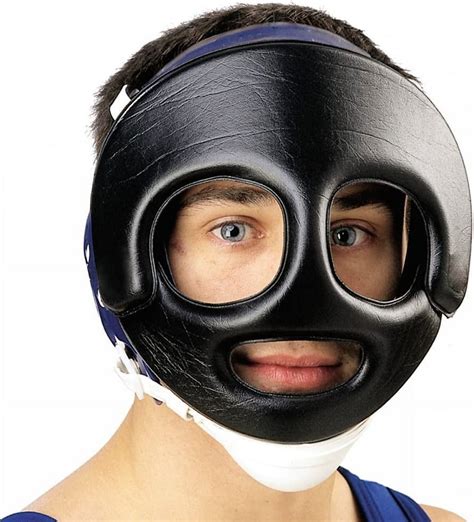
Modern wrestling face guard for impact protection.