Michael Gerard Tyson, also known as 'Iron' Mike Tyson, is one of the greatest legends of all time in boxing.
A man who was unbeatable in his prime and who was mainly a victim of his own demons, who gained fame at a very young age and with serious demons in his emotional life, which led him to lose everything, to the point of going to jail and who has now redeemed himself, in a Hollywood-style story.
Among his achievements, Tyson became the youngest boxer to win a heavyweight title on November 22, 1986, when he knocked out Trevor Berbick in the second round at just 20 years, four months and 21 days old to win the WBC title.
Let's delve deeper into the life and career of this iconic figure.
Early Life and Career
Michael Gerard Tyson was born on June 30, 1966, in Brooklyn, New York City. Throughout his childhood, Tyson lived in and around neighborhoods with a high rate of crime.
Read also: Mike Tyson vs. Brock Lesnar?
By the age of 13, he had been arrested 38 times. He ended up at the Tryon School for Boys in Johnstown, New York.
Tyson's emerging boxing ability was discovered there by Bobby Stewart, a juvenile detention center counselor and former boxer.
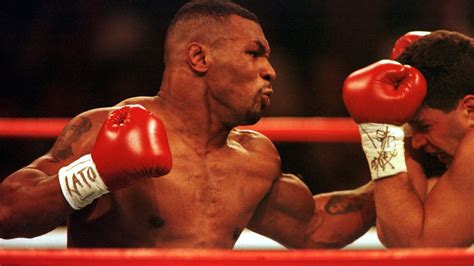
Stewart noted that Tyson could bench press more than his weight, and through Stewart, Tyson met boxing manager and trainer Cus D'Amato. Tyson dropped out of high school as a junior. Kevin Rooney also trained Tyson, and he was occasionally assisted by Teddy Atlas, although Atlas was dismissed by D'Amato when Tyson was 15.
As an amateur, Tyson won gold medals at the 1981 and 1982 Junior Olympic Games, defeating Joe Cortez in 1981 and beating Kelton Brown in 1982.
Tyson made his professional debut as an 18-year-old on March 6, 1985, in Albany, New York. He defeated Hector Mercedes via first-round TKO. He had 15 bouts in his first year as a professional.
Read also: Mike Tyson vs. Jake Paul
Mike Tyson vs Trevor Berbick Full Fight HD (Tyson became the youngest heavyweight champion at 20)
Becoming the Youngest Heavyweight Champion
Fighting frequently, Tyson won 26 of his first 28 fights by KO or TKO; 16 of those came in the first round.
On November 22, 1986, Tyson was given his first title fight against Trevor Berbick for the World Boxing Council (WBC) heavyweight championship.
Tyson won the title by TKO in the second round, and at the age of 20 years and 4 months became the youngest heavyweight champion in history.
He added the WBA and IBF titles after defeating James Smith and Tony Tucker in 1987.
Tyson's dominant performances brought many accolades.
Read also: The Legend of Iron Mike
Expectations for Tyson were extremely high, and he was the favorite to win the heavyweight unification series, a tournament designed to establish an undisputed heavyweight champion.
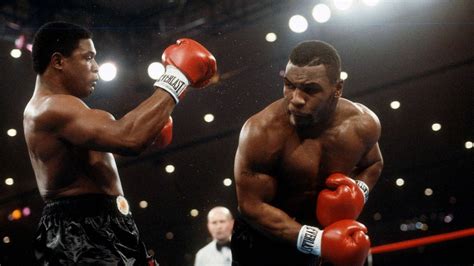
Tyson defended his title against James Smith on March 7, 1987, in Las Vegas, Nevada.
On June 27, 1988, Tyson faced Michael Spinks.
Spinks, who had taken the heavyweight championship from Larry Holmes via fifteen-round decision in 1985, had not lost his title in the ring but was not recognized as champion by the major boxing organizations.
The bout was, at the time, the richest fight in history and expectations were very high.
Boxing pundits were predicting a titanic battle of styles, with Tyson's aggressive infighting conflicting with Spinks's skillful out-boxing and footwork.
The Fall from Grace
By 1990, Tyson seemed to have lost direction, and his personal life was in disarray amidst reports of less vigorous training prior to the Buster Douglas match. In a fight on February 11, 1990, he lost the undisputed championship to Douglas in Tokyo.
Tyson was a huge betting favorite; indeed, the Mirage, the only casino to put out odds for the fight, made Tyson a 42/1 favorite.
Just 35 seconds into the tenth round, Douglas unleashed a brutal uppercut, followed by a four-punch combination of hooks that knocked Tyson down for the first time in his career.
Despite the shocking loss, Tyson has said that losing to Douglas was the greatest moment of his career: "I needed that fight to make me a better person and fighter.
Legal Issues and Comeback
Tyson was convicted of the rape charge on February 10, 1992, and was released in 1995. After being paroled from prison, Tyson easily won his comeback bouts against Peter McNeeley and Buster Mathis Jr.
Tyson regained one belt by easily winning the WBC title against Frank Bruno in March 1996. It was the second fight between the two, and Tyson knocked out Bruno in the third round.
Tyson added the WBA belt by defeating champion Seldon in the first round in September that year.
The Holyfield Fights
Tyson attempted to defend the WBA title against Evander Holyfield, who was in the fourth fight of his own comeback.
On November 9, 1996, in Las Vegas, Nevada, Tyson faced Holyfield in a title bout dubbed "Finally".
In a surprising turn of events, Holyfield, who was given virtually no chance to win by numerous commentators, defeated Tyson by TKO when referee Mitch Halpern stopped the bout in round eleven.
Holyfield became the second boxer to win a heavyweight championship belt three times.
Tyson claimed he was the victim of multiple illegal head butts by Holyfield during the bout and vowed to avenge his loss.
Tyson trained heavily for a rematch with Holyfield, and on June 28, 1997, the two boxers faced off again.
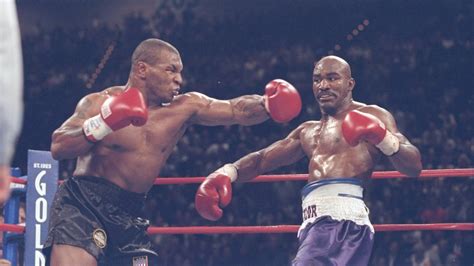
The highly anticipated rematch was dubbed The Sound and the Fury, and it was held at the Las Vegas MGM Grand Garden Arena, site of the first bout. It was a lucrative event, drawing even more attention than the first bout and grossing $100 million.
The fight was purchased by 1.99 million households, setting a pay-per-view buy rate record that stood until May 5, 2007, being surpassed by Oscar De La Hoya vs.
Soon to become one of the most controversial events in modern sports, the fight was stopped at the end of the third round, with Tyson disqualified for biting Holyfield on both ears.
The first time Tyson bit him, the match was temporarily stopped. Referee Mills Lane deducted two points from Tyson and the fight resumed.
However, after the match resumed, Tyson bit him again, resulting in his disqualification, and Holyfield won the match.
As a fallout from the incident, US$3 million was immediately withheld from Tyson's $30-million purse by the Nevada state boxing commission (the most it could legally hold back at the time).
Two days after the fight, Tyson issued a statement, apologizing to Holyfield for his actions and asked not to be banned for life over the incident.
Later Career and Retirement
In October 1998, Tyson’s Nevada boxing license was reinstated and he returned to the ring the next year.
The boxer four wins and two no contests before attempting to win back the heavyweight title in 2002.
To do so, he would need to beat Lennox Lewis, the WBC, IBF, and International Boxing Organization champion.
Tyson lost the fight by a knockout, a defeat that signaled the decline of the former champion’s career.
Tyson only fought three more times.
After losing to Danny Williams via knockout in July 2004, he faced Kevin McBride just under a year later.
Tyson immediately announced his retirement. “I don’t have the stomach for this anymore,” he said. “I felt like I was 120 years old.”
In June 2011, Tyson was inducted into the International Boxing Hall of Fame.
Life Outside of Boxing
Since retiring from boxing in 2005, Tyson has appeared in several movies and TV shows, become a best-selling author, and launched a successful cannabis business.
He also developed a side hustle making guest appearances as himself: in 2006’s Rocky Balboa, 2009’s The Hangover, 2011’s The Hangover 2 and a 2013 episode of How I Met Your Mother.