Many people find the jiu-jitsu belt system confusing. The order of belts is a key part of mastering this martial art. In Jiu-Jitsu, each belt color represents a step in learning this martial art. This guide will explore the significance of each belt, the requirements for progression, and what makes the BJJ journey so unique.
The Brazilian jiu-jitsu ranking system signifies a practitioner's increasing level of technical knowledge and practical skill within the art. Colored belts worn as part of the uniform are awarded to the practitioner.
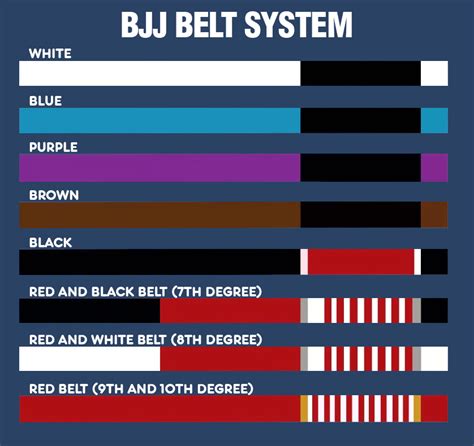
Brazilian Jiu-Jitsu Belts
The Origins of the BJJ Belt System
The belt system in Brazilian Jiu-Jitsu was adapted from Judo, which itself was influenced by traditional Japanese martial arts. In 1907, Kanō Jigorō, the founder of judo, introduced the use of belts (obi) and gi (judogi) in the martial arts, replacing the practice of training in formal kimono. In 1914, Kanō's pupil Mitsuyo Maeda arrived in Brazil, a journey which led to the development of Brazilian jiu-jitsu.
The founders of BJJ, the Gracie family, designed the belt system to ensure students developed real-world effectiveness rather than just memorizing techniques. Today, the belt hierarchy remains a respected and integral part of BJJ culture, symbolizing dedication, skill, and personal growth.
Read also: Training at Alliance Chula Vista
Adult Belt Ranking System
BJJ uses a five-belt system for adults (white, blue, purple, brown, and black), with additional degrees for black belts. Each belt represents a different stage in a practitioner’s journey, with time, skill, and mindset all playing crucial roles in progression.
1. White Belt: The Foundation
- Focus: Survival, defense, and basic techniques
- Typical Duration: 1-2 years
- Key Skills Learned:
- Fundamental positions (guard, mount, side control, back control)
- Escapes and submissions (armbar, triangle choke, rear-naked choke)
- Developing timing and sensitivity
Starting as a white belt in Jiu-Jitsu marks your first step on this martial arts journey. You will learn fundamental techniques, how to defend yourself, and start understanding how to move on the ground. As you train and improve, you aim to master these basic skills before moving onto more complex moves. The white belt phase is about building a strong foundation. Many students feel overwhelmed at first, but persistence leads to breakthroughs.
2. Blue Belt: Developing a Game
- Focus: Refining techniques, developing a personal style
- Typical Duration: 2-4 years
- Key Skills Learned:
- Chain submissions together
- Improve guard retention and passing
- Understand positional hierarchy
After mastering the basics as a white belt, students move up to the blue belt. This level shows they understand the fundamentals of Brazilian Jiu-Jitsu. They must also improve their defense skills against higher belts. Blue belts begin to problem-solve during rolls and develop their own strategies. However, this belt is also known as the “quitting belt” because some students plateau and lose motivation. Pushing through this phase is crucial.
Read also: New Jujutsu Odyssey Codes
3. Purple Belt: The Transition to Advanced Skill
- Focus: Creativity, adaptability, and teaching
- Typical Duration: 3-5 years
- Key Skills Learned:
- Flowing between techniques effortlessly
- Developing a well-rounded game
- Starting to mentor lower belts
Earning a purple belt in Jiu Jitsu marks a significant step. Students show deep understanding of techniques and strategies at this level. This belt requires years of training and dedication. Purple belt fighters can perform complex moves with ease. Purple belts are often considered “the first advanced belt.” They have a deep understanding of BJJ and can adapt to different opponents. Many begin assisting in classes at this stage.
4. Brown Belt: Precision and Mastery
- Focus: Sharpening techniques, competition-level skill
- Typical Duration: 2-3 years
- Key Skills Learned:
- High-level submissions and counters
- Advanced positional control
- Developing a competitive edge
A brown belt in Jiu Jitsu shows a high level of skill and understanding. This rank is just one step below black belt. Brown belts work hard to refine their techniques. They focus on small details that make a big difference during matches. Brown belts are elite practitioners, often competing at high levels. They refine their strengths and work on weaknesses before reaching black belt.
5. Black Belt: The Beginning of Mastery
Read also: Benefits of Jiu Jitsu
- Focus: Leadership, teaching, and lifelong learning
- Typical Duration: 10+ years (from white to black)
- Key Skills Learned:
- Mastery of fundamentals and advanced techniques
- Ability to teach and inspire others
- Continued evolution in strategy
Earning a black belt in Brazilian Jiu-Jitsu (BJJ) is a major achievement. It shows you have mastered the techniques and can apply them with skill. Earning a black belt is not the end-it’s a new beginning. Many black belts say they finally realize how much they still have to learn. Degrees (up to 9th) are awarded for continued contributions to BJJ.
As a black belt holder, you can focus on refining techniques and sharing your knowledge with others. Many choose to open their own schools or mentor upcoming fighters.
Coral and Red Belts: The Highest Levels
The journey doesn’t stop at black belt for those passionate about Brazilian jiu-jitsu. A Red / Black Belt, also known as a Coral Belt, is a major milestone in the martial art of Jiu Jitsu. This belt shows that someone has vast knowledge and years of experience. Jiu jitsu practitioners who earn a Coral Belt have contributed significantly to the sport. They often shape the future generations by sharing their wisdom and skills.
Earning a red and white belt, also known as a coral belt in Jiu Jitsu, is a massive achievement. This rank signifies deep knowledge and decades of dedication to the martial art. The red belt in Brazilian Jiu-Jitsu signifies the highest level of expertise. Masters and grandmasters who receive this honor are seen as living legends within the community. Reaching red belt status is an incredible achievement in the BJJ belt system, reflecting immense dedication, skill, and knowledge.
According to Renzo and Royler Gracie, in Brazilian jiu-jitsu the red belt is reserved "for those whose influence and fame takes them to the pinnacle of art". Brazilian jiu-jitsu red belt holders are often addressed within the art by the title grandmaster.
Youth Belt System
Young Jiu Jitsu students follow a unique belt system different from adults. Different youth belt systems exist in Jiu-Jitsu. Some schools use colors like white, gray, yellow, orange, and green for kids.
Switching from one school’s youth system to another can seem tricky at first. But most coaches know how to match up belts between different systems. This way, kids can move into a new class without losing their hard-earned rank.
In 2015, the International Brazilian Jiu-Jitsu Federation specified 13 belts for youth practitioners within these ages. When a practitioner turns 16, they are immediately promoted to the adult ranking system according to the belt they have at the time. Beginners remain at white belt, and gray, yellow, or orange belts either revert back to white or can be promoted to blue belt at the professor's discretion.
The table below shows an approximate conversion between the Gracie system and the International Brazilian Jiu-Jitsu Federation system, including striped sub-ranking within each belt. These are the two most common systems for kids belts in Brazilian jiu-jitsu.
| Belt | Description |
|---|---|
| White | Beginning rank for all BJJ students |
| Gray | Intermediate rank for youth practitioners |
| Yellow | Further progression for youth practitioners |
| Orange | Advanced rank for youth practitioners |
| Green | Highest youth rank before transitioning to adult system |
Youth Belt System
Kids develop coordination and focus faster when they earn small, frequent rewards. That’s why the youth ranking system offers more colors and stripe levels. Many large academies ask children to spend at least 6 months per stripe and roughly one year per belt to ensure fundamentals mature along with growing bodies.
Earning Stripes and Moving Up
To move up in jiu-jitsu belt ranks, students must show they have learned certain skills and know-how. They also consider your dedication to training, respect for others, and how you help teammates improve. Progress is marked by stripes before moving to the next belt color. Earning stripes shows your improvement and gets you closer to your next big step - changing belts.
Many academies use stripes on belts to mark progress between promotions. Typically, a student earns 4 stripes per belt before advancing. Stripes help motivate students and give them short-term goals. Stripes on belts show progress in Jiu Jitsu. Coaches give them out based on skill, knowledge, and time spent training. Earning stripes keeps motivation high. It shows you’re improving even if you haven’t reached a new belt level yet.
Within each of the belts, students have the opportunity to earn up to generally 4 stripes on their belt, indicating progress within that belt. The cumulative number of stripes earned serves as an indication of the student's skill level relative to the total curriculum of that belt color. Stripes may consist of small pieces of cloth sewn onto the sleeve of the belt, or simple pieces of athletic tape applied to it. Although the exact application, such as the number of stripes allowed for each belt, varies between institutions, the IBJJF sets out a general system under which four stripes can be added before the student may be considered for promotion to the next belt rank. Stripes are only used for ranks prior to black belt.
After learning about promotion criteria, it’s time to explore formal testing in Jiu Jitsu. Formal testing is a key part of moving up in belt ranks. Tests can be tough. They cover moves, defense techniques, and sometimes sparring with another student. Passing your formal tests shows you’re ready for the next exciting part of Jiu Jitsu: competitions.
Competitions are a big deal in Brazilian jiu-jitsu (BJJ). Competition allows instructors to gauge students' abilities while grappling with a fully resisting opponent, and it is common for a promotion to follow a good competition performance. They help students see where they stand and what they need to work on.
Technical and conceptual knowledge are judged by the number of techniques a student can perform and the level of skill with which they are performed in live grappling, allowing smaller and older practitioners to be recognized for their knowledge, although they may not be the strongest fighters in the school. Brazilian jiu-jitsu is a distinctly individual sport, and practitioners are encouraged to adapt the techniques to their body type, strategic preferences, and level of athleticism.
Goals for Each Belt Level
Moving through the Jiu Jitsu belt system shows your growth and skill. At the white belt level, beginners learn the basics of Jiu Jitsu. They focus on understanding the fundamentals, practicing discipline, and respecting their peers. Blue belts work on refining techniques and starting to develop their own style. Brown belts are nearing mastery and polish their skills while teaching others. Their goals include perfecting techniques and preparing for black belt responsibilities. Coral belts represent decades of dedication to Brazilian jiu-jitsu after becoming black belts. Red belts symbolize a lifetime commitment to Jiu Jitsu’s art and philosophy.
Understanding the goals for each belt level sets the stage for knowing how long it might take to progress. Jiu jitsu practitioners often spend years at each belt level, honing their skills and acquiring deeper knowledge of Brazilian jiu-jitsu principles. Growth in this martial art isn’t tied strictly to time spent on the mat; knowledge gained is just as crucial. Achieving higher ranks like the coral or red belts takes decades, reflecting both immense skill and significant contributions to the sport of jiu-jitsu.
Consistent Practice and Dedication
Practice consistently to improve in jiu-jitsu. Show up to class, listen carefully, and apply what you learn. Focus on learning from losses. Each mistake teaches something important. Ask higher belts for advice and use their feedback to grow stronger in Brazilian Jiu-Jitsu ranking system.
The journey through Jiu Jitsu belts is a rewarding adventure. Every belt represents growth, skill, and dedication in this martial art. The path isn’t just about fighting; it’s also about personal development.
Brazilian Jiu-Jitsu (BJJ) is more than just a martial art-it’s a way of life that cultivates discipline, resilience, and personal growth.
What Every BJJ White Belt And Blue Belt Should Learn And Focus In Jiu Jitsu by Gordon Ryan
tags: #jiu #jitsu #championship #belts