Kyusho Jitsu, often referred to as the art of vital points, is a martial art that focuses on manipulating specific areas of the body to achieve a desired effect, whether it be healing or causing pain. The term "Kyusho" literally translates to "Vital Point(s)" in Japanese, representing a practice that has existed for millennia.
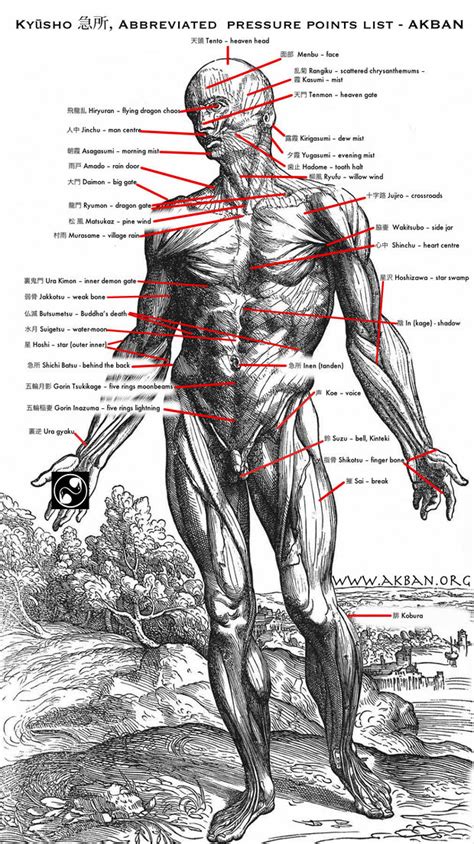
The study of Kyusho involves understanding the body's vital points, which include obvious targets like the eyes, throat, and temples, as well as lesser-known internal points. These points are manipulated to disrupt the body's natural functions, leading to various effects.
The Historical Context of Kyusho
Kyusho, or the study of the vital points, is the backbone of many ancient martial arts like Karate, and was historically transmitted via written and personal instruction. These old patterns of movements hid the vital targets as they honed the weapons, the motions and muscle memory to access and utilize them.
Kyusho was a keystone of the older styles, and can logically explain even the stranger movements of kata, that most conclude are just a “stylistic” physical action. One kata, like Sanchin as example, can be a complete martial art by itself when the Kyusho is understood. In other words, when it comes to Kyusho, the lessons of a kata - once understood and applied correctly - transcend the boundaries of said kata and can be applied to numerous situations.
In recent times, society has had less need for this type of study - as well as more laws that prohibited bodily damage or loss of life even under physical attack, and the martial arts have begun to trend away from life-and-death or weapon combat into more sport and exercise based activity. Another reason why Kyusho is not well known is that the science almost became extinct, as the real old bushi [Jap. “warrior”] died out. Luckily for us and future generations, the information has resurfaced - but it will take time spreading it as more qualified instructors with measured skill and lineage are developed.
Read also: Training at Alliance Chula Vista
Most martial artists today spend decades of their life in practicing and researching the physiology of a punch, kick, grab or manipulation of the human body - but not the physiology of the body functionality itself. They give little thought or effort to the vital areas, inter-relationships or anatomical structures that most efficiently accomplish these skills, or can, in reverse engineering, incapacitate the same functionality of an opponent.
Kyusho Jitsu and Kata
Many people would love to understand how vital points can be discovered and applied through analyzing the movements of kata. Many of the moves in kata are “odd” to say the least. They have no potential to really defend a practitioner with muscle force in either defense or offensive actions. However, when the practitioner understands that these moves are descriptive motions on how to properly attack or manipulate an opponents weaker anatomical structures, i.e. Old-school Okinawan Karate has tons of unique movements, absent from modern Karate.
When you begin to involve Kyusho in your kata, your bunkai becomes infinite and only limited to your thoughts.
Kyusho Top 10 Points for Self Defense. FULL Instructional
The Importance of Accurate Pressure Point Charts
Finding good quality printable charts can be a challenge when learning Kyusho Jitsu. Many online resources offer charts with poor resolution or excessive acupuncture information. The charts used by 95% of all Kyusho practitioners are acupuncture charts... and Kyusho is not acupuncture. The issue with this is that all the Kyusho targets are anatomical structures inside the body, not outside.
Superficial charts depict exterior targets and imaginary lines that interconnect a series of them. These old drawings or charts were at the time sufficient as they were held by instructors to show their students as they performed actual methods on live beings, they were a simple reminder of what they did in reality. If a Kyusho Practitioner is working from such a chart is that the actual locations or Kyusho targets are not even shown or depicted. They are skin level or on some more modern examples on two dimensional drawings of the muscle structures... but again this is too superficial and inadequate to understand or know the actual target.
Read also: New Jujutsu Odyssey Codes
What is needed is a multi layered and anatomically accurate image that the practitioner can interact with to discover all the exacting structures, depth, surrounding structures and ways to best manipulate them.
Anatomical Understanding
All serious practitioners of Martial Arts know that there are certain principles that govern technical executions, whether offensive or defensive; to physics we know the principle that “force is equal to the mass times the square of the velocity” (F = M x V2), that is, to increase the force applied to a strike, greater speed is required.
To affect a point (read damage tissue or an organ) we must concentrate the force using the greatest part of the muscles sequentially given that if we used only the movement of the arm without resorting to the push with the legs and the rotation of the waist, the effect of impact of the strike would be minimum. We have learned that the force of reaction acts in our favor, for example, at striking the Uke with a fist, when the back foot from which you strike is supported with greater firmness on the ground and the force of reaction that results is transmitted first to the body, later to the arm, and afterward to the striking hand, accumulating force in the strike.
Body movements are due to the synchronized flexing/extension-relaxation of the agonistic and antagonistic muscles and that these are driven by a network that transmits electric impulses denominated peripheral nerves and which in turn are connected to the marrow and to the brain, exercising a mechanism of stimulus reception and transmission of impulses that can or cannot be controlled. If we affect a nerve, we will provoke a stimulus that will travel toward the marrow and the brain and these will respond by way of a reaction to that stimulus, possibly being a reflexive reaction, that is, a stimulus that travels to the marrow without the need of processing the information in the brain.
The research done in 1960 by the Research and Anatomical Teaching Group of the No. 1 medical school in Shanghai, through a study done on 324 Acupuncture Points, showed us an incredible connection between these points and the nerves; we know that the nerves pass between the tissues (muscles, tendons, ligaments, subdermic cellular tissue, bones) and if we learn the way to access them, we will be able to provoke a reaction in the Uke (pain, organic dysfunction or alterations in the sta...
Read also: Benefits of Jiu Jitsu
Kyusho Jitsu: A Synthesis
Kyusho, as Even Pantazi teaches it, is a marvelous complement to any martial style. It allows us to know our body much better and in consequence, those of others; it allows us to optimize our weapons, as much in defense as in attack; to experience the knowledge of tradition; to innovate and familiarize ourselves with the unknown possibilities of our Martial Art, showing us how to have, in a subtle way, the most efficient formulas in the application of the martial techniques, concentrating our attacks and defenses on specific areas of the body where we know (with scientific evidence!) there are accumulations of energy or centers of energetic diffusion, or if you prefer… nerve, muscular, tendon and vein centers that are accessible and which, for their placement and characteristics, provoke effects on the organism far superior to those that we can habitually expect from a similar power attack on a different area.
Kyusho Jitsu is something that should not be overlooked within any given martial art. It is an effective targeting system that enhances any style. It can take the training and turn it into a study of martial arts, a unique stepping stone to many other areas of martial art. Turns kata into something living and fundamental to your practice. Moreover, it encourages a safe environment. The study of Kyusho brings an interest in the anatomy of the body, an additional study often overlooked.