Brazilian Jiu-Jitsu (BJJ), often abbreviated to BJJ, is a self-defense system, martial art, and combat sport based on grappling, ground fighting, and submission holds.
It is commonly known as the gentle art, is a martial art that involves self-defence and combat sports. It is generally practiced on the ground and uses grappling and submission techniques (often chokes and joint locks) to neutralise an opponent.
BJJ practitioners are among some of the most audacious and gifted athletes to step into an international competition scene.
Origins and Early Development
The rich history of Brazilian Jiu-Jitsu traces its origins to the battlefields of feudal Japan, where samurai warriors developed a sophisticated system of combat techniques in the 17th century.
Japanese jiu-jitsu emerged as a comprehensive martial system that combined throws, joint locks, and ground fighting techniques. The art’s foundational principle centred on the ingenious use of advantage and body positioning, allowing practitioners to overcome physically stronger opponents.
Read also: Comprehensive Look at Thiago Santos
As Japanese society evolved beyond the samurai era, jiu-jitsu continued to develop and influence other martial arts. The art’s emphasis on practical effectiveness and technical precision became its defining characteristics, eventually catching the attention of martial arts innovators who would help spread these methods across the globe.
The evolution of BJJ began with Mitsuyo Maeda, who was one the elite experts in Kodokan Judo and one of Kano Jigoro's top students.
Departing Japan in 1904, Maeda traveled to various countries, demonstrating his skills and taking on challengers like wrestlers, boxers, savate fighters, and other martial artists.
Following an extensive journey through Central and South America, Count Mitsuyo Maeda arrived in Brazil in 1914, marking the beginning of a pivotal chapter in martial arts history.
Once in Brazil, Maeda began showcasing his remarkable Judo skills through demonstrations and challenge matches, including a memorable performance at Teatro Variedades in Santos. Standing at 164 centimetres tall, Maeda proved that physical size was not a limiting factor in martial arts mastery.
Read also: Training at Alliance Chula Vista
He eventually settled in Belém, establishing his first Judo academy in 1921, starting modestly in a small 4m x 4m shed. Maeda’s integration into Brazilian society was seamless, aided by his friendship with Gastão Gracie. He accepted Carlos Gracie as a student, setting a chain of events in motion that would transform martial arts.
Maeda’s teachings would profoundly shape martial arts history through his student Carlos Gracie, who became the patriarch of Brazilian Jiu Jitsu’s most influential family.
The Gracie Family and the Development of BJJ
Brazilian jiu-jitsu was first developed by the Brazilian brothers Carlos, Oswaldo, Gastão Jr., and Hélio Gracie around 1925, after Carlos was taught jujutsu and catch wrestling in 1917 by either Mitsuyo Maeda, a travelling Japanese judoka, or one of Maeda's students Jacyntho Ferro.
According to the Gracie family's account, Carlos became a direct student of Maeda at his school, which was overseen by Jacyntho Ferro. However, some Brazilian jiu-jitsu practitioner historians like Robert Drysdale challenge this narrative, proposing that Carlos was primarily instructed by Ferro rather than Maeda himself.
Born in 1902, Carlos Gracie accepted these teachings and, alongside his brothers, began developing new techniques that would transform the art of grappling. The art truly evolved when Carlos’s younger brother, Helio, began modifying techniques to overcome his physical limitations.
Read also: New Jujutsu Odyssey Codes
Due to his smaller build, Hélio struggled with executing many judo throws and with judo techniques that relied on overpowering opponents. Instead, he refined the art, emphasizing ground fighting and leverage-key aspects of jiu-jitsu and judo's ne-waza-over traditional throws.
Instead of relying on strength, Helio emphasised utilisation and precise movement, making the art accessible to practitioners of all sizes. Their dedication to innovation extended beyond physical techniques, with Carlos developing the “Gracie Diet” to improve athletic performance. Combined with their proven fighting system, this comprehensive approach to martial arts training established Gracie Jiu-Jitsu as a distinct and highly effective martial art that continues empowering practitioners worldwide.
Later, the Gracie family developed their own self-defense system that they named Gracie jiu-jitsu.
The Gracie Family's Impact on MMA
Key Concepts and Techniques
Brazilian jiu-jitsu is based on the concept that a smaller, weaker person can successfully defend against a bigger, stronger opponent by using leverage and weight distribution. The focus is on taking the fight to the ground and using a number of holds and submissions to defeat them.
The art of Jiu Jitsu has become an exceedingly popular form of Martial Arts. The bjj philosophy is outstanding as it has integral and humble qualities, which are rarely seen in the world of Martial Arts.
Brazilian jiu-jitsu focuses on getting an opponent to the ground in order to neutralize possible strength or size advantages through ground fighting techniques and submission holds involving joint-locks and chokeholds.
Once on the ground, the BJJ practitioner strives to take a dominant or controlling position from where to apply submissions.
Achieving a dominant position on the ground is one of the hallmarks of BJJ, which includes effective use of the guard position to defend oneself from bottom (using both submissions and sweeps, with sweeps leading to the possibility of dominant position or an opportunity to pass the guard), and passing the guard to dominate from top position with side control, mount, and back mount positions.
Positions and Submissions
Here are some of the key positions and techniques used in BJJ:
- Side Control: In side control (also known as side mount, cross-side and cem quilos - "a hundred kilograms" in Brazilian Portuguese), the practitioner pins their opponent to the ground from the side of their torso. The top grappler lies across the opponent, with weight applied to the opponent's chest. A wide variety of submissions can be initiated from side control.
- Knee-on-Belly: The knee-on-belly position (also known as knee ride) is a modified side pin that is distinctly separated from the side control position. The knee-on-belly position is characterized primarily by the control of the opponent with one leg out for base and balance and the other leg positioned across the opponent's torso, pinning them to the ground.
- Mount: In the mount (or full mount) position, the practitioner sits astride the opponent's front torso or chest, controlling the opponent with body-weight and hips. In this position, the person attacking from mount can isolate their opponent's arms (bringing them overhead), which creates a strong attacking position. Full Mount can be used to apply a variety of submissions, including armlocks or chokes.
- Back Mount: When taking the back mount position (often known in Brazilian jiu-jitsu as back control or attacking the back), the practitioner attaches to the back of the opponent by wrapping his legs around and hooking the opponent's thighs with their heel, or locking in a body triangle by crossing one shin across the waist like a belt then placing the back of the opposing knee over the instep as if finishing a triangle choke. Simultaneously, the upper body is controlled by wrapping the arms around the chest or neck of the opponent.
- North South Position: The North South position occurs when a practitioner is lying on top of their opponent, with their weight over their opponent's chest and head area, with their legs pointing away from their opponent. Control is established by controlling the opponent's head and/or arms.
- Guard: When in the "Guard" position, the practitioner is on their back controlling an opponent with his legs. The bottom practitioner pushes and pulls with the legs or feet to unbalance and limit the movements of his opponent.
- Closed Guard: In closed guard, the bottom grappler has his legs around the opponent's hips, with ankles closed together to control their opponent. The closed guard can be an effective position. This guard allows many setups for submissions such as joint locks and chokes, as well as sweeps.
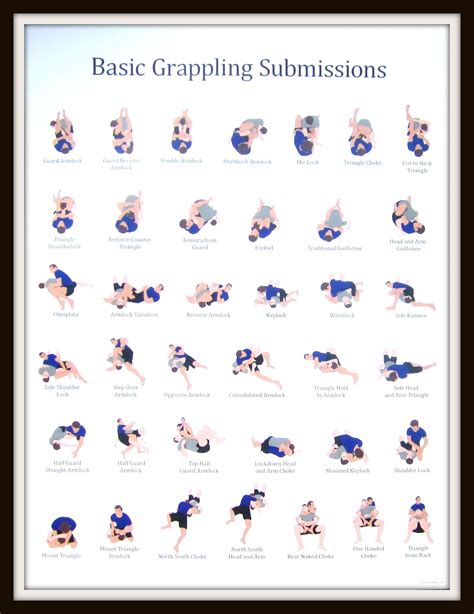
Variations of Open Guard
There are many variations of open guard with distinct names and positioning including:
- Butterfly Guard
- De La Riva Guard
- X-Guard
- K-Guard
- Rubber guard
- Spider Guard
- Octopus Guard
- Lapel Guard
- Worm Guard (made popular by Keenan Cornelius)
Butterfly guard is when the bottom grappler brings his legs up and feet together against the inner thighs of top opponent. The name is derived from the resulting butterfly wing shape. Butterfly guard increases both space to maneuver and the ability to counter the opponent with the shins or arches of the feet against the competitor's inner thighs.
In the half guard, one of the top grappler's legs is controlled by the bottom grappler's legs, preventing the top opponent from passing side control or full mount positions. There is also a variant of half guard called "50/50 guard", which consist of each opponent usually in sitting positions with one of their legs hooking the same leg of their opponent in a mirrored fashion.
Training Methods
Sparring, commonly referred to as "rolling" within the BJJ community, and live drilling play a significant role in training.
As BJJ focuses on submissions, sparring and live drilling ("rolling") become the most essential part of the training regime. This type of training allows practitioners to practice at full speed and with full strength, resembling the effort made in a competition.
Training methods include drills in which techniques are practiced against a non-resisting and resisting partners; isolation sparring (commonly referred to as positional drilling) where only a certain technique or sets of techniques are used; and full sparring where each practitioner tries to submit their opponent through technique.
Another big difference between BJJ and other martial arts is how we practice fighting. Unlike other martial arts, with BJJ you have the opportunity to live spar every single class. The term we use for this is “rolling” and is a fun and safe way to try new techniques every day.
In contrast to some other martial arts BJJ can be practiced using a gi or without it, also called 'no-gi', for this purpose rash guards are used.
BJJ in Modern Martial Arts
Jiu-jitsu came to international prominence in martial arts circles when Brazilian jiu-jitsu expert Royce Gracie won the first, second and fourth Ultimate Fighting Championships, which at the time were single elimination martial arts tournaments.
Royce fought successfully against several larger opponents proficient in other fighting styles, including boxing, shootfighting, Muay Thai, karate, wrestling, and taekwondo.
BJJ has since become an elementary aspect of MMA, revealing the importance of ground fighting in a fight.
Brazilian Jiu-jitsu fundamentally transformed the landscape of mixed martial arts (MMA) following its introduction to global audiences through the Ultimate Fighting Championship (UFC) in the early 1990s. The integration of BJJ into MMA training became essential for success in the octagon, as fighters quickly realised they needed strong grappling skills to remain competitive.
Today, BJJ continues to influence MMA evolution, with practitioners constantly developing new techniques and strategies.
The Global Expansion of BJJ
Brazilian Jiu Jitsu’s expansion into international tournaments marked a significant milestone in its global recognition, with prestigious competitions emerging across multiple continents.
The North American BJJ boom began in the 1990s, as more academies opened doors and attracted enthusiastic students to learn this effective martial art. This growth was further accelerated by the success of BJJ practitioners in mixed martial arts competitions, which demonstrated the effectiveness of Brazilian Jiu-Jitsu techniques to audiences worldwide.
The significant expansion of international BJJ tournaments can be traced back to February 1996, when the inaugural Mundial de Jiu Jitsu brought together competitors from the United States, France, Japan, and other nations at Rio de Janeiro’s Tijuca Tênis Clube.
Establishing the International Brazilian Jiu Jitsu Federation (IBJJF) marked an essential turning point, providing structure and standardisation for international competitions. The federation now organises prestigious tournaments that attract competitors from over 30 countries, demonstrating BJJ’s widespread appeal and competitive spirit.
Throughout the 1980s and 1990s, BJJ academies began sprouting across major cities, attracting students from diverse backgrounds enthusiastic about learning this sophisticated martial art.