For many years, the Tbilisi Championships in Soviet Georgia held the reputation as the world's toughest freestyle wrestling tournament, even harder to win in some respects than the World Championships or Olympic Games.
In those days, only one athlete from the Soviet Union could enter the Worlds or Olympics. In Tbilisi, dozens of stars from this nation were in each division.

American Success at the Ivan Yariguin Memorial Championships
The Ivan Yarygin Memorial Championships, held annually in Krasnoyarsk, Russia, is a prestigious international freestyle wrestling tournament.
Ivan Yarygin was a World and Olympic wrestling champion for the Soviet Union, who went on to become the national freestyle coach for his nation, and ultimately the President of the Russian Wrestling Federation. In 1997, a few months after he helped host the World Freestyle Championships in his hometown of Krasnoyarsk, Siberia, Russia, Ivan Yarygin was killed in an automobile accident. In his honor, the annual international freestyle wrestling tournament held in Krasnoyarsk each year was renamed the Ivan Yarygin Memorial Championships.
When you're an American going to Russia, the expectation is that you're going to lose. But 18 Americans battled through that perception to win the toughest tournament in the world: the Ivan Yariguin.
Read also: Discover the story of Casey Swiderski
The first American to win this event was Jim Scherr in 1990, setting off a four year run of champs for the United States.
Capping off that run was Tom Brands title in 1993. Now the head coach of the Iowa Hawkeyes, Brands had this to say about his mindset heading into that tournament:
"When I went it was right after the Cold War, or the Cold War was in a serious thaw. It was ’93, January, the first time. So you were going somewhere that not a lot of people had been, from the West. But the thing is, I grew up with my twin brother knowing that the best wrestling in the world came out of Russia. So you’re going, not behind the Iron Curtain politically, you’re going behind the Iron Curtain to the best wrestler’s nest."
Even more incredibly, it was the event that kicked off Brands' senior level career.
Krasnoyarsk was the first senior level tournament that I had been to. I was in a culture that I admire because of the importance of wrestling.
Read also: Sectional Wrestling Tournament Details
After Brands, there was a five year drought in which no Americans won, ended by another Hawkeye in Lincoln McIlravy.
There was again a six year drought, that was actually ended by two women: Tela O'Donnell and Irish Smith in 2004. That was the third time that USA has had multiple champs in a single style at Yariguin.
The next year was the first time Team USA had both a male and female champ in the same year.
Joe Williams 74kg gold brought Iowa's Yariguin haul to four, the most Yariguin titles of any NCAA school. Our other male champ that year, Daniel Cormier, beat Tommy Rowlands for gold, the only time two Americans have ever met in the Yariguin finals.
Now a UFC champion, Cormier said he loved every time he went to the Yariguin. He called winning it one of his biggest accomplishments, after not placing and finishing fourth in his first two trips. The former Oklahoma State star went on to say:
Read also: The story of Angelo Posada
I was so happy to be in the finals with Tommy Rowlands. Not many Americans had won that tournament and for the two of us to be in the finals was amazing. What a grind of a tournament!
Although we had no men's freestyle champs after 2005 until 2009, Sally Roberts became the first American to win two Yariguin titles, taking both of hers in the Olympic years of 2004 and 2008.
In 2009, Steve Mocco won the heavyweight title, and it would be eight years until another American would bring home gold. We asked Mocco what he felt going into that tournament. He said, "Going there is such a rich experience from the palace, to the weather, to the officiating, and the whole energy of the event," but ended it with a classic Mocco gem:
It felt like every match there I had to wrestle like I had a price on my head.
The past two years have been an excellent time for Team USA in Krasnoyarsk. Kyle Snyder and Tamyra Mensah-Stock simultaneously became the first two Americans to win back-to-back Yariguin titles.
This Wrestler Put Everyone On Their Backs. The Legend of Freestyle Wrestling - Ivan Yarygin
Adam Saitiev vs. Shirvani Muradov: A Classic Match
The feature this week is the 2006 Adam Saitiev vs. Shirvani Muradov men's freestyle match at the Ivan Yarygin Memorial Golden Grand Prix held in Krasnoyarsk, Russia.
In 2006, FILA announced a series of Golden Grand Prix Tournaments, where prize money would be awarded. The 84 kg/185 lbs. division has been one of the most talented in international wrestling, and has traditionally had numerous stars from Russia among the contestants.
In recent years, three Russians won World titles in the division: Khadjimurad Magomedov, Adam Saitiev and Sajid Sajidov. Magomedov and Saitiev were also Olympic champions.
The finalists at 84 kg in the 2006 Ivan Yarygin Golden Grand Prix was one of those past World champions, Adam Saitiev, who for a time was considered one of the greatest wrestlers on the planet.
Adam Saitiev is the younger brother of one of the greatest stars in freestyle history, two-time Olympic champion and six-time World champion Bouvaisa Saitiev, who competes at 74 kg/163 lbs.
The world first saw Adam in action at the 1997 World Championships held in Krasnoyarsk, as the Russian entry at 69 kg/152 lbs., a weight class below his brother. Adam did not medal at that World meet, placing sixth.
The next year, Adam made the move up in weight to 74 kg, and was actually at his brother's division for a few seasons. He competed at events such as the World Cup, European Championships and Goodwill Games in 1988, without winning a gold medal.
In 1999, Bouvaisa did not go to the European or World Championships, and the Russians decided to bring Adam. Although Russia was loaded at 85 kg, with Magomedov already a World silver medalist there, Adam moved up another weight class, no longer competing with Bouvaisa for a spot on the team.
Adam got on a roll at his new division in 2000, winning a gold medal at the European Championships and the Olympic Games at 84 kg.
Adam was not the Russian competitor at the 2001 World Championships at 85 kg, when Magomedov won his World title.
It was in 2003 that Sajid Sajidov emerged at the 84 kg division, and was able to challenge Saitiev in this loaded division within Russia.
Sajidov was given the opportunity to compete in the 2003 World Championships in New York City, and he won the gold medal, defeating American star Cael Sanderson in the finals in Madison Square Garden.
The 2004 year started with the Yarygin Tournament, and Saitiev, Sajidov and Sanderson were all there. Sanderson defeated Saitiev in the third round, 4-3 in overtime.
Russia went with Sajidov for the 2000 Olympic Games, and he seemed to be on a collision course with Sanderson in the finals. However, Moon Eui-Jae of Korea turned Sajidov multiple times in the semifinals for a big win, then lost to Sanderson in the Olympic finals.
In 2005, it was once again Sajidov at the World Championships for Russia. entry Mo Lawal, Sajidov was defeated and placed fifth in the World meet.
With Saitiev bringing all of this experience and achievements to the Yarygin Tournament this year, Muradov had little on his resume. In 2005, Muradov won a gold medal at the European Junior Championships, his only event representing Russia on a major stage.
The finals showdown between Saitiev and Muradov went three full periods, with Saitiev winning 2-0, 0-1, 1-0.
Whether this match shows that the superstar Adam Saitiev is back is yet to be seen.
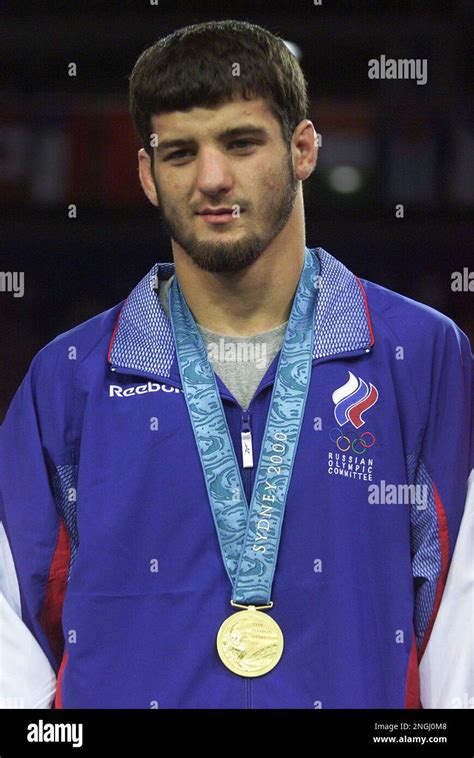
Wade Schalles: A Wrestling Legend
One of the most exciting and spectacular athletes of his time, Wade Schalles would wrestle anyone, anytime, anywhere, at any weight from 150 to 198 pounds, with odds of 2 to 1 that he would win by a fall.
Nor was he particular about the style. Schalles was a national champion, or an All-American, in folkstyle, freestyle and Greco-Roman, and in the allied disciplines of Sombo and Judo.
He earned a place in the Guinness Book of World Records as wrestling's all-time leader in victories with 821, and in falls with 530. Schalles also was renowned for defeating 36 national champions, pinning 17 of them, and defeating eight World titlists, pinning 4 of them. Each total is considered to be a record and why he’s considered to be America’s Greatest Pinner.
Following high school graduation, Schalles attended summer school for one week at East Stroudsburg and then left for Clarion University. The Eastern College Athletic Conference ruled that because he had attended summer school, Schalles had transferred to Clarion and would be required to sit out his freshman year. The NCAA said that Schalles could wrestle because summer school doesn’t count for any athlete, at any time, regardless of where they go.
Seeded fifth at the NCAA tournament in 1971, he lost in the third round.
Schalles won the NCAA Division I and Division II titles at 150 pounds in 1972 and at 158 pounds in 1973. He was named Outstanding Wrestler at both national tournaments in 1972.
In 1974, Schalles went undefeated and wrestled the entire season per the ECAC rules, but was not allowed to attend the NCAA tournament given their previous ruling regarding his transferring. Schalles compiled a collegiate record of 153-5-1, and amassed a staggering 106 falls. He won the Pennsylvania State Conference title four times and was Outstanding Wrestler all four years. This followed a high school career in which he pinned 96 percent of his opponents.
He won a gold medal in the 1977 World University Games, pinning all six opponents, and another in the Tbilisi International, with five falls in six bouts. In both events, he was named the Outstanding Wrestler.
Mr. Schalles is known for creating and perfecting a radically different pinning hold which he named the "spladle." It best demonstrates the limber physique which prompted Sports Illustrated to refer to him as "Plastic Man." In 1994, Wade was one of just 15 athletes named to the NCAA 75th Anniversary Wrestling Team and in 1998 the National Wrestling Media Association named him Sports Writer of the Year.
During and after his competitive days, he coached youth, collegiate and national teams.
tags: #tbilisi #wrestling #tournament