This page provides videos & instructions for Taekwondo black belt forms. You will need to learn these Taekwondo forms in order to be awarded your next level Taekwondo belt. Students will learn Taekwondo black belt forms after they have completed all of the Taekwondo color belt forms (Taegeuk Il Jang through Taegeuk Pal Jang). Whether a student has completed the “newer” Taegeuk color belt forms or the “older” Palgwe color belt forms, they will progress to these Taekwondo black belt forms. Many Taekwondo students are also tested on the meaning of each Taekwondo form during their belt tests.
In Korean, Taekwondo forms are generally known as Poomse. Poomse can also be spelled as Poomsae, Pumsae, etc. In addition, Taekwondo forms are known as patterns, teul, tul, hyeong, hyung, etc. Many martial arts styles use forms in order to help students practice certain moves (i.e. kicking techniques, self-defense techniques and various strikes) as well as for improving a student’s physical conditioning, muscle memory, focus/concentration, balance, etc. To master Taekwondo forms, martial arts students should try to imagine that they are fighting an imaginary opponent. This allows students to practice “offensive” and “defensive” techniques.
Taekwondo poomsae helps a student to practice offensive and defensive martial arts techniques (i.e. kicks and punches) without the need for a partner. Taekwondo students must perform the movements correctly in each form in order to pass belt tests. Taekwondo forms are a series of standardized movements that Taekwondo students use in order to practice “offensive” and “defensive” techniques without a partner.
WTF/WT Taekwondo Forms
This Black Belt Wiki section examines the Taegeuk forms used by World Taekwondo (WT), one of the two largest Taekwondo organizations. Be aware that in 2017, the World Taekwondo Federation (WTF) changed its name to World Taekwondo (WT). This has led to a little confusion regarding WTF versus WT forms but they are the same thing. The forms were not changed. The organization simply changed its name in order to avoid the negative connotation associated with “WTF”.
Most WT Taekwondo schools use Taegeuk forms for the color belt levels. However, before the current Taegeuk forms were adopted, the WT used Palgwe forms. Therefore, there are still some Taekwondo schools that use the older Palgwe forms.
Read also: Is Black Lion Jiu Jitsu worth it?
Palgwe Forms
The Palgwae forms used in Kukkiwon/WT-style taekwondo were developed in the late 1960s, but were later deprecated, as they were not authorized to be exported to countries outside Korea, and replaced with the Taegeuk forms in the early 1970s. These forms, initially conceived for children, are geared toward preparing the students for sparring in sports-style taekwondo (i.e., they are less combat oriented).
Pal-Gwe is descriptive of a world made up of elements both conflicting and harmonious, i.e. sky and earth, light and dark, man and woman, and good and evil.
The WTF forms practiced at Two Rivers Martial Arts are Pal-Gwe One through Pal-Gwe Eight, and Koryo. They are studied at our school according to the timetable below.
- Heaven: The first form represents the greatness of heaven and light.
- Lake: The second form represents the treasures and mysteries of the lake. This form should be performed with ease and fluidity. This is an uplifting, serene and gentle form that should be performed forcefully but not aggressively.
- Fire: The third palgwe form represents the energy of fire or the sun. This form should be performed with warmth and enthusiasm. This form represents the characteristics of fire such as variety and passion.
- Thunder: The fourth form represents thunder (noise without substance) which is a powerful natural source that comes from the sky and is absorbed by the earth. This form should be performed with bravery and courage.
- Wind: The fifth palgwe form represents wind (substance without noise) which is a gentle force that can change directions and become destructive without warning. This form should be performed with movements that change from gentle to violent. The movements of this form are yielding yet penetrating, soothing yet destructive, invisible yet manifest.
- Water: The sixth form represents the liquidity and formlessness of water. Water flows around and absorbs things. It never loses its form. This teaches us that hardships and difficulties can be overcome by maintaining the natural flow, movement and integrity of water.
- Mountain: The seventh form symbolizes the immovable mountain. This form is characterized by stability in which moving and stopping occur at the appropriate times and for the appropriate reasons. This pattern reflects the need to combine movement and non-movement in response to an attack.
- Earth: The eighth palgwe form represents the earth from which all all things are born, mature and die. It represents the end of the beginning as the platform from which the next level of growth can take place. It is the end of the cycle that begins the new cycle of forms.
Koryo Form
Koryo is the name of an ancient dynasty in the Korean peninsula. The English name of "Korea" originated from the name of this "Koryo" dynasty with which was famed for the valiant spirit of its people which tey defeated the Mongolian aggression. The Koryo Dynasty lasted from 935 to 1392 AD and was the first dynasty to unify all of the Korean peninsula. Koryo Poomsae is based on spirit of / sonbae(Sonbi) which was inherited from Koruryo to Balhae and to Koryo.
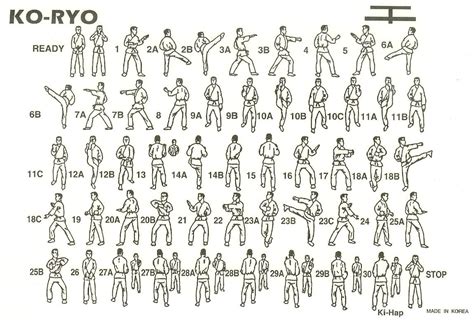
Koryo Poomsae
Read also: A Look at Wrestling Masks
ITF Taekwondo Forms
ITF-styles schools use 24 Chang Hon forms (firstly known as hyeong and currently known as teul), developed primarily in the 1960s by Choi Hong Hi. These are the first forms developed for what would now be called a modern style of taekwondo. Some people refer to ITF-style taekwondo also as a "traditional" form of taekwondo.
ITF beginners (White Belts) do not study forms per se; instead, ITF uses short exercises for introductory lessons: Four Direction Block and Four Direction Punch. Some forms from Traditional Taekwondo sometimes find their way into ITF curriculums at some schools, for example Chul-Gi and Bassai.
After the establishment of Global Taekwondo Federation in 1990, Park Jung Tae added six patterns to the original 24 ITF patterns.
Dan Gun performed by Joel Denis
Traditional Taekwondo Forms
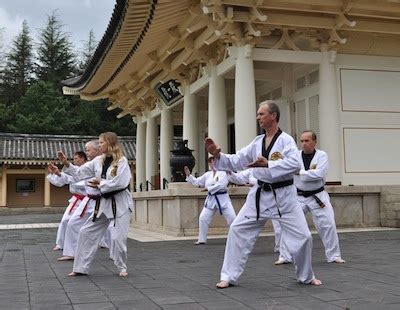
These forms are often practiced in Traditional Taekwondo such as Moo Duk Kwan Taekwondo and Tang Soo Do. These forms pre-date even the ITF forms (below); these forms date back to the 1940s-1950s when the Nine Kwans first began to establish the foundations of what came to be known as taekwondo. Many of these forms were used to train the South Korean military.
Because Traditional Taekwondo really represents an amalgam of several difference styles, there are many forms that fall into the category of traditional. Unlike ITF, ATA, and WT-styles of taekwondo, there is no "standard" definition of a Traditional Taekwondo curriculum; different schools use very different curriculums.
Read also: Brazilian Jiu-Jitsu Gi in Black
Authors typically attribute taekwondo's adoption of forms to the the influence of Okinawan karate on the original Nine Kwans of taekwondo. In karate, forms are called kata. Kata, in turn, are believed to have been inspired by forms used in Chinese chuan fa and kenpo. In 1429 C.E. many Chinese nationals immigrated into Okinawa and other parts of Japan, and it is believed that these immigrants brought the idea of forms study with them. In fact, some of the karate kata still studied today bear the names of the Chinese practitioners who inspired them.
Below are two lists which have the names of the forms we study, their meanings, and the belt rank at which we first study them at Two Rivers Martial Arts.
- human history. Therefore, it is the initial pattern learned by the beginner.
- the "Confucious of Korea". The thirty-two movements in this pattern represent Mr.
- authority on Neo-Confucianism. 620 A.D. which was the precursor of the present day submarine in 1592 A.D.
In the table below, forms marked with an asterisk * are derived from Karate.
Traditional Taekwondo
Additional Taekwondo Styles and Forms
Contemporary to ITF-style taekwondo, ATA forms were likewise developed in the late 1960s in the United States, based on the teachings of Traditional Taekwondo. Like ITF-forms, these forms tend to be focused on combat (rather than sport). These forms however tend to emphasize kicking more than the ITF forms do.
Being a franchise organization, ATA forms are copyrighted by ATA, so one rarely seems them documented outside official ATA publications. ATA franchise schools are provided with PDF files that define the forms.
When taekwondo pioneer Jhoon Rhee first brought taekwondo to the United States, he taught Traditional Taekwondo (what he was calling Korean Karate at the time). Later, Rhee's schools switched and began using the ITF-style forms instead. Due to the controversies surrounding Choi Hong Hi, Rhee eventually switched again and developed his own series of forms for Color Belts. First-Dan Black Belts in Jhoon Rhee-style taekwondo then go on to study the ITF-style Color Belt forms. The form Marriage of East to West is performed to the music of Beethoven's Fifth Symphony.
Chun Kuk Do is an American hybrid of Traditional Taekwondo developed by Chuck Norris.
WanJeonHan Taekwondo - this style of taekwondo is used by only a few schools.
Kicho Hyeong Sam Bu or Kibon Set.
Taekwondo Poomsae Competitions
For Open Poomsae events, you know ahead of time which form you will be demonstrating. For Sport Poomsae events, you do not know ahead of time which forms you will be demonstrating. At the time of the event, you will be asked to perform any of the standard forms with only short notice.
For Team Poomsae events, you perform poomsae as part of team of people who all perform the same poomsae at the same time. For Creative or Freestyle Poomsae events, you perform a poomsae that you yourself have designed. Of course each tournament will have its own guidelines for judging forms competitions.
Poomsae performance is more than just technical correctness however, it is a performance, i.e., "an entertaining show", so the technical factors listed above are not the only considerations typically evaluated. Were the basic techniques especially (basic kicks, basic blocks, basic strikes, etc.) performed well. Did the athlete exhibit accuracy, balance, power, snap, speed, coordination, rhythm, and energy.
Judging and Scoring
Note: In some competitions, scoring begins not when you start the execution of your form, but when you first step onto the mat.
Typically there are at least three judges and one referee for a poomsae competition. Only the referee interacts with the athletes.
Some tournaments will assign an actual numerical score to poomsae performances, with each judge assigning a score (such as 1 through 10) based on the quality of the performance. In this case, often 4 points are assigned to technical correctness, with the remaining 6 points assigned to the quality of the performance.
Other tournaments will simply have each judge designate a winner among pairs of competitors, with the best 2 out of 3 judges determining the winner. In this case, at the end of a match the referee first calls-out something along the lines of "Judges, ready!" The judges then raise both elbows outward, the front of the fists touching in front of the judge's chest. The referee then calls-out something along the lines of "Judges, score!" The judges then raise either their right hand or the left hand, depending on who they are picking as the winner.
- Have the athletes bow to the judges. ("Chay-ryeot!
- Start the athletes in their performance. ("Joon-bee!
- End the athletes' performances.
- Call for the judges to score.
A division continues in this way eliminating competitors in brackets until a winner has been determined.
Even though most taekwondo forms are very standardized, it is still possible to broadly interpret a form when performing it. As an example, the video below is a very exaggerated version of Koryo.
Benefits of Practicing Taekwondo Forms
The performance of Taekwondo forms & patterns has many fitness benefits. For example, forms & patterns can help students to lose weight given the significant calorie expenditure achieved during training. They may also improve a student’s muscular strength and muscle tone given their use of powerful kicks, punches, leaps, etc.
Another fitness benefit is that forms & patterns can improve a person’s balance because they need to learn and practice different stances, kicking positions, etc. Furthermore, forms & patterns can improve eye, hand and foot coordination because students need to combine a wide variety of kicks, punches and stances. Finally, Taekwondo forms & patterns has the fitness benefit where it can help with the athletic performance in other sports.