Taekwondo is a Korean martial art that combines self-defense techniques with physical and mental discipline. It originated in Korea in the 1940s and is now taught in many countries around the world. If you're new to Taekwondo, mastering the basic moves is essential for building a strong foundation. These fundamentals will help you progress to more advanced techniques and improve your overall performance.
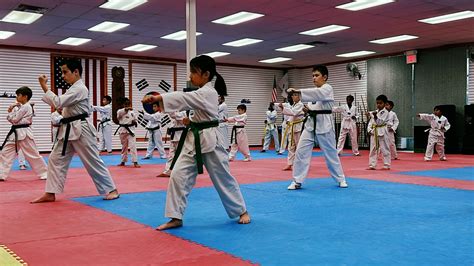
Taekwondo training session.
Key Basic Taekwondo Techniques
As a beginner, focus on mastering the following key techniques:
- Stances
- Blocks
- Kicks
- Strikes
Proper stances are crucial for balance and power, while mastering different blocks will help you defend against attacks effectively. Kicks are a signature of Taekwondo, and strikes are essential for close combat engagements. Consistent practice of these techniques will strengthen your Taekwondo foundation.
Stances in Taekwondo
Stances are fundamental positions that help you maintain balance, stability, and power. Here are some common stances used in Taekwondo:
Read also: Effective wrestling moves
- Ready Posture (Junbi-jase 준비자세): This is how you start and end class to show focus and respect. You’ll want to stand tall with your heels together and toes slightly out. Hands rest by your sides, eyes forward, mouth closed. Think “stillness on purpose.” You control your body before you throw a single strike.
- Walking Stance (Ap Sogi): This is a basic stance used for moving forward or backward. Your feet should be shoulder-width apart, with one foot forward and the other foot behind, pointing slightly outward.
- Front Stance (Ap Kubi 앞굽이): In this stance, your body weight is distributed evenly between both legs, with one leg in front and the other leg stretched behind for balance and power. Front knee bends over the ankle; back leg stays straight. Hips square to the front. Most of your weight sits on the front leg. Keep your back heel glued to the floor.
- Back Stance (Dwit Kubi): This stance emphasizes a strong back leg for stability and power. Your body weight is primarily on the back leg, with the front leg slightly bent for flexibility.
- Horseback Riding Stance (Juchum-seogi 주춤서기): According to the 14 basics, straight punch should be performed from the horse stance.
- Parallel Stance (Narani Sogi 나란히서기): This stance is used for defensive purposes, with both feet facing forward and shoulder-width apart.
Mastering these stances is crucial for building a strong foundation in Taekwondo and improving your overall technique. Regular practice will enhance your skills and performance.
Basic Blocks in Taekwondo
Blocks are essential for defending against attacks. Here are some basic blocks every beginner should learn:
- Low Block (Arae-makgi 아래막기): Used to defend against kicks or punches aimed at the lower part of your body. The blocking arm is chambered with the fist (pinky side) positioned over the collar bone. The arm then swings down across the body in a snapping motion. The block finishes with the arm stopping just above the knee, palm facing down, deflecting the attack away.
- Middle Block (Momtong Makgi 몸통막기): Protects your midsection from attacks coming straight at you. Cross your arms, then drive the blocking forearm out across your torso. Keep your elbow bent about 90 degrees. Your fist ends just outside your shoulder line. Eyes stay forward; hips stay square.
- High Block (Eolgul Makgi 올려막기): Guards your upper body against high strikes or overhead attacks. Chamber like a punch, then lift your forearm above your forehead. Angle it so a strike slides off. Keep your eyes through the “window.” Don’t hide behind your arm.
- Inward Block (An-makgi 안막기): The defender's arm swings from the outside of the body (near the ear) inward across the center line to deflect an attack. The fist (palm facing forward) is lifted to the side of the body at ear level and then swings in a chopping motion across the front of the body.
- Outward Block (Bakkat-makgi 바깥막기): The outside (thumb-side) of the forearm is used to deflect an attack from the inside to the outside of the defender's body. The blocking arm (chambered fist on the hip) swings across the body in a horizontal arc, stopping in front of the centerline.
Mastering these blocks is crucial to developing a strong foundation in Taekwondo. Practice them consistently to improve your defense skills.
Basic Punches in Taekwondo
The basic punches you'll start with are the jab and the cross. The jab is a quick, straight punch using your lead hand, while the cross is a powerful punch thrown with your rear hand. These punches are fundamental and serve as the foundation for more advanced techniques.
- Straight Punch: The fist starts from a chamber on the hip and is then thrust straight forward. Impact is made on the two big knuckles.
- Hammer fist (Mejumeok-chigi 망치 주먹): A closed fist may be brought down in a hammering motion to strike with the underneath.
- Back Fist Strike (Deungjumeok 등주먹): A clenched hand is swung backwards into the face of an opponent. The back of the hand makes contact.
- Knifehand Strike (Sonnal-chigi 손날치기): An open hand is hammered down to make impact with the underside.
Remember, mastering the basics is key to progressing in your Taekwondo journey.
Read also: Is the Century Taekwondo Uniform Worth It?
Basic Kicks in Taekwondo
As a beginner, mastering basic kicks is essential. Here are some of the fundamental kicks you should focus on:
How to Roundhouse
- Front Kick (Ap-chagi 앞차기): A powerful kick where you thrust your foot forward, targeting the opponent's midsection or face. The practitioner raises the knee to the waist, pulls the toes back and quickly extends the foot at the target. It is also known as the snap kick. The front kick is one of the first kicks learned in taekwondo; if mastered it can become one of the most powerful.
- Roundhouse Kick (Dollyeo-chagi 돌려차기): Involves a circular motion where you strike your opponent with the top of your foot or shin. Pivot on the support foot, turn your hip, and whip the shin across. Strike with the instep or ball of the foot. Your knee leads the path; your hip provides the power. Re-chamber before you land.
- Side Kick (Yeop Chagi 옆 차기): Executed by thrusting your leg directly to the side, making contact with the opponent. A very powerful kick, in which the practitioner simultaneously raises the knee and rotates the body 90 degrees, while extending their leg.
- Back Kick (Dwi-chagi 뒤차기): A kick where you strike backward with your heel, used as a defensive move in various situations. The practitioner turns the body away from the target and pushes the back leg straight toward the target, hitting it with the heel while watching over the shoulder. The turning motion helps to give this kick a lot of power.
- Axe Kick (Naeryeo Chagi 내려 차기): The leg is raised usually from the outside of the body like an outside crescent kick. then the leg is pulled down with the heel pointed downward. It is typically targeted toward the head, shoulder, or chest and requires significant flexibility to employ effectively.
- Crescent kick (An Chagi/Bakkat Chagi 안 차기/바깥 차기): There are two variations of this kick: the outer crescent and the inner crescent. In the outer, the practitioner raises the extended leg as high as possible, and slightly up across the body, (a bit across the centerline of the body), then sweeping outward to the side, in a circular movement. In the inner, the motions are the same but the direction of the kick changes, this time originating from the outside of the body, heading towards the inside, or centerline of the body.
Proper execution of these basic kicks will help you build a strong foundation. Practice them consistently to improve your techniques and gain confidence in your abilities.
Additional Taekwondo Techniques
In addition to the basic kicks, punches, and blocks, there are other techniques that are important to learn in Taekwondo. These include:
- Hand-blade / Double Forearm Block: One hand blocks while the other is ready for a follow-up strike.
- Face Block: Shoot your arm up at and angle, stopping it just over your brow. It should look like a roof or a church steeple. This makes strikes glance off and protects your head.
Practicing Taekwondo Techniques
In Taekwondo, practicing techniques is fundamental for improving your skills. Focus on mastering each move with precision and control. Pay attention to your form and technique to ensure you are executing each move correctly. Remember, consistent training is key to mastery.
Common Mistakes to Avoid
To avoid common mistakes, ensure you maintain a proper stance and balance during movements. Engage your core muscles to enhance stability and power. Focus on breathing techniques for optimal energy flow and control. Practice regularly to improve your form and avoid rushing through movements. Pay attention to detail and precision in each technique to prevent injury and ensure effectiveness.
Read also: The Meaning Behind Taekwondo Belts
Progressing Beyond Basic Techniques
Once you have mastered the fundamental techniques, you can progress to more advanced movements and skills. This includes learning more complex kicks, combinations, and sparring techniques. Continuing to challenge yourself and refine your skills will help you advance in Taekwondo.
Here's a table summarizing the basic moves in Taekwondo:
| Technique | Description |
|---|---|
| Front Kick | Thrust your foot forward, targeting the opponent's midsection or face. |
| Roundhouse Kick | Strike your opponent with the top of your foot or shin in a circular motion. |
| Side Kick | Thrust your leg directly to the side to make contact with the opponent. |
| Low Block | Defend against kicks or punches aimed at the lower part of your body. |
| Middle Block | Protect your midsection from attacks coming straight at you. |
| High Block | Guard your upper body against high strikes or overhead attacks. |
| Straight Punch | The fist starts from a chamber on the hip and is then thrust straight forward. |
By mastering these basic moves and consistently practicing, you'll be well on your way to becoming proficient in Taekwondo.