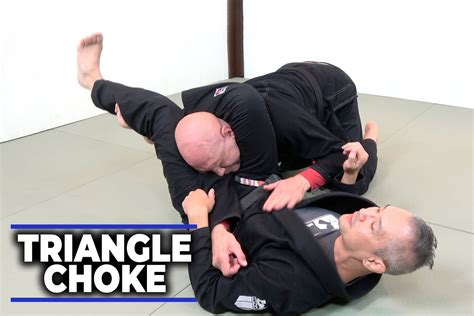
The triangle choke is one of the signature submissions in Brazilian Jiu-Jitsu (BJJ), largely thanks to its versatility. Originating as a judo technique, it’s a figure-four chokehold that involves using your legs to encircle your opponent’s neck and one arm and applying pressure using both legs and the opponent’s own shoulder to constrict the blood flow to their brain. While it is most commonly applied from the closed guard, fighters who are able to master this move can apply from virtually any position, which means it is not only great on the mat, but also for real-life self-defense scenarios. It’s an effective and safe way to restrain an attacker.
Triangle Choke Application
The History and Evolution of the Triangle Choke
The triangle choke was created in the early 20th century by two judo masters: Tsunetane Oda and Yaichibei Kanemitsu. They were both direct students of the groundbreaking martial artist Jigoro Kano. Kanemitsu and his apprentice Masaru Hayakawa first registered use of the move in a judo tournament in 1921. He claimed that it was the result of a less refined move practiced by Takenouchi-ryū master Senjuro Kanaya. The exact origins and evolution of the technique are unknown, but over time, it became an essential part of most BJJ fighters’ arsenals. A big reason the triangle choke is so popular is that it can be used in many ways, including from the bottom position, the mount, side mount, and back mount. As fighters are often vying to isolate one arm, it makes sense that the triangle choke is so frequently used.
Key Steps to Execute the Triangle Choke
The triangle choke is a highly effective BJJ technique in self-defense and competition. However, it can only be effective when performed correctly, and here’s how:
1. Gain Wrist Control
The first step in the triangle choke is gaining control of the other person’s wrists. This move in a closed guard position serves several purposes. Your opponent’s first step in opening and passing your guard will likely be securing grips. Gaining control of their wrists will thwart such attempts. Furthermore, in self-defense, controlling your opponent’s wrists prevents them from attempting strikes. It also allows you an opportunity to position your arms for the triangle choke. Gain control of your opponent’s wrists so they can’t secure grips and can correctly position their arms to apply the triangle choke.
Read also: From Sitcom Star to BJJ Master
2. Trap One Arm In and the other Arm Out
Executing the triangle choke requires taking charge of your opponent’s arm. This is because you’ll need to press onto your opponent’s neck using one of their shoulders and your legs. Isolate one of your opponent’s arms - you’ll need control of it to apply pressure to their neck using your legs and their shoulder. After you have wrist control, press one of your opponent’s arms into his or her torso while pulling the other arm forward. This move positions the opponent with one arm out and one out, which is ideal for the triangle choke hold.
3. Push Your Hips Upward to Lock the Triangle
With your opponent positioned one arm in and the arm out, you’ll need to open your closed guard to thrust both hips upwards briefly. This swift and sudden move serves two purposes:
- It reduces the space between your opponent’s neck and your hips
- You’ll catch the other person off-guard
Moving your hips upward as quickly as you can to limit how much time your opponent has to react. At the peak of this move, position one leg above the shoulder of the hand you held against your opponent’s torso. Next, move your second leg beneath your opponent’s second shoulder.
4. Gain Head Control
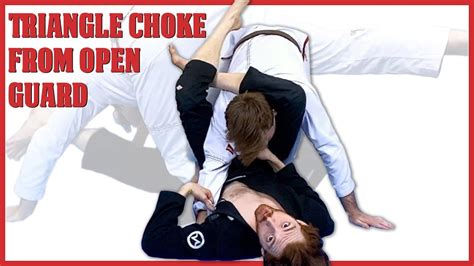
Most closed-guard submissions involve breaking your opponent’s stance or posture. When trying to achieve the triangle choke from a closed guard position, taking charge of the other person’s posture is essential. You can gain this control by using your legs to pull forward or both hands to pull downwards on your opponent’s head. Keep in mind that failing to maintain control over your opponent allows them to regain an upright position. It also increases their chances of thwarting your triangle choke strategy.
Triangle Choke Setup
Read also: The Art of Brazilian Jiu-Jitsu
5. Position Yourself in a 90-degree Angle
A proper angle is the only way to achieve a successful triangle choke hold. From a closed guard position, your goal should be attaining a perpendicular angle between you and your opponent. You can try shifting your body into the proper position by pushing off the other person’s opposite hip using your foot. Remember that performing this move requires you to unlock your legs. You must hold your shin behind the person’s neck and then pull downwards to retain control of their posture. Once you finish this move, one side of their face should be directly visible.
6. Finish the Submission
If you achieve the above steps, it’s easy to finish the submission. You’ll need to make a few moves to complete the choke.
The first move is relocking your legs, if you open them, to get to the correct angle. Using the leg positioned behind the person’s neck, place the ankle’s top side under the knee of your second leg. Lift your other leg and pass it over the shoulder of the arm that is trapped inside, making sure the back of your knee is tight around the neck. Pull down on your opponent’s head to tighten the choke and adjust your legs. Make sure your ankle is securely locked under your knee, and your hips are elevated enough to apply pressure. The foot on the hip can push off to help tighten and adjust the lock.
After relocking your legs, ensure the trapped arm remains across your body. You can complete the triangle choke at this stage without your opponent’s arm crossing their body. However, freeing the arm allows them a chance to escape, making it more challenging to fulfill the submission. Your opponent may try to fight back by pressing their elbow against them. You can easily expose their arm by dislodging it through a minor hip bridge. With your legs and the person’s arm correctly positioned, you can pull down on their head and squeeze both legs.
Understanding the Mechanics and Anatomy
The triangle choke is such an effective submission not because it causes pain but because it compresses the carotid arteries in the neck, slowing blood flow to the brain. Like all moves in Brazilian Jiu-Jitsu, the triangle choke requires a fighter to understand the anatomy involved. Restricting someone’s blood flow and air supply can be very dangerous when done incorrectly, so practicing the triangle choke requires careful attention to detail and safety for both you and your training partners. Successfully pulling off the triangle choke requires utilizing leverage and body mechanics, such as the proper angle and alignment of your legs.
Read also: Jiu Jitsu Classes
Escaping the Triangle Choke
Escaping the triangle choke can be tricky because you don’t have much time to react (if your opponent knows what they’re doing). First, elevate your head so your opponent can’t use their full force, and try to keep your arm away from your neck. If you can get control of your arm, try to reverse or escape the figure-four by breaking your opponent’s legs apart. If your opponent is in a bottom guard position, stand up, and try to walk to the side opposite the captured arm to put stress on their legs.
Training Drills and Exercises
Like all aspects of BJJ, practice makes perfect, and the triangle choke is no exception. We’re going to get into some exercises and drilling you can do to get better at the maneuver and improve your flexibility and strength. Mimicking competition is the best way to learn. But before you can do full-scale resistance drilling, start with repetition drills that involve setting up the triangle from the guard position (without resistance). This will help you hone the mechanics of shifting your hips, placing your legs correctly, and locking the triangle. As you get more comfortable with the mechanics, you can practice performing the triangle more quickly to work on improving your speed.
Once you’re confident in your ability to apply the triangle choke, you can move on to resistance drilling. Eventually, you can take it a step further and try using the technique during actual sparring sessions with your partner. Sparring gives you the chance to try fighting from positions that naturally lead to the triangle, like the closed guard or from a failed sweep. BJJ training isn’t just about practicing the moves. You also need to improve your endurance, mobility, and stability.
Enhance Your Training
- Weight training to enhance core stability, grip strength, explosive power, and overall muscle endurance.
- Improving cardiovascular health through aerobic and anaerobic workouts that mimic the dynamic and varying intensity of grappling matches.
- Stability exercises that focus on core strength, joint stability, and proprioception, all of which help to improve your ability to control every movement of your body.
Study matches and instructional videos featuring high-level practitioners who are known for their triangle chokes. Pay attention to how they set up the choke, handle resistance, and finish the submission. Implementing these drills and exercises into your training routine will help you become more proficient with the triangle choke, making it a dangerous weapon in your BJJ arsenal.
How To Do The Perfect Triangle Choke Even If You Have Short Legs by John Danaher
Triangle Choke Setups from Different Positions
The important thing about triangle choke is that it is versatile. Being versatile means that you can execute the triangle choke from any position in BJJ. Whether directly or indirectly, it is possible for you to take your opponent to triangle choke submission. This article will focus on putting your opponent into triangle chokes from many different positions.
1. Closed Guard
So suppose you are in the closed guard against your opponent. You should do two things at the same time: push and pull. You will push one wrist of your opponent toward their chest. Pull their other wrist at the same time toward yourself. You will do both push and pull at the same time. Doing this will create space for you. So, after push and pull, hop your hips and place your legs across your opponent’s neck. Hold the back of your opponent’s neck. Move the neck toward you. You are holding their neck because if they try to posture themselves, they cannot do it. Get your one hand inside their legs. Rotate yourself. Now, your knees are facing the same direction. They are not far from each other and are closer. Move them closer and make a triangle around your opponent’s neck with your legs.
2. Shin-to-Bicep
The second position or technique through which you can take your opponent to triangle choke submission is the shin-to-bicep. Hold their collar with your one hand, and with the other hand, hold their sleeves. Now grab them tightly and slide yourself back. Push your opponent with your knees. You are using your shin to push your biceps. They will not like that and will try to pull their arm out. Follow them and circle around their neck. Take your hands between your opponent’s legs. Rotate yourself. Grab the back side of their neck and pull them toward yourself. This will prevent them from setting up their posture. Entangle their neck with your legs.
3. Pyramid Guard Setup
The third position or technique that will help you to take your opponent to triangle choke is the pyramid guard setup. So your opponent is in between your legs. You are pressurizing your opponent with your legs. One of the things your opponent will try to do at this stage is pull themselves away from you. They will try to set their posture again. Open their side and put your leg over them. Now, follow all the steps as in the previous two positions. Rotate yourself. Grab the back of their neck and pull them towards you. Entangle their neck with your legs. Squeeze their neck.
4. Knee on Belly
Another position to take your opponent to BJJ triangle choke submission is the knee on the belly. So you are in the knee-on-belly position against your opponent. One of the escapes at this position your opponent can try at this stage is taking their hand beneath your legs and then pushing you with their other hand. They will try to escape in this way. So, as soon as they move their hand beneath your legs, grab their sleeves. Move your leg across your head. Now, you have the option to go for an arm lock and triangle choke.
There is another way you can take your opponent to triangle choke submission from knee on belly position. When you are in the knee-on-belly position, your one knee is already on your opponent’s belly. Take your other leg on them, keeping the knee on their belly. Now, step over your opponent and move across them. Keep their elbow exposed. Place your hand on the mat. Grab your opponent’s head and pick them up. Cross your knees across your opponent’s head. Your knees must be facing the same direction. Entangle your opponent’s neck.
5. Bottom Kesa Setup
Another position you utilize to take your opponent to BJJ triangle choke submission is the bottom kesa setup. Your opponent has your arm. They can use that arm control in various ways. They can put you in a very nasty position just because of this arm. So, the first thing you need to do is to get your arm free from them. Push their hand away. This will create a little bit of space. Get your other hand through the armpit. Now, pull their arm upwards. Get your foot from outside and keep it inside their arm. Now, pull their arm away with your leg and entangle their arm with both your legs. Get your one hand on their collar and the other hand on their Gi. Now, you have complete control of their body. Move them across and put them to the bottom. You will notice that your legs will still be holding their arm. Move your leg across them. Try to get your leg beneath their head. Move your other leg. Entangle your opponent’s neck with our legs.
| Position | Description |
|---|---|
| Closed Guard | Push and pull opponent's wrists to create space, then lock legs around neck. |
| Shin-to-Bicep | Control collar and sleeves, push with shin on bicep, circle around neck. |
| Pyramid Guard | Opponent between legs, open side, put leg over them, rotate, and entangle neck. |
| Knee on Belly | Grab sleeves as opponent tries to escape, move leg across head, or step over and entangle neck. |
| Bottom Kesa | Free arm, control opponent's arm and Gi, move across and entangle neck. |