Brazilian jiu-jitsu (BJJ) is a martial art, combat sport, and self-defense system that focuses on grappling and especially ground fighting. The name jiu-jitsu originated from the Japanese word "Jū'' meaning gentle, and "Jutsu," meaning art. BJJ promotes the concept that a smaller, weaker person can successfully defend against a bigger, stronger assailant by using leverage and proper technique - most notably by applying joint-locks and chokeholds to defeat their opponent. BJJ training can be used for sport grappling tournaments (gi and no-gi) and mixed martial arts (MMA) competition or self-defense. Sparring (commonly referred to as “rolling”) and live drilling play a major role in training, and a premium is placed on performance, especially in competition, in relation to progress and ascension through its ranking system.
If you are interested in BJJ and want to enroll in a class, learning about the rich history will likely spark your interest.
Origins of Jiu-Jitsu
The origins of jiu-jitsu, however, are said to date back thousands of years before they reached the shores of Brazil. Various theories surround its origins, but most agree that it may be traced back to Buddhist monks roughly 4,000 years ago in India. Some claim that "grappling" has a considerably longer history than India alone. It later spread to medieval Japan, where it evolved into a highly effective type of hand-to-hand combat during hostilities before changing to become more of an art and sport. In the early 17th century, as weapons were outlawed in Japan, unarmed combat grew in popularity.
Jujutsu evolved as a form of self-defense, and new techniques were created to adapt to unarmed opponents. Jujutsu continued to rely on throws, strangles, and joint locks but also introduced limited striking techniques to distract and unbalance opponents. However, in 1870 during the Meiji Restoration period in Japan, the samurai class was abolished, and people were no longer allowed to wear swords in public. This caused many martial art schools to collapse.
Jigoro Kano and the Kodokan Judo Institute
During the Meiji Restoration, a young Jigoro Kano found himself fascinated by the traditional Japanese martial art of jujutsu. Kano quickly realized that many of the jujutsu techniques he was learning were dangerous and potentially lethal. He also noticed that many of the jujutsu schools of his time were focused more on winning competitions than on the personal development of their students. In 1882, Kano officially opened the Kodokan Judo Institute, which he named after the "Kodokan" (a term meaning "school for studying the way") and "judo" (meaning "the gentle way"). The Kodokan quickly gained a reputation as one of the most progressive and innovative martial arts schools in Japan.
Read also: From Sitcom Star to BJJ Master
Mitsuyo Maeda, also known as Count Koma, was a Japanese judoka and member of the Kodokan judoka, Judo's governing body. There, he started teaching and performing demonstrations in jiu-jitsu and judo, which were not recognized as different sports at the time. Four of the students he mentored became the pioneers of what is now recognized as Brazilian jiu-jitsu.
Since its inception in 1914, its parent art of judo was separated from older systems of Japanese jujutsu by an important difference that was passed on to BJJ: it is not solely a martial art: it is also a sport; a method for promoting physical fitness and building character in young people; and, ultimately, a way (Do) of life.
From Japan to Brazil: The Fascinating History of Brazilian Jiu-Jitsu
The Gracie Family and the Development of BJJ
The art was brought to Brazil by Mitsuyo Maeda (1878-1941), a student of Kodokan Judo with a history of challenging and interacting with other combat arts.
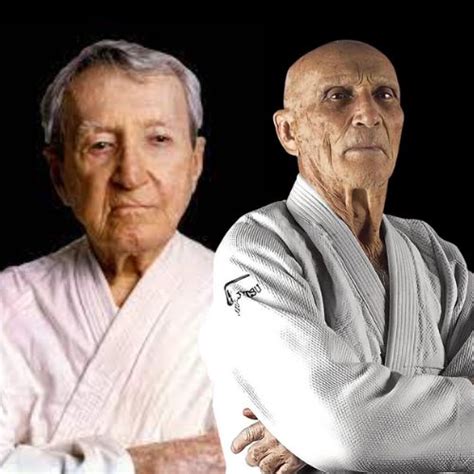
Gastão Gracie was a business partner of the American Circus in Belém. In 1916, Italian Argentine circus Queirolo Brothers staged shows there and presented Mayeda. In 1917, Carlos Gracie, the eldest son of Gastão Gracie, watched a demonstration by Maeda at the Da Paz Theatre and decided to learn judo. Maeda accepted Carlos as a student and Carlos learned for a few years, eventually passing his knowledge on to his brothers.
Read also: Jiu Jitsu Classes
At age fourteen, Hélio Gracie, the youngest of the brothers, moved in with his older brothers who lived and taught Jiu-Jitsu in a house in Botafogo. Following a doctor’s recommendations, Hélio would spend the next few years being limited to watching his brothers teach as he was naturally frail. Over time, Hélio Gracie gradually developed Gracie Jiu Jitsu as an adaptation from Judo, as he was unable to perform many Judo moves. Hélio Gracie also was said to hold the rank of 6th dan in judo at the time of his death.
Although Brazilian Jiu-Jitsu is largely identified with the Gracie family, there is also another prominent lineage from Mayeda via another Brazilian disciple, Luis França. This lineage had been represented particularly by Oswaldo Fadda.
Evolution and Prominence
Hélio Gracie had competed in several submission-based competitions which mostly ended in him winning. One defeat (in Brazil in 1951) was by visiting Japanese judoka Masahiko Kimura, whose surname the Gracies gave to the arm lock used to defeat Hélio. The Gracie family continued to develop the system throughout the 20th century, often fighting full-contact matches (precursors to modern MMA), during which it increased its focus on ground fighting and refined its techniques.
Today, the main differences between the BJJ styles is between traditional Gracie Jiu-Jitsu’s emphasis on self-defense, and Sport Brazilian Jiu-Jitsu’s orientation towards competition. There is a large commonality of techniques between the two.
Jiu-Jitsu came to international prominence in the martial arts community in the early 1990s, when Brazilian Jiu-Jitsu expert Royce Gracie won the first, second and fourth Ultimate Fighting Championships, which at the time were single elimination martial arts tournaments. Royce fought against often much-larger opponents who were practicing other styles, including boxing, shoot-fighting, karate, wrestling, judo and tae kwon do. It has since become a staple art for many MMA fighters and is largely credited for bringing widespread attention to the importance of ground fighting.
Read also: Brazilian Jiu-Jitsu Gi in Black
Brazilian jiu-jitsu quickly began spreading to other regions and continents. This art first came to the United States in the early 1970s. However, it only took off once the Ultimate Fighting Championship (UFC) popularized mixed martial arts and Brazilian Jiu-Jitsu in the 1990s. The UFC was initially co-founded by one of Helio Gracie's sons, who moved to the US, Rorion Gracie. His brother, Royce Gracie, entered the first few tournaments as a showcase to demonstrate the effectiveness of BJJ vs.
The International Brazilian Jiu-Jitsu Federation (IBJJF), established in 2002 by Carlos Gracie, Jr., started hosting organized jiu-jitsu tournaments worldwide.
Techniques and Style of Fighting
Brazilian Jiu-Jitsu emphasizes getting an opponent to the ground in order to utilize ground fighting techniques and submission holds involving joint-locks and chokeholds. The premise is that most of the advantage of a larger, stronger opponent comes from superior reach and more powerful strikes, both of which are somewhat negated when grappling on the ground. A more precise way of describing this would be to say that on the ground, physical strength can be offset or enhanced by an experienced grappler who knows how to maximize force using mechanical strength instead of pure physical strength.
BJJ permits a wide variety of techniques to take the fight to the ground after taking a grip. While other combat sports, such as Judo and Wrestling almost always use a takedown to bring an opponent to the ground, in BJJ one option is to “pull guard.” This entails obtaining some grip on the opponent and then bringing the fight or match onto the mat by sitting straight down or by jumping and wrapping the legs around the opponent.
Once the opponent is on the ground, a number of maneuvers (and counter-maneuvers) are available to manipulate the opponent into a suitable position for the application of a submission technique. Achieving a dominant position on the ground is one of the hallmarks of the BJJ style, and includes effective use of the guard (a signature position of BJJ) position to defend oneself from bottom (using both submissions and sweeps, with sweeps leading to the possibility of dominant position or an opportunity to pass the guard), and passing the guard to dominate from top position with side control, mount, and back mount positions. This system of maneuvering and manipulation can be likened to a form of kinetic chess when utilized by two experienced practitioners. A submission hold is the equivalent of checkmate in the sport, reflecting a disadvantage which would be extremely difficult to overcome in a fight (such as a dislocated joint or unconsciousness).
Renzo Gracie wrote in his book Mastering Jiu-jitsu:“The classical jujutsu of old Japan appeared to have no common strategy to guide a combatant over the course of a fight. Indeed, this was one of Kano’s most fundamental and perceptive criticisms of the classical program.’ Maeda not only taught the art of judo to Carlos Gracie, but also taught a particular philosophy about the nature of combat developed by Kano, and further refined by Maeda based on his worldwide travels competing against fighters skilled in a wide variety of martial arts.”
The book details Maeda’s theory as arguing that physical combat could be broken down into distinct phases, such as the striking phase, the grappling phase, the ground phase, etc. Thus, it was a smart fighter’s task to keep the fight located in the phase of combat that best suited to his own strengths.
Ground Fighting
BJJ is most strongly differentiated by its greater emphasis on groundwork than other martial arts. Commonly, striking-based styles spend almost no time on groundwork. Even other grappling martial arts tend to spend much more time on the standing phase. It is helpful to contrast its rules with judo’s greater emphasis on throws, due to both its radically different point-scoring system, and the absence of most of the judo rules that cause the competitors to have to recommence in a standing position. This has led to greater time dedicated to training on the ground, resulting in enhancement and new research of groundwork techniques by BJJ practitioners.
Along with BJJ’s great strengths on the ground comes its relative underemphasis of standing techniques, such as striking. To remedy this comparative lack, there is an increasing amount of cross-training between the sports of BJJ and wrestling, Judo, or Sambo, as well as striking based arts such as Karate, Muay Thai, kickboxing, and boxing.
Training Methods
Sport Brazilian Jiu-Jitsu’s focus on submissions without the use of strikes while training allows practitioners to practice at full speed and with full power, resembling the effort used in a real competition. Training methods include technique drills in which techniques are practiced against a non-resisting partner; isolation sparring, commonly referred to as positional drilling, where only a certain technique or sets of techniques are used, and full sparring in which each opponent tries to submit their opponent using any legal technique.
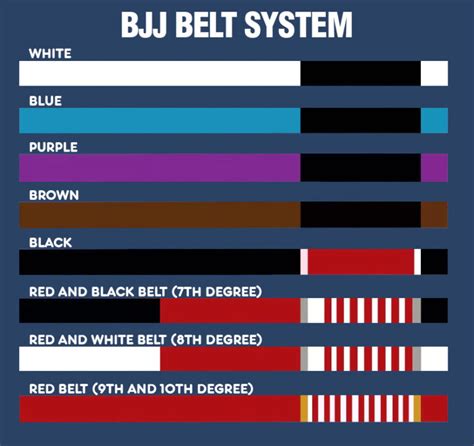
The Belt System
Nearly everyone has a basic understanding of how the belt system functions, even before beginning jiu-jitsu. However, belts simply represent rank and expertise. There are numerous theories surrounding the origins of the black belt. According to one legend, all pupils back then wore white belts. The belts would get dirtier and dirtier over many years of use and practice. They eventually turned black. In this tale, the belt's darkness represents the years of dedication required to reach this skill level.
Jigoro Kano, the founder of judo, created the first belt system. There were only two belt colors, white and black, when Kano’s dojo, the Kodokan, was established in 1882. After mastering the foundations of judo, students received their black belts after starting out as white belts. Mikonosuke Kawaishi, a Japanese judo coach, introduced the colored belt system while teaching in Paris. The belt system is currently used worldwide.
Benefits of Practicing Jiu-Jitsu
Jiu-jitsu is often described as "human chess" since it is more than just a workout but also challenges the body and intellect. Jiu-jitsu has numerous, well-researched physical and mental benefits. This art helps enhance strength and cardio and promotes weight loss and muscle tone. Jiu-jitsu also heightens body awareness, enhances balance, and sharpens your ability to react because you're continuously reacting to another person's motions. In addition, Jiu-jitsu is also a fantastic cerebral exercise. This art also improves your ability to reason because you continuously decide what to do next, whether in a defensive or advantageous position.
Additional Benefits
- Release for daily concerns
- Enhance strength and cardio
- Promote weight loss and muscle tone
- Heightens body awareness
- Enhances balance
- Sharpens your ability to react
- Improves your ability to reason
Lastly, Jiu-Jitsu has been found to give most people a release for their daily concerns. The rich history behind BJJ and the fact that everyone can practice the art makes it unique compared to many other sports and physical activities. Jiu-Jitsu was created and developed so that weaker, smaller individuals might protect themselves or outwit a larger and stronger opponent.
Common Misspellings
Jiu-Jitsu often goes by a lot of different phrases & spellings as a result of Japanese word 'Jūjutsu' being translated differently throughout the years, and around the World. Despite the fact that misspellings like jujitzu, jui jitsu, and jui jitsue are common, there are distinctions between them with three main spelling being used.You will see Jiu-Jitsu and Ju-Jutsu in two different methods. Jiu-Jitsu is typically used to refer to the Brazilian variation because it is spelt differently from the traditional Japanese variant, which is called JuJutsu.