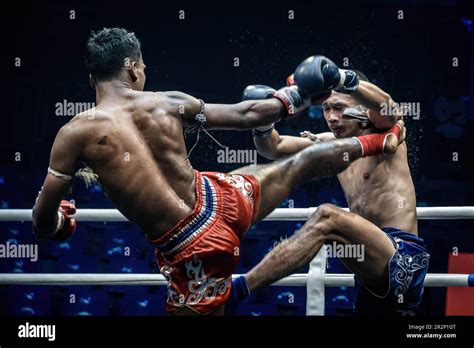
Muay Thai, also known as Thai boxing or the "Art of Eight Limbs," is a martial art and full-contact combat sport originating from Thailand. This discipline uses stand-up striking, sweeps, and various clinching techniques. The name "Art of Eight Limbs" refers to the combined use of fists, elbows, knees, and shins. A practitioner of Muay Thai is known as a Nak Muay.
Muay Thai is related to other martial art styles of the Indian cultural sphere such as Musti-yuddha, Muay Chaiya, Muay Boran, Muay Lao, Lethwei, Kun Khmer, Benjang and Tomoi.
The term muay is derived from the Sanskrit root word mavya, which means "to pull together," "to form into a single group or unit," or "unity." It is defined as "to tie" and "sport boxing" in Thai.
Historical Development
Muay Thai had been trained from variant movements of dance; Fon jerng included weapons and bare hands, showing the art of men's fighting, which is similar to Lei tai due to the war engagement with China for a long time. From 738 AD in the Nanzhao period, It is said to be the earliest stage of Thai people forming, and Muay Thai had been training for generations along the Fon jerng dance.
From 947 AD onward, they conquered various ethnic groups, including the Khom ethnic groups, aboriginal Siamese (known as Siam-asli, Saimi-mandala, Siamese Lavo, Xiān, or Siam at that time), and Mon-Khmer in the upper part of the Chao Phraya River basin, using their martial arts skills (Muay). The Tai people then moved down northwest and successfully established the Sukhothai Kingdom under the rule of King Si Inthrathit, who was a descendant of King Phrom, a descendant of the Singhanavati Dynasty (King Lavachakkaraj).
Read also: The Significance of the Mongkol
The Mungrai Customary Law 1296 CE (Mungraiyashastra), one of the oldest palm-leaf manuscripts written in the Northern Thai language during the reign of King Mangrai, who established the town of Chiang Mai (1292-1311), also mentioned the Tai martial arts (Muay) in section 7, under the article of 18 types of quarrels, for the first time in the Lan Na Kingdom.
During the Pre-Ayutthaya era (Ayodhya period) before 1351, the Royal Chronicle of the North documented King Uthong's importation of Muay boxers from the city of Sri Phalo (now Chonburi province, Thailand) to the city-state of Ayodhya. This occurred during his reign from 1253 to 1289, and a Muay boxing match between a Siamese boxer and a Chinese boxer also took place during the late reign of King Suwanracha, who ruled Ayodhya from 1301 to 1310.
During the Sukhothai Kingdom from 1238 to 1268, Muay Thai was highly regarded as an art form and was even included in the curriculum for members of the royal family. It was seen as a way to train brave warriors with exceptional physical fitness, as well as prepare them for leadership and warfare against neighboring kingdoms. King Si Inthrathit sent his second son, aged 13, Prince Ram Khamhaeng, to study Dharma, liberal arts, and martial arts (Muay) at the Samo Khon School in Lawapura town (now Lopburi province, Thailand), Lavo Kingdom.
In 1431 AD, King Borommarachathirat II, the King of Ayutthaya Kingdom, led Siamese forces and included groups of Siamese boxers to assault the Khmers plundering Angkor Thom, also known as the Fall of Angkor in 1431. From 1455 AD in the Ayutthaya period, Muay Thai was officially integrated with Siamese royal courts of Ayutthaya called The King's Guard Department since the reign of King Borommatrailokkanat enacted the Law of the Military and Provincial Hierarchy 1998 BE (1455 AD), which consisted of two director generals with noble titles, Khun Phakdeeasa and Khun Yothaphakdee in the hierarchy.
According to history, Muay Thai had been developed by the Siamese army as a form of self-defense and to date back at least to the 13th century, according to King Ram Khamhaeng's war strategics manual.
Read also: Authentic Muay Thai Training
In 1698, according to the second French mission to Siam by King Louis XIV, who after appointed Guy Tachard to be in charge of the French ambassador to Siam. This news caused vassals of the Siamese Royal Court to be suddenly shocked. King Phetracha then announced the force recruitment to train fighting techniques such as wrestling, muay, krabi-krabong, and many others.
the entire history of muay thai, i guess
World Muaythai Day is observed globally on 6 February to commemorate King Sanphet VIII (Phra Chao Suea, the 'Tiger King'). In the 1702 reign of King Suriyenthrathibodi, the king questioned his vassals about the Siamese people festival held outside the boundary of Ayutthaya Royal Palace. The government official responded to the king that the temple fair will be held at Khwaeng Wiset Chai Chan (now Ang Thong province, Thailand). Tomorrow, there are Buddhist monastery celebrations, grand competitions, and amusements.
The Royal Chronicle of the Kingdom of Rattanakosin: First Reign, documents the arrival of two French boxing brothers in Bangkok in 1788. They had come to compete in a boxing match for a monetary prize. Seeking to compete with a Siamese boxer, they enlisted the help of an interpreter to convey their request to a Siamese nobleman, Chaophraya Phra Khlang (Hon). This nobleman then brought the matter to the attention of King Rama I.
According to the popular folklore story, in 1767, after the second fall of Ayutthaya Kingdom from the Burmese-Siamese War (1765-1767), the invading Burmese troops rounded up thousands of Siamese citizens and brought to Burma. While King Hsinbyushin of Burma was residing at Yangon to raise an umbrella crown of the Shwedagon Pagoda for celebration, a Burmese nobleman informed him of a Siamese-skilled muay thai man. The King then stated a royal order to arrange for a Siamese man named Nai Khanom Tom, a famous fighter from Ayutthaya, to confront a Burmese boxer in front of the throne.
The popular folklore story of Nai Khanom Tom is widely celebrated in Thailand and around the world and the character is referred as the "father of Muay Thai." Several scholars have critically examined the legend of Nai Khanom Tom, suggesting it is mythological rather than historical.
Read also: Choosing a Muay Thai Gear Bag
The ascension of King Chulalongkorn (Rama V) to the throne in 1868 ushered in a golden age not only for Muay but for the whole country of Thailand. Muay progressed greatly during the reign of Rama V as a direct result of the king's personal interest in the sport. To increase interest in Muay Thai, King Chulalongkorn implemented nationwide tournaments and established a Royal Boxing Center, known as Muay Luang or Royal Boxers, similar to the Muay Fighters Regiment during the Ayutthaya Period, to administer the training of both Muay Thai and Krabi-krabong.
The officially recognized history of Muay Thai was largely codified in the late 20th century, when the sport gained widespread popularity and became recognized as a national sport and cultural heritage.
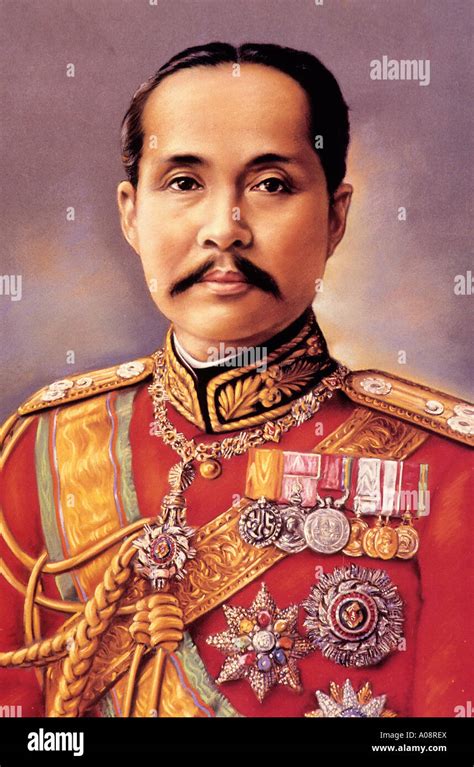
King Chulalongkorn (Rama V)
In 1910, the King requested muay fighters from outlying provinces to fight matches at the funeral of his son Prince Urubongse Rajasombhoj, and granted the noble rank of Muen to the three best fighters, who were from Lopburi, Khorat and Chaiya.
King Rama VII (r. 1925-1935) pushed for codified rules for Muay and they were put into place. Thailand's first boxing ring was built in 1921 at Suan Kulap. Referees were introduced and rounds were now timed by kick.
On October 29, 1970, Muay Thai has also made its great progress. It is noteworthy that for Thailand, Thai boxing has its long history, and has been very popular and attractive to the Thai people. It seems that everybody supports Muay Thai and wants to see this sport progress further.
It is highly hoped that every individual person who is interested in this sport will take part in developing it to its higher efficiency so that it becomes the country's outstanding sport. Thailand's boxing has its several interesting points because it is our own Thai style of boxing, which is regarded as a high-efficiency fighting method, and it is interesting to foreigners, too.
Basic Techniques
Muay Thai incorporates a wide array of techniques, utilizing all eight limbs as weapons. Here's a breakdown of some fundamental techniques:
Boxing Techniques
While punches may not be the highest scoring techniques, they are essential for setting up other attacks. Proper body mechanics, including footwork, hip rotation, and shoulder movement, are crucial for effective punches.
Basic Punches
- Jab: A fundamental punch used for both offense and defense. It is often the first punch learned and should be practiced extensively.
- Cross: A power shot designed to shake the opponent. It is typically set up by a good jab.
- Hook: A punch aimed at the opponent's chin. A well-executed hook can result in a knockout.
- Uppercut: Often used in close-range infighting to knock the air out of the opponent. It can also be used for knockouts.
- Overhand Punch: A powerful punch that generates significant momentum.
Advanced Punches
- Spinning Back Fist: A less common technique that requires generating momentum through spinning.
- Superman Punch: A deceptive punch that involves a fake movement to surprise the opponent.
Kicks
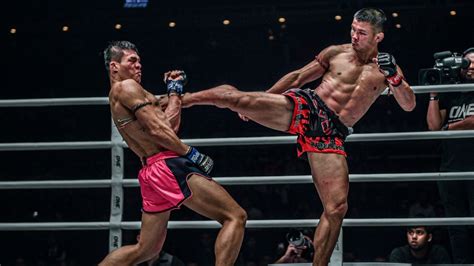
The two most common kicks in Muay Thai are known as the thip (literally “foot jab”) and the te chiang (kicking upwards in the shape of a triangle cutting under the arm and ribs), or roundhouse kick. The Thai roundhouse kick uses a rotational movement of the entire body and has been widely adopted by practitioners of other combat sports. It is done from a circular stance with the back leg just a little ways back (roughly shoulder width apart) in comparison to instinctive upper body fighting (boxing) where the legs must create a wider base.
Clinching Techniques
- arm clinch: One or both hands controls the inside of the defender’s arm(s) and where the second hand if free is in the front clinch position.
Defensive Techniques
Defense in Muay Thai involves blocking attacks, disrupting the opponent, anticipating strikes, and counter-attacking. A common block is known as a ‘check’. When blocking, a parry, the glove (elusively), elbow, or shin will be used.
Disruption - Pre-empting an attack e.g. distance or counter-attack to the remaining leg of the opponent. Anticipation - Defender catching a strike (e.g. roundhouse kick to the body) or countering it before it lands (e.g. techniques.