These are tense times for unranked UFC fighters following a recent loss. In an attempt to trim a bloated roster of well over 500 fighters, UFC officials have gone on a firing spree, releasing well over a dozen fighters, with many more said to be on the way. UFC president Dana White said to expect in the neighborhood of "60 cuts coming up before the first of the year."
Much has been made of these words in the roughly 48 hours since they were uttered. But it's important to note that even massive roster purges are nothing new for the UFC.
Former UFC lightweight Christos Giagos told fans via Instagram that he’d been cut because the UFC was “overbooked.” Other fighters who haven’t fought in six months or more told MMAjunkie that UFC officials explained their releases as the inevitable consequence of a grim numbers game.
But how did the UFC roster get so overburdened in the first place? And what reason is there to think that it won’t outgrow its own needs again, entering into a regular cycle of binge and purge?
Why UFC Fighters Are Broke - Documentary
Contributing Factors to Roster Growth
According to sources with knowledge of the situation who spoke on the condition of anonymity, injuries were one contributing factor in the UFC roster growth. With so many fighters withdrawing from bouts on late notice, UFC matchmakers were left scrambling to plug holes on upcoming fight cards.
Read also: Fixing Boxing with Zuffa
That’s not exactly a new problem for the UFC, which has spent the past few years in a constant battle with the injury bug. So what changed?
Ironically, in some ways, it seems to have been the fear of roster cuts that helped swell the UFC stable to a size that made those cuts essentially unavoidable.
Take, for instance, what happened in the case of light heavyweight Matt Van Buren (6-4 MMA, 0-2 UFC), a finalist on season 19 of “The Ultimate Fighter.” He suffered a TKO loss in the show’s finale bout, then lost his follow-up bout in January after UFC light heavyweight Sean O’Connoll staged a late comeback to win via TKO in a bout that earned “Fight of the Night” honors.
After that 0-2 start to his UFC career, Van Buren said, he knew he couldn’t afford to lose another fight. So when he was injured in training before a planned bout against Jonathan Wilson in August, he deemed it prudent to withdraw rather than fight hurt at that precarious time in his career.
“I needed a win, so I couldn’t afford to come into the fight hurt and fight nowhere near 100 percent,” Van Buren told MMAjunkie. “I can’t go into a fight injured when my back’s against the wall, so I had to pull out of the fight.”
Read also: White's Martial Arts Background
But injury withdrawals can sometimes set off a chain reaction that affects the entire roster. As UFC matchmakers have said in the past, unless the injury strikes a title fight or contender eliminator between two highly ranked fighters, they almost always prefer to find a replacement opponent rather than scratching the fight from the card altogether. That not only keeps the events, themselves, from falling apart but also ensures that the injured fighter’s opponent doesn’t suffer along with him.
“We understand,” UFC matchmaker Sean Shelby told MMAjunkie in 2013. “You spent money on a camp. You’ve got bills to pay. We will do our best to find you a fight. I bend over backward to keep guys in fights, to keep the machine moving. You have to.”
But what happens if an injury strikes one relative UFC novice who’s set to fight another? Then the options for a suitable replacement are likely to be limited to other fighters of around the same experience level and standing within the organization.
Those fighters, however, might be more likely to feel as if they’re already on shaky footing with the UFC. Maybe they’re coming off a loss. Maybe they’re already on the hot seat for the next round of roster cuts. Why make things harder on themselves with a short-notice fight against an opponent who’s been training for weeks with this date in mind?
When UFC matchmakers can’t find someone on the current roster willing to step up and take the fight, they have to choose between scratching the bout altogether (which could potentially put them in breach of contract with regards to the healthy fighter, who’s owed a bout), and signing a new fighter who might be willing to fight on short notice if it proves to be his ticket into the UFC.
Read also: Reunited after 23 years: Carlina White
But that new fighter doesn't automatically replace an outgoing one. UFC officials are reluctant to immediately cut the fighter who withdrew due to injury, since that could be seen as the UFC pressuring its athletes to fight hurt. And even if the new fighter loses in his role as a replacement, cutting him right afterward seems more than a little ungrateful. So everyone remains under contract, at least for the time being.
This is how the roster begins to balloon out of control. The constant stream of new “The Ultimate Fighter” seasons - both foreign and domestic - doesn’t help either. Pretty soon, the UFC ends up with more fighters than it can realistically use, which is when a great big purge starts to sound like a good idea.
“I saw a report online saying something like 50 people were going to get cut,” Michaud said. “I was like, ‘That would suck if it was me.’ Then it was me. And it did suck.”
According to sources close to the UFC, the final number of fighters cut during this roster scale-down is likely to be closer to 30 than 50, but that’s not much consolation to guys like Michaud. He was one of those who got into the UFC as a short-notice replacement and lost a split-decision to Li Jiangling in his debut. He won his next one, then lost the fight to Aubin-Mercier.
Since then, he said, he's done his best to stay in shape, ready to pounce on a short-notice opportunity. Instead, nearly six months after his last loss, he was cut.
The timeline is the part that bothered TUF 19 middleweight winner Eddie Gordon (7-4 MMA, 1-3 UFC), he said. After his victory at the finale event last July, he lost three straight in the UFC. The third loss came in June, and after that he and his management discussed with UFC officials a potential move down to welterweight, he said. He was awaiting word on an opponent when he found out he’d been cut.
“To me, it was definitely a surprise,” Gordon said. “If I was going to get released, I wish it had been immediately after my last fight. That way I could get the ball rolling with another promotion right away. A four-month layoff, that’s a long time. Now I have to get with my management team and figure out the next step.”
Compared to some others caught up in the recent cuts, however, Gordon’s four-month wait between his last fight and news of his release was relatively brief. Michaud was just shy of six months from his loss to Aubin-Mercier when he was let go. After withdrawing from his August date, Van Buren’s cut comes roughly nine months after his last UFC fight.
With months between them and their last paychecks, all three of those fighters said the need to find something else quickly just got more urgent. Then it becomes a question of whether to seek a short-term situation on the small circuit, where they’ll likely have more freedom to answer a call from the UFC whenever it might come, or to try for a new start in a larger organization like Bellator or WSOF.
“I don’t really want to go fight for pennies on some small show,” Van Buren said. “(UFC President) Dana (White) told me that if I get a couple wins they’ll bring me back, but I don’t know. I’ve got to make some money.”
For the UFC, the challenge will be avoiding another roster bloat. Fighters aren’t likely to stop getting hurt any time soon, and the headline-grabbing nature of the en masse cuts might only make the remaining fighters less likely to step up and take their chance with short-notice fights.
“From what they told me, this was probably the biggest cut they had in UFC history,” Gordon said.
While the UFC releasing fighters is certainly nothing new, it's nevertheless jarring when high-profile fighters such as Yoel Romero - currently ranked No. 6 in the latest USA TODAY Sports/MMA Junkie middleweight rankings - suddenly part ways with MMA's premiere promotion.
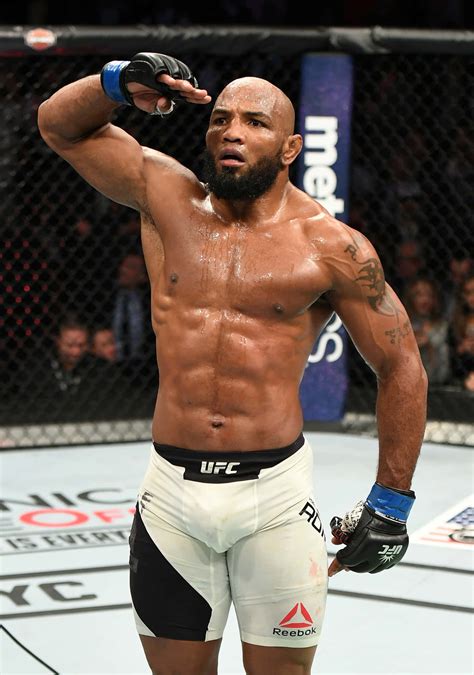
Yoel Romero
Such was the case last week after UFC officials decided they no longer required the services of "The Soldier of God," sending the 43-year-old four-time title challenger packing to the free agent market. Raising even more public concern this time around, UFC president Dana White said to expect in the neighborhood of "60 cuts coming up before the first of the year."
A quick MMA Junkie backend search actually led me on a fun trip down memory lane earlier today. How about an October 2015 piece from former MMA Junkie columnist Ben Fowlkes asking a simple but direct question: What's behind the latest UFC roster purge?
This came at a time when there were reports of 50 upcoming UFC releases, which Fowlkes partially attributed to a glut of injuries, forcing the company to build its roster beyond an ideal number of athletes. It sounds like a story incredibly familiar to 2020, if you simply take out the word "injury" and replace it with "positive COVID-19 test," not to mention the incredible difficulty of obtaining international travel visas during the ongoing coronavirus pandemic. Fowlkes admitted in 2015, as well, that "for the UFC, the challenge will be avoiding another roster bloat."
But if you think this is simply a recent phenomenon, go further down the Junkie rabbit hole with me.
There was an April 2009 piece that I believe was written by MMA Junkie founder Dann Stupp detailing the release of Canadian middleweight Jason Day, in which he mentions "the UFC has been in roster-purge mode in recent months and has axed dozens of fighters."
Or how about a May 2008 teaser of an episode of the now-defunct weekly MMA news show "Inside MMA," which aired on HDNet (later rebranded to AXS TV), which mentioned "the UFC’s recent roster cuts"? Perhaps surprisingly, UFC Hall of Famer Bas Rutten actually spoke in favor of such moves at the time.
"If they're not fighting anywhere, they're not going to make any money," Rutten said. "So they said, 'You know what, we'll release you so you can go fight somewhere.'"
UFC matchmakers are, quite unfortunately, not allowed to go on the record, so the only official explanation we're likely to get of the UFC's decision on Romero will come from White, who on Saturday simply said, "Yoel has lost four of his last five. He's 44 years old."
It sounds like a rather calloused approach to roster management. After all, Romero is a fan favorite who has provided UFC viewers with some incredibly memorable moments in and out of the octagon. But if you think UFC brass takes the decisions lightly, you're quite wrong.
MMA Junkie had a rare opportunity in 2013 to get then-lead matchmaker Joe Silva on record for a special USA TODAY publication, "The 25 Most Powerful People in MMA," and the notoriously direct UFC Hall of Famer admitted releasing fighters was the least favorite part of his position.
"That's the worst," Silva said. "It's the absolute worst. I've almost quit this job multiple times because of that. People have broken down and cried."
Current matchmaker Sean Shelby echoed those same sentiments in 2013 but also explained a bit of the logic behind the moves.
"It never gets easier," Shelby added. "We realize that these are human beings with wives, kids, and this is their dream. It's a dream to become the best in the world at something. … It's not like looking for someone to come in and work for some company and just be average. We're not looking for that. We're looking for the single best person on the planet in their respective weight class. You're obligated to cycle through in search of that person, to find these challengers."
Roster management, Silva said in 2013, is "a simple math problem." Behind the scenes, it's a mantra still preached to this day.
The Math Behind Roster Management
The formula goes something like this: In 2021, the UFC expects to put on 42 events, with an average of 12-13 fights per card. That means between 504 and 546 fights should take place, with, of course, two fighters in the cage each bout, meaning between 1,008 and 1,092 opportunities for an athlete to compete. Ideally, each athlete on the roster would compete two or three times each calendar year, so if you use two-and-a-half as a simple ballpark number, that equates to a range of 403 to 437 fighters needed on the roster, putting aside the added complication of deciding how many athletes you need in each weight class.
Current number of fighters on the UFC roster according to company officials as of Monday: 659.
Of course, the roster does need some flexibility due to the nature of the sport, with injuries in training a constant battle. Replacement athletes are needed. Coupled with the complications of COVID-19 and the current difficulty in obtaining visas, and one UFC official told MMA Junkie that 575-600 fighters is likely the perfect mark.
Shelby is also quoted in that 2013 piece as saying his job is "to bring challengers to the champion."
Romero's recent losses have come to Israel Adesanya, Robert Whittaker, and Paulo Costa, who occupy the top three spots in the latest USA TODAY Sports/MMA Junkie middleweight rankings. At 43, and with four failed championship bids, it seems unlikely that he would be able to get back to a title shot based on recent results. Further complicating matters, fan appetite would likely be minimal for a rematch with Adesanya based on their lackluster UFC 248 bout earlier this year.
Meanwhile, the UFC has a batch of contenders below that top tier who could serve as the future of the division, at least in terms of bringing fresh challengers to the reigning champion. While veteran Whittaker seems to be in the driver's seat for a UFC middleweight title shot right now, names like Jared Cannonier, Jack Hermansson, Darren Till, Marvin Vettori - and maybe even Khamzat Chimaev - lurk in waiting.
Multiple UFC reps insisted to MMA Junkie that fighter pay is simply not part of conversations based around potential roster cuts.
"We've been making these same moves every weekend for 20 years," White told MMA Junkie. "We haven't in the past few months. It has nothing to do with fighter pay or anything else. It just hasn't been done in a few months during the pandemic."