The world of wrestling and combat sports is often surrounded by myths and misconceptions. One persistent concern is whether wrestling can stunt growth, particularly among young athletes. This article delves into the facts surrounding wrestling, growth, and related health aspects.

Andre the Giant's size helped him dominate the sport of wrestling in the 1970s and '80s.
Andre the Giant: A Case of Acromegaly
Andre the Giant, born André René Roussimoff (1946-1993), was a prominent figure in wrestling history. His extraordinary size was due to acromegaly, a hormonal disorder where the pituitary gland releases excess growth hormone. In Andre's case, it resulted in gigantism.
His size helped Andre dominate the sport of wrestling in the 1970s and '80s. He made millions, became world famous, and found crossover success in the movie The Princess Bride. Near the end of his career, Andre faced off with Hulk Hogan in 1987's Wrestlemania III.
Early in life, according to his family, it was around this time that his acromegaly became noticeable. He grew to be nearly 6-foot-6 by the time he was 15. Continued growth resulted in his enlarged head, hands, feet, and chest. Andre wore a size 22 shoe, and in his hands, a regular beer can seemed to be miniaturized (as he demonstrated in a photo that appeared in a 1981 Sports Illustrated profile).
Read also: Mike Tyson: Punch Accuracy
Doctors didn't diagnose Andre with acromegaly while he was growing up in France. At this point in his life treatment would not have reversed Andre's growth but it could have increased his life expectancy. He opted not to get treated because he decided that he did not want treatment at that time because it might interfere with his career as a wrestler.
Andre died at the age of 46 in his native France from congestive heart failure, linked to his untreated acromegaly.
Height and Weight
Andre's exact height remains unknown. Throughout his wrestling career he was usually described as 7-foot-4, but the world of wrestling is prone to hyperbole. His French passport gave a height in meters that converts to just under 7-foot-2. Some believe Andre may have stood at 7 feet, or possibly up to three inches shorter than that.
Andre was often said to weigh 520 lbs., but this may be another wrestling exaggeration. Descriptions of his weight have varied from 380 lbs. to as much as 555 lbs. when he died.
The Impact of Weight-Cutting in Combat Sports
Is Cutting Weight Necessary For Amateur Combat Sports?
Read also: Everything About WrestleMania 41
In combat sports, athletes are divided into categories based on gender and body mass. Athletes attempt to compete against a lighter opponent by losing body mass prior to being weighed (i.e., ‘weight-cutting’).
Methods of weight-loss include energy intake restriction, total body fluid reduction and pseudo extreme/abusive medical practice (e.g., diuretics). The influence of weight-cutting on performance is unclear, with studies suggesting a negative or no effect.
It appears that when larger magnitudes (>3% body mass) are lost rapidly (<5 h) using thermal strain, high-intensity exercise performance is impaired. However, when a similar magnitude of weight is lost over multiple days (2-5) using a combination of methods (food restriction and body-fluid manipulation) laboratory-based trials have failed to observe any negative effect.
Athletes undertaking weight-cutting may be able to utilise strategies around glycogen, total body water and electrolyte replenishment to prepare for competition.
Common Practices in Weight Cutting
A plethora of weight loss methods have been utilised prior to competition across combat sports including energy intake restriction (gradual dieting and fasting); total body fluid reduction (restricting fluid intake, increasing sweat response (heated wrestling, plastic suits, saunas and spitting) and; pseudo extreme/abusive medical practice (laxatives, diet pills, diuretics, enemas, sporting bulimia (vomiting)).
Read also: Where to Watch Paul vs. Tyson
It appears that gradual dieting and increased energy expenditure through exercise are common among all combat sports that have been investigated. However, the magnitude of the increase in the volume of exercise is not clear, nor the type of exercise utilised.
In short time periods (<24 h), the majority of body mass reduction will likely come from body fluid manipulation. Both a restriction of fluid ingestion and an increase in thermal strain to induce sweating appear to be commonplace in a wide range of combat sports, with losses of over 5% of athlete body mass reported within 24 h of the weigh-in.
Physiological Mechanisms
Acute reductions in energy intake are likely to influence performance through reduced glycogen concentration. Dehydration induced via sweat loss is commonly associated with a reduction in the blood plasma and thus total blood volume which would impair cardiovascular function, muscle blood flow and thermoregulatory capacity.
Body Fat Percentage in Women Wrestlers
The estimation of body fat percentage (BF%) in wrestling is used to determine the minimum wrestling weight (MWW) and lowest allowable weight class (MWC) in which wrestlers are eligible to compete.
There are currently multiple schools across the US that have club teams or compete as an emerging sport at the Division I, II, or III levels within the National Collegiate Athletic Association (NCAA) as well as other collegiate athletic associations (e.g. National Association of Intercollegiate Athletics or NAIA, National Junior College Athletic Association and California Community College Athletic Association).
As a counter to harmful weight loss practice, SGBs now require wrestlers to complete a weight certification process that consists of a bodyweight assessment, urine specific gravity test (to confirm an euhydrated state), and a body composition test to estimate body fat percentage (BF%) and fat-free mass (FFM) during the pre-season period.
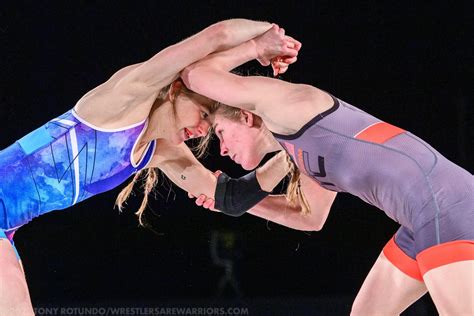
Women wrestling championship.
Key Findings on Body Fat Percentage
- The median ± interquartile range BF% for all wrestlers was 27.4 ± 10.2%.
- Only 354 out of 1,579 (22.4%) wrestlers competed in their lowest allowable weight class, based on the 12MWW.
- The lowest recorded weight for all wrestlers registered throughout the season was 19.4 ± 16.9 lbs.
The median BF% was 27.4% with findings from the current study indicating that 95% of the female wrestlers from the 2022-2023 pre-season were above 17% body fat.
When using the 12% BF% threshold currently used for MWW determination in collegiate wrestling, on average wrestlers were 28.1 ± 17.3 lbs. above their eligible MWW at the time of weight certification.
Table: Comparison of Minimal Wrestling Weight Methods
| Method | Mean Difference ± SD | 95% Confidence Intervals | Effect Size |
|---|---|---|---|
| 12MWW | 28.1 ± 17.3 lbs | 27.3, 28.9 | 1.6 |
| 17MWW | 22.1 ± 19.2 lbs | 21.2, 23.0 | 1.1 |
Strength Training and Youth
While the research-based answer to "Can weight lifting stunt growth?" is a resounding no, that doesn't mean the activity is free from risk. An adolescent body is different from a mature adult.
Effective supervision and guidance on proper form, and that means individualized training programs are crucial. It was recommended that athletes, parents, coaches, and anyone in the athlete’s support system look at the NCSA infographic on youth resistance training, which outlines strategies to get started and stay safe.