The double leg takedown is a fundamental and highly effective technique in various combat sports, including mixed martial arts, judo, and Brazilian Jiu-Jitsu (BJJ). Known in judo as morote gari, the double leg takedown is one of the most used techniques in grappling. It combines speed and power, making it a go-to move for both beginners and advanced practitioners. In the double leg takedown, you grab your opponent’s legs while pushing their upper body forward, forcing them to the ground. Executing this move against a resisting defender can be challenging, and many fighters are on high alert against this move.
This article delves into the intricacies of the double leg takedown, offering insights into setups, variations, and strategies for both gi and no-gi grappling.
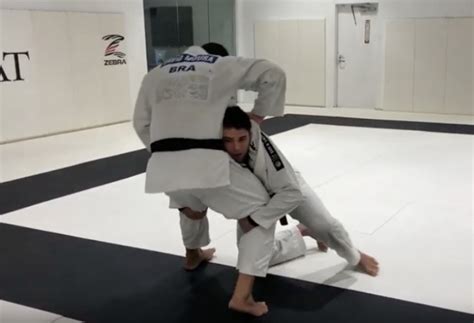
Setting Up the Double Leg Takedown
To execute the takedown properly, you need to get low enough and close enough to get past your opponent's defense. That's partially speed, which will come with practice, but also shooting from the right position. For some wrestlers, that can be as many as two or three feet, while others may need to be in closer. Some wrestlers can shoot from farther away, while some need to be closer to do it properly.
To start with, you have to have the right range. If your opponent blocks you with their hands, you’ll have a hard time getting to their legs. Check your range by extending your hand and seeing if you can reach your opponent. You want them just outside of your reach but not so far that you have to close too much ground. Once you’ve checked your range, drop your level so you can move underneath your opponent’s arms and get past their primary defense.
Read also: UFC 322: Makhachev's opportunity
As you drop, step in with your lead leg, putting pressure on your back leg so your front leg can cover the distance. Don’t go straight at the legs because this will lead you right into your opponent’s hands. Step with your front leg, not your trailing leg, as this will slow you down and give your opponent time to react. Maintain good posture, and don’t lean forward, or your opponent will sprawl and flatten you out. Step deep with your lead leg, keeping your upper body tall. Use your legs to drive forward while pulling their’s toward you. Keep your head outside of their body while pressing against their hip or torso to maintain control and prevent them from twisting away. Ideally, you’ll land in a dominant position, such as side control or guard, as you complete the takedown.
While you are taking the penetration step, lower your level to give yourself more balance and make the shot harder to counter. Then put your head on the side of their hip so your can push their body with your head. Trying to wrap up too high on the legs might seem like a better way of controlling your opponent, but most wrestlers' thighs will be much too strong to control with your upper body. Putting your ear to the side of their hip make everything tighter.
Finishing the Takedown
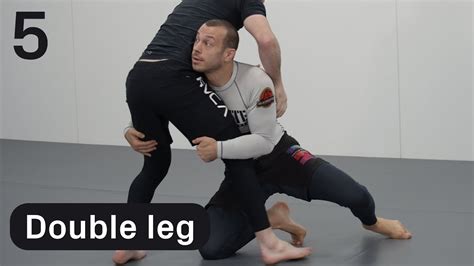
You shot in and wrapped up your opponent, but now it's still up to you to get back to the mat and get some points. To make it happen, bring your trailing foot forward, without dragging your knee, and push off with your lead foot, taking a little stagger step to the outside of your opponent's body, if necessary. Your step to get up to your foot should be almost like another shoot, or a hop, powering through your opponent's body and throwing them off their gravity. Keep your shoulder in tight, your arms snaked around your opponents lower legs, and driving forward and your opponent should be on the mat in no time.
When you take your opponent onto the back, keep pressure on his torso with your shoulder, as if you were trying to drive through the other wrestler's body and into the mat. Flatten out, chest-to-chest, if you can. Good wrestlers will flop over onto their belly when you execute a double-leg take down.
Variations of the Double Leg Takedown
Basic Double Leg Takedown
Read also: Topuria: From Prospect to Champion
When doing the double leg from a standing position in traditional gi Jiu Jitsu, the higher percentage double leg variation would be the blast double. The reason being, in gi Jiu Jitsu, when grips are established from both competitors, it is very difficult to implement a take down.
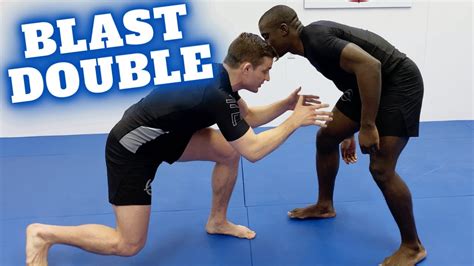
The Blast Double Leg
The key characteristic of the blast double is its sheer force and speed, making it a highly effective technique for driving an opponent off their feet and onto the ground. Unlike a standard double leg, where you might set up the takedown with more finesse or chain it with other techniques, the blast double is all about speed and power. For this beginner variation, put your knee underneath the opponent’s butt and drive forward, and snake your hands around their knees to touch their calves.
Defending Against the Sprawl
If your opponent defends by sprawling or shifting their weight, transition to a double leg by switching your outside hand to their opposite knee or leg.
Securing a Dominant Position
Once your opponent is down, control of their legs to prevent them from establishing a closed guard. Keep your posture low, with your chest close to their hips, and quickly pass their legs before they can set up a guard. If their legs are still open, use an over-under pass by dropping one shoulder into their thigh while controlling the other leg, flattening them out, and circling to side control. If you land with one knee between their legs, execute a knee cut pass by sliding your knee across their thigh, pushing the opposite leg away, and using head and shoulder pressure to pass to side control. As they hit the mat, immediately circle toward your opponent’s back. Keep your chest close to their hips and use your grip on their legs to help maneuver around them. Once your opponent goes down, control one of their legs while releasing the other, and quickly position yourself so that your hips are close to the leg you’re targeting. Slide your hips or rotate to align yourself for the leg lock, keeping their leg trapped and securing a strong grip.
Read also: Olympic Champ to UFC Star
Double Leg Takedowns in Gi vs. No-Gi
The double leg takedown technique varies depending on whether you are grappling with a gi (traditional uniform) or in a no-gi setting.
Gi
In gi, you can use the gi itself to your advantage. Gripping your opponent’s collar, sleeve, or lapel gives you additional control and options for setting up the double leg. You can use a collar and sleeve grip to off-balance your opponent before shooting in. The gi also makes it easier to pull and manipulate your opponent to break their posture or disrupt their balance.
No-Gi
In no-gi, you rely more on body control and hand fighting since there’s no fabric to grip. The emphasis is on speed, athleticism, and securing a good underhook, collar tie, or wrist control to set up the takedown. Without the gi, you’ll need to maintain tight control through direct contact, such as clasping behind your opponent’s knees or gripping their waist.
Common Mistakes and How to Avoid Them
One of the most straightforward and common ways of trying to set up the double-leg takedown is by striking at the head with jabs to draw your opponent's arms up into a defensive position, then shooting in for the takedown. One of the best ways of defending a quick wrestling-style shoot for a takedown is with a hard knee strike to the head. It's a quick way to end the match and a devastating strike. Practice half-shoots, in which you fake a shoot from far away, keeping your eye on your opponent's knee the whole time, to make sure you come up short when it's thrown.
Shooting in for a double is usually best after you've worn each other down some, and your opponent is grabbing for your shoulders, rather than striking out. A quick chop upward with your hands, striking your opponent's elbows with the space between your thumb and forefinger, should be effective in breaking their grip and allowing you to shoot in for a takedown. Stay low and watch for knees, then chop upward hard, using a short jab with your hands to get your opponent's arms up.
Additional Tips and Considerations
- The Safest Place: The safest place to be in a fight, while standing, is in a clinch. From the clinch, your opponent’s striking power is almost entirely eliminated.
- Upper Body Clinch: The advantage of establishing an upper body clinch is that once you take your opponent down you end up in the very dominant mount position, and you can disengage from the clinch if necessary (e.g., in a multiple attacker situation). If you anticipate difficulty in establishing the clinch, however, the Double Leg Takedown is a great alternative.
- Haymaker Punch Defense: You have already learned how to establish the clinch if they attempt to knock you out while standing. The Haymaker Punch Defense is used when a determined attacker comes at you from a distance with the objective of putting all of their bodyweight behind one fight-ending punch.
Resources for Further Learning
Now you want to take your wrestling and specifically, your double leg to the next level? Perfect, we have a solution for you, and no, its not wrestling classes. Check out IBJJF World Champ and Division-1 All American wrestler, Hudson Taylor's DVD "Wrestling for bjj" out below.