Grip fighting is a fundamental aspect of Brazilian Jiu-Jitsu (BJJ). It dictates control and positioning, whether you’re defending against an opponent’s control or setting up your attacks. Understanding and mastering grip techniques is essential for success on the mat.
In BJJ, grips are of two major types: Gi BJJ grips and No-Gi BJJ grips. In both forms, the necessity to establish grips, reposition grips, and then break them is considerably substantial. The importance of using grips in Brazilian Jiu Jitsu is exponential, as the necessity to control an opponent, and manipulate their structures is more effective using grips.
This guide provides a framework for you to explore grip resources, focusing on grip strategy and techniques to enhance your grappling skills.
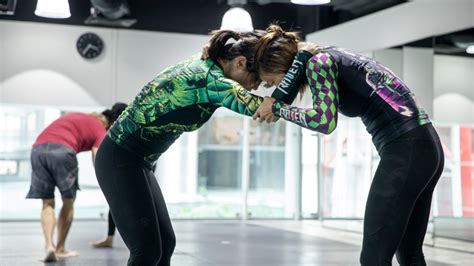
Importance of Grips in BJJ
Grips dictate control in BJJ. A strong grip can limit your mobility, disrupt your techniques, and give your opponent a significant advantage. Conversely, breaking an opponent’s grip allows you to regain control, execute your game plan, and maintain offensive or defensive positions. Knowing how to use a grip to keep an opponent away, or to stifle the attack systems of their opponent is one of the key factors in the stand up aspect of Brazilian Jiu Jitsu.
Once the fight hits the ground, grips are just as important to help an athlete transition from one position to the next. Grips are used to force an opponent to move in a certain direction, so the athlete can maneuver their way past their opponent's guard, or set up different sweeping mechanisms. All submission techniques require an athlete to set up grips, whether they are collar grips in the Gi, or wrist grips and necktie grips in No Gi. The importance of a solid grip is crucial for an athlete to achieve a successful submission like a cross collar choke, a bow and arrow choke, an arm bar, or a triangle choke.
Read also: Training at Alliance Chula Vista
Key Principles of Grip Fighting
- Deny Their Grips First: If they don’t get the grips they want, their game never gets going. The more skilled person is always going to win given equal mastery of grips. But if you get into a situation where your grip is much more advantageous, you can win exchanges with opponents who are more skilled than you are.
- Control Inside Space: We’re more powerful when our arms are pulled in close to our bodies. This makes it easier to push and pull an opponent, harder for them to push and pull us, and creates a barrier to them striking us.
Gi Grips
The Gi is the most traditional aspect within the art of Brazilian Jiu Jitsu. The extensive range of grips that an athlete can use is instrumental to achieving success during a competition match.
Here are some BJJ gi grips that you should learn at all costs to succeed in the sport. If you are able to place grips on your opponents before they do so, you are on edge to apply any of your jiu-jitsu techniques, including chokes, locks, and sweeps, in a more effective way.
Common Gi Grips:
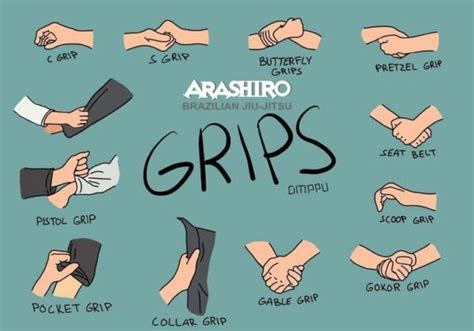
- Collar Grip: One of the most important grips, used predominantly to choke an opponent. Athletes can use a grip that consists of a four fingers in, and one thumb out, or a one thumb in and four fingers out grip. These two grips combined is how an athlete can secure the baseball bat choke, and individually they are used to set up different chokes like the cross collar choke, the bow and arrow choke, and the clock choke. Another important collar grip is when an athlete secures the tip of their opponent's lapel, this is used to Gi wrap their opponent.
- Sleeve Grip: Extremely important for upsetting the defensive structure of an opponent. They are also used to trap the opponent, and take away their ability to post.
- Pants Grip: Securing grips on an opponent's pants is vital in stifling a guard player, and being able to pass their guard. Using pistol grips on the inside, and the outside of an opponent's pants will help an athlete secure guard passes like the toreando, and the x pass.
For placing a grip, the ideal position on a gi is the sleeves. There are two points on the sleeves where you can grab them for grips. One point is above the wrists and the second one is above the elbow or higher in the armpit. Here, the noteworthy point is that you cannot grip inside the sleeve; it is illegal according to the IBJJF regulations. Therefore, ensure that, except for your thumb, all fingers are on the outer side of the sleeve. If for some reason, you are unable to apply a four-finger grip, you can also go for a pistol grip using your opponent’s Gi sleeves.
When it comes to controlling legs in BJJ, you cannot ignore the significance of the pants grips. Regardless of the position on BJJ pants, the four-finger grip is applicable everywhere, but you cannot go for the pistol grip on pants as it might not provide enough control. Pants grips are only beneficial when you grab them from the top.
Other Gi Grips:
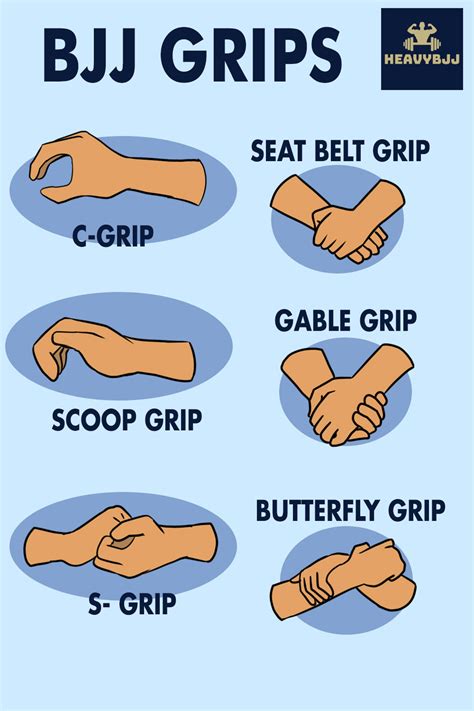
- "S'' Grip: Hook your fingers of one hand onto the fingers of the other hand, which makes a shape like an S. You can make use of this gripping technique, specifically when your opponent is too big and you cannot wrap them by going palm to palm. You can also take advantage of this grip while defending armbars.
- Monkey Grip: Requires you to grip with your four palm fingers rather than your thumb. In this grip, you also tuck your thumb next to your forefinger. This grip requires you to remove your thumb’s main function. For the clinching game, monkey grip is one of the best options, despite its simplicity, as it helps grapplers control the distance and apply pressure. This grip is also effective when it comes to submission techniques such as chokes like the arm triangle or straight arm locks.
- Americana Grip: One of the classic fulcrum movements that help you put plenty of pressure on the opponent's shoulder. This grip works more effectively when you get your opponent on their back, but you can also use it from the bottom position against new grapplers.
- Butterfly Grip: This is not only effective in takedowns but also serves as seat belt control. The purpose of this grip is to have the wrist hooks bend against each other in order to boost the strength of your grip. In this grip, the elbows remain close to the ribs.
- Ball and Socket Grip: This is one of the most versatile and common grips that are used during stand-up to control an opponent's waist, upper body, and legs, particularly in sweep single-type circumstances. To perform this grip, you will be required to hide your choking hand under the other one, and by doing so, you will be making it harder for your opponents to grab and pull away.
- C-Grip: This grip is found to be quite effective for creating panic scenarios, avoiding engagement, and fainting opponents during the fight. This grip is mostly used from the bottom offensive positions. However, you can also surprise your opponent by placing a c-grip in the top position.
- Pretzel Grip: This grip has been proven as a great innovation that has the ability to change a submission. To apply the pretzel grip, you need to get into an arm-in guillotine position.
No-Gi Grips
In the No Gi art securing grips are different, because an athlete has no uniform they are allowed to grip onto. Instead they must rely on their ability to control their opponents using strength, dexterity, and creative thinking.
Read also: New Jujutsu Odyssey Codes
Common No-Gi Grips:
- Wrist and Elbow Grip: Using a wrist and elbow grip can be an effective way to control the arm of an opponent, and this is how they can isolate a limb. Sometimes one grip on a wrist is not enough, so the athlete will secure a two on one grip, meaning they have both of their hands securing one wrist, and this will make life extremely hard for an opponent.
- Under Hook: This is when an athlete shoots their arm underneath the armpit of their opponent, reaching up behind their back, and using their shoulder to control their posture.
- Over Hook: This is when an athlete scoops their arm around an opponent's arm, as they control the limb, and the shoulder. These two grips combined are used in the butterfly guard, and will help athletes execute hook sweeps.
- Necktie: This is basically a grip that controls the neck, or the head. A necktie is the same grip used in a Muay Thai clinch, and can be a good way to set up different takedowns, and different sweeps like the scissor sweep, or the technical standup. Using neck grips is important for breaking down the posture of an opponent, but is also good for setting up different kinds of chokes.
- Head Control: Another important way to control an opponent is by securing a cupping action on the back of an opponent's head. Manipulating the head of an opponent is extremely important, because the head is connected to the spine, and if the spine is out of alignment with the head then the opponent will be in a weakened state.
Other No-Gi Grips:
- C Grip: This grip is basically used to grab hold of a wrist, or an ankle, although it is one of the most common grips, it is not the strongest grip, because an opponent can circle their wrist out to escape the grip.
- Cupping Grip: This is a grip used in the necktie, the tricep grip, as well as gripping onto an ankle for a leg drag. This is another grip that is extremely useful, but relatively easy to address from an opponent.
- S Grip: The s grip is an effective way to keep control of chokes like the head and arm triangle, as the strength and versatility of this grip is extensive. The s grip consists of one hand palm up, with the other hand palm down, as the connection is between the tips of the fingers.
- Gable Grip: This grip is secured by connecting an athlete's hands together palm to palm, as the four fingers on each hand cup over the carpal bones underneath the little finger.
- Figure Four Grip: To secure the figure four grip, an athlete will take a wrist grip, threading their other hand around the limb, and cupping onto their own wrist. This will create a vice like grip on the opponent, making them vulnerable to a range of different submissions.
Grip-Breaking Techniques
Effective grip-breaking relies on technique and leverage rather than brute strength. Understanding the weakest point of your opponent’s grip and applying force in that direction is key. For example, most grips are weakest at the thumb.
Effective grip-breaking requires precise timing. Reacting immediately when your opponent establishes a grip gives you a better chance of success. Instead of relying solely on your arms, engage your entire body when breaking grips. Using your hips, shoulders, and legs generates more force and minimizes fatigue.
Common Grip-Breaking Techniques:
- Two-on-One Pull: Grab your opponent’s sleeve with both hands, focusing on their grip’s weakest point.
- Circular Motion: Rotate your wrist in a circular motion against the thumb of your opponent’s grip.
- Push and Pull: Use one hand to push their gripping hand upward while pulling their sleeve or wrist downward with the other.
- Kick and Strip: Use your free leg to push against their gripping hand while pulling your leg back.
Exercises to Increase Grip Strength
There are a number of different ways to increase an athlete's grip strength. The hands need to be incredibly strong if an athlete wants to become successful utilising certain techniques. Using grip strength for bjj means an athlete will have a significant advantage over most of their opponent's, even if they have a lesser muscle mass.
When training grip strength most athletes focus on flexion, which is the act of squeezing, or pinching, but they forget an extremely important aspect, extension. To extend their fingers outwards is just as important as the flexion technique.
Here are some good exercises that can help build significant grip strength:
Read also: Benefits of Jiu Jitsu
- Reverse bicep curls
- Hanging exercises and chin ups
- Rope climbing, rock climbing, or using battle ropes
- Farmers' walks
- Dead hangs
- Wrist curls and extensions
- Plate pinch exercise
- Hand grippers
- Fat grips
- Towel and gi grips on specific exercises
- Isometric med ball squeeze
Table of Grip Strength Exercises
| Exercise | Description | Benefits |
|---|---|---|
| Reverse Bicep Curls | Lifting weight with palm down. | Builds strength in the hands and forearms. |
| Hanging Exercises | Hanging from a pull-up bar. | Works out hands and improves overall grip strength. |
| Farmers' Walks | Holding heavy weights and walking. | Strengthens hands and improves endurance. |
| Wrist Curls | Lengthens the finger flexor muscles. | Improves grip strength and flexibility. |
| Plate Pinch | Pinching and holding a weight plate. | Challenges flexor muscles with an alternative stimulus. |
| Hand Grippers | Using tools to squeeze and release. | Supplements grip strength training. |
Grip training works best as a 'supplemental add-on' to your regular strength training. By following the add-on approach, you can easily incorporate grip training into your regular programming without sacrificing your primary lifts or having to rework your programming competitively.
Regular drilling helps you internalize grip-breaking techniques. Partner up during practice and simulate various gripping scenarios.
By mastering leverage, timing, and body mechanics, you can neutralize your opponent’s control and gain the upper hand. With consistent practice and the right mindset, grip-breaking becomes second nature.
1 Rule for Grip Fighting Every White Belt Should Know
Join black belt Belt Leigh Remedios as he shares his expert knowledge on gripping strategies for stand up in BJJ. In this in-depth video, Leigh will break down the key techniques and tips for maximising your grip game on the mat. Whether you're a beginner or an experienced practitioner, this tutorial will help you take your grappling skills to the next level.