One of the biggest goals for martial artists is to learn how to kick higher. People spend so much time trying to stretch as much as possible in hopes of getting higher kicks. They repeat the same stretches over and over, getting frustrated not seeing the results they are after.
If you want to kick higher, it’s important to know that you actually need more than flexibility, you need strength as well. I’m pretty sure you’ve been told by your Sensei that regular stretching (flexibility exercises) is the most effective way to increase kick height. Sorry to disappoint you, but he’s wrong. Well, not totally wrong, more like partially right. Let me explain.
Flexibility is essential if you want to kick higher, I mean there’s no denying that, but flexibility it’s also just one of two requirements for higher kicks. That being said, if you cannot kick higher than waist level, it’s quite safe to say that a lack of strength is probably what’s holding you back from kicking high.
Flexibility and strength. The Yin and the Yang, you heard it before! Stretching and strengthening exercises targeted at specific muscle groups are necessary for kicking higher.
Once you work on improving your flexibility and your strength, there are some other things to consider that will help you kick higher. Too often, we tend to do things automatically, like a robot, without being really aware of what we do. In order to improve the height at which you can kick, it is imperative to slow down, be mindful, and understand how your body works. Don’t just use your brain, feel your body.
Read also: Understanding Kick Pads
It’s amazing how much understanding your kicks biomechanics can help improve not only their effectiveness but also their range of motion. When you deliver a kick, have an honest and mindful look at your technique. Bad posture, poor ergonomics, and improper form can cause wrong body mechanics that will result in reduced speed, power, stability, and kicking height.
The same way swimming improves your swimming ability, kicking will improve your kicking ability. Yes, you should definitely work on flexibility and strength training, but keep on doing your kicks - alone, in kihon-style, on a punching bag, on a makiwara (yes!
Hundreds of years ago in the Ryukyu Kingdom - the birthplace of Karate (modern-day Okinawa), Karate practitioners knew the importance of core training and used all sorts of equipment to improve their core strength. Kicking makes great use of your core muscles, and sadly, core strength is often overlooked by many karate practitioners. Of course, your upper and lower body should not be neglected, but you must understand that your core is the base, the center of EVERY physical movement, hence the name CORE.
When you develop your core, every move becomes so much easier, trust me. Kihon, kata, kumite, everything will feel more natural and effortless! Core exercises strengthen the muscles in your pelvis, lower back, hips, and abdomen, which leads to better balance and stability, whether in the dojo or in daily activities. As I mentioned before, every aspect of your Karate will benefit from having a strong core, but since this article focuses on kicking, let’s talk about kicks.
To kick higher, you need to strengthen the muscles in the periphery of your core like your thighs hamstring and glutes, but the core muscles are mostly responsible for all the lifting, pushing and pulling involved in Karate kicks.
Read also: Choosing the Right Kick Boxing Bag
Here, I will suggest to you three specific stretches and three specific strengthening exercises designed to improve specific kicks. I’ll focus on the three basic Karate kicks, the mae-geri (front kick), the mawashi-geri (round kick) and yoko-geri (sidekicks). As you probably know this but let me remind you again.
When you stretch, don’t go to your maximum extension right from the start, go progressively. If it starts to be too painful, release a bit of pressure and breathing through discomfort. To have the best results possible, try to hold each stretch for at least 30 seconds.
Now regarding strength exercise, breathing correctly not only help you do the movements correctly, but also help and prevent injuries. Please remember this simple rule: you exhale during the portion of the training that requires the maximum effort and inhale during the part requiring less effort.
Here are some exercises and stretches to improve your kicking ability:
30 Days to Higher Kicks
Improving the Mae-Geri (Front Kick)
As you know, the front kick or mae-geri in Japanese is the fundamental kick in every style of Karate. The mae-geri is a powerful and fast kick and is “easier” to master than less “natural” kicks. By stretching the muscles antagonist to the movement of your front-kick, you will gain, with time, the ability to not only kick higher but to kick with more power.
Read also: Individual Martial Arts Instruction
Stretches for Mae-Geri
- The Supine Hamstring Stretch is a great exercise.
- The inverted lotus it one of my favorite exercises for stretching and relaxing the lower back.
- The lower back rotational stretch is a fantastic exercise to perform to help improve your kicks. It helps relieve tension in the lower back and trunk. The sumo squat stretch is a fantastic posture not only to stretch your lower back, but also to relieve lower back pain.
Strengthening Exercises for Mae-Geri
If your aiming to kick higher with your mae-geri, your body requires a certain level of strength specifically in the hips, tight and core.
- I suggested this exercise to many MANY people struggling with their front kick, some of them could barely kick above the belt. I can tell you that they all got amazing results with this exercise. Lie down on your back with your knees bent and feet flat on the floor.
- The bodyweight squat is a great exercise to help strengthen your tights but also your glutes, lower back, and core. The lunge is a single-leg bodyweight exercise that’ll work not only on your tight but also your hips, glutes, quads, hamstrings, and core. The horse stance is practiced in almost every Karate and Kung-Fu styles for a reason - it works!
- Crunches are an easy and effective way to strengthen your abdominal muscles. The reverse crunch is a core exercise that essentially works on the inferior portion of your rectus abdominus (a.k.a. the six pack abs), the part of your core mainly used when delivering the mae-geri. Of course, you can do abs without equipment, but the ab roller will help you perform some of the most challenging core exercises out there.
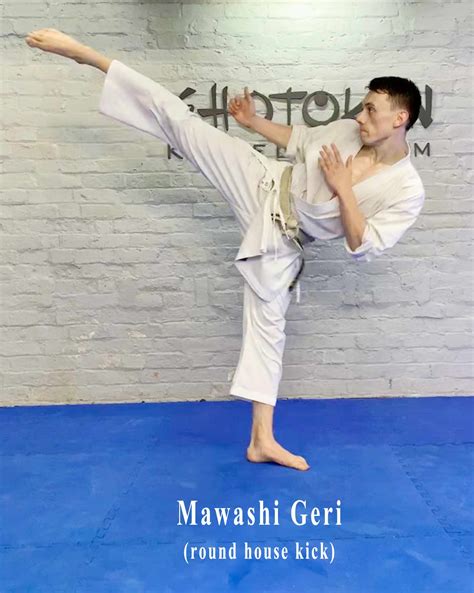
Improving the Mawashi-Geri (Round Kick)
Without any doubt, the power of your mawashi-geri or round kick comes from your hips and core. You might be flexible, but that doesn’t guarantee that you’ll be able to kick high with your round kick.
Stretches for Mawashi-Geri
- This version of the hurdler’s stretch is excellent for improving the flexibility of your mawashi-geri. This exercise will stretch not only your hamstrings and inner thighs but also your core stabilizers.
- The side lunge is specifically designed to stretch your inner thighs. The seated adductor stretch is a classical Karate stretch.
- Many people do this exercise incorrectly and turn out stretching the lower back more than the hip flexors. Lizard Pose comes from Yoga where ist called Utthan Pristhasana in Sanskrit.
Strengthening Exercises for Mawashi-Geri
- Lateral leg Lifts really help strengthen the outer hip muscles, especially by the gluteus medius. The “toe-touch and extend” is an exercise that I developed for strengthening my muscles for the mawashi-geri.
- The Crescent Moon is originally a Pilates exercise, but it was quickly adopted by martial artists. It’s one of the best, if not the best exercise that activates the deep muscles necessary for the round kick. The Leg Circle is another excellent strengthening exercise that will literally take your mawashi-geri to a whole new level! The side crunch is a classic exercise for a reason, IT WORKS!
Improving the Yoko-Geri (Side Kick)
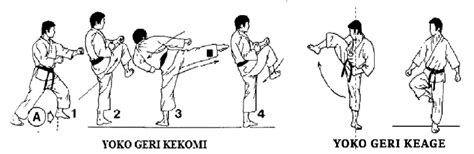
From a technical standpoint, it’s a difficult kick to perform, it has lots of parameters to meet to be done right. Unfortunately, like every other kick, knowing the right technique isn’t enough, you need the necessary strength and flexibility of some specific muscle groups. If you are not flexible, the yoko-geri can be quite challenging to pull off.
Stretches for Yoko-Geri
- The forward bend is another classical Karate stretch that made it through the years.
- The standing Pendulum is a basic stretch but gets the job done right. Personally, this stretch makes my hips and lower back feel like new. I do it every morning in bed before rising up.
- The Cat Stretch is a fundamental yoga posture that mimics the movement of a cat. Another of my favorite!
Strengthening Exercises for Yoko-Geri
Delivering high yoko-geri is hard work because this kick requires a not so common combination of muscle synchronicity (muscles working together). If you want to deliver your yoko-geri higher, you absolutely need to get your glutes, hips, and core stronger.
- This move will not only work hard on your glutes, but it will also work on your entire core. This exercise almost seems design for the sidekick as it mimics its fundamental motion (pulling the knee in). You will develop crazy powerful yoko-geri with this exercise, trust me! Kicking higher won’t be a problem after you work this move for a certain time.
- The fire hydrant stretch is another great strength exercise for improving your sidekick. Make sure you’re opening your hip throughout the move rather than rotating your torso to elevate your knee. The lateral band walk is a fantastic hip exercise for strengthening your hips (and tights).
- The side plank is the hardcore version of the Floored Hip Thrust. The bird-dog is an exercise that will strengthen your core, -more precisely, the abdominal muscles, lower back, glutes, and thighs. Bicycle crunches are an excellent way to target your rectus abdominis and the obliques in one single workout.
Like most things worth pursuing, improving your body to kick higher takes some time and effort. Make them part of your morning and evening routine and avoid as much as possible skipping a day.