The Marine Corps Martial Arts Program (MCMAP) is a combat-oriented martial arts program created by the Marine Corps. MCMAP was officially created by Marine Corps Order 1500.54, published in 2002, as a "revolutionary step in the development of martial arts skills for Marines and replaces all other close-combat related systems preceding its introduction."
MCMAP is a synergy of mental, character, and physical disciplines with application across the full spectrum of violence." The disciplines are the foundation of the MCMAP system, as it serves a dual purpose. MCMAP was implemented to increase the combat efficiency, as well as to increase the confidence and leadership abilities, of Marines. This program is designed not only to increase combat efficiency but also to develop values like leadership in trainees. These goals are expressed through the MCMAP motto, “One mind, any weapon.”
The focus of Marine Corps Martial Arts Program (MCMAP) is the personal development of each Marine in a team framework using a standardized, trainable, and sustainable close combat fighting system. As a weapon-based system, all techniques are integrated with equipment, physical challenges, and tactics found on the modern battlefield. The MCMAP is designed to increase the warfighting capabilities of individual Marines and units, enhance Marines’ self-confidence and esprit de corps, and foster the warrior ethos in all Marines.
The Commandant of the Marine Corps determined that the disciplines studied in MCMAP are integral to the function of Marines and had ordered that all Marines attain a tan belt qualification.
While at School of Infantry (SOI), your Marine may receive sustainment or advanced training of Marine Corps Marital Arts. MCMAP training teaches Marines the skills required in unarmed combat, weapons of opportunity, rifle and bayonet tactics, and edged weapon techniques. The program also incorporates warrior ethos training with focuses on past warriors of world history, such as the Spartans, Zulu and Apache warriors, and the Marine Raiders from World War II. Progress in the MCMAP is measured by achieving colored belts that indicate a Marine's MCMAP ability.
Read also: Individual Martial Arts Instruction
The Marine Corps Martial Arts Program (MCMAP) is one of the most brutally efficient military combat systems in the world.
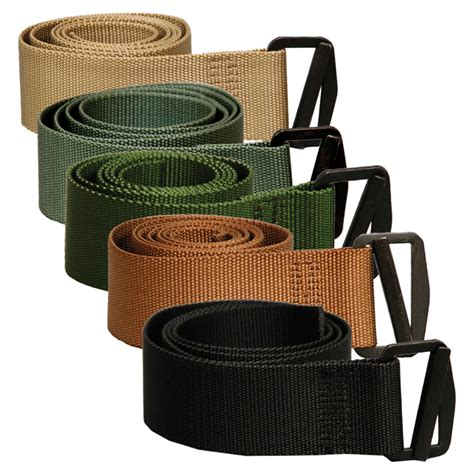
MCMAP instructors can train and certify other Marines up to their current belt level. The instructor status is signified by one vertical tan stripe on the MCMAP belt. A Marine must have attended at least the Martial Arts Instructor (MAI) course to advance beyond first degree black belt. The only one who can train a Marine to be an instructor are black belt Martial Arts Instructor-Trainers (MAIT). An instructor-trainer's status is signified by a vertical red stripe on the MCMAP belt and a secondary MOS of 0917 (formerly 8552). To become a MAIT, a Marine must have already completed a local MAI course.
The government has funded the Marine Corps Martial Arts Program (MCMAP) since 2002. And just like the many benefits of karate that go beyond combat skills, Marines are instructed in ethics and mental exercises in addition to effective techniques to use when going mano a mano. So it’s just like your local dojo. Navy personnel that are attached to Marine units.
In terms of techniques, the curriculum covers unarmed combat and improvised weapons, as well as rifle and bayonet techniques (yes, bayonets-- more on that later). Those techniques are adapted from 17 different fight styles, from BJJ, krav maga, and Muay Thai to kung fu, Isshin-ryu karate, and taekwondo.
Most of the protective gear worn during Marine Corps martial arts is standard issue from the Individual Issue Facility (IFF).
- Mouth Guard - For the most part, you don't have to worry about getting hit in the face, but sometimes it just happens. An inexpensive mouth guard will protect your teeth from chipping, and prevent them from getting knocked out.
- Hand Wrap and/or Gloves - Protect your knuckles from abrasions and bleeding. Some Marines prefer to act tough and hit the pads bare knuckled. The problem with that mentality is that it's going to slow your training, slow your recovery, and detract from focusing on technique.
Read also: The Jade Fortress Martial Arts System
MCMAP Disciplines
“MCMAP is a synergy of mental, character, and physical disciplines with application across the full spectrum of violence."
In MCMAP, only a third of the training involves techniques and physical development. This discipline also includes sustainment of skills and techniques already taught, in order to improve skill as well as develop weak-side proficiency. Ground fighting, grappling, pugil bouts, bayonet dummies, and other techniques are used to familiarize Marines with the application of the techniques used. In addition, physical strength and endurance are tested and improved with various techniques that often require teamwork or competition, such as calisthenics, running with full gear, log carries, and boxing matches.
The techniques used by MCMAP vary in degrees of lethality, allowing the user to select the most appropriate (usually the least) amount of force. For example, a Marine facing a nonviolent but noncompliant subject can use an unarmed restraint to force compliance with minimal damage and pain. A more aggressive subject could be met with a choke, hold, or a strike. Lethal force can be used on a subject as a last resort.
The Tan Belt syllabus focuses on the development of the basics of armed and unarmed combat. In order to obtain a tan belt the student must score 80 %, students can fail no more than 10 techniques. If a student fails testing, he/she must wait a minimum of 24 hours before retesting. In order to obtain a gray belt the student must score 80%, students can fail no more than 10 techniques.
Outside of physical development, students take classes to help train themselves mentally and ethically. Topics include leadership, courage, commitment, and teamwork. Part of the program is also dedicated to Warrior Studies, wherein students learn fundamental combat tactics by examining notable warriors and societies that have been known to produce warriors, from the Apache to the Spartans. Another focus is Combative Behavior, in which Marines study interpersonal violence, Rules of engagement, and responsible use of force.
Read also: Deep Dive into Court Martial Films
Warrior Studies focus on individuals that have shown exemplary service on the battlefield, as well as discussion and analysis of combat citations. Martial culture studies focus on societies that produce warriors either primarily or exclusively. Some of the martial cultures that are studied are the Marine Raiders, Spartans, Zulu and Apache. By studying these cultures, Marines learn fundamental tactics and methods of the past and reconnect themselves with the warrior ethos of the Marine Corps.
Combative behavior studies interpersonal violence, as well as rules of engagement and the force continuum (which dictates when and how much force can be used in response to the mission, up to and including lethal force). The purpose of this discipline is to create "ethical warriors." It involves discussion on Marine Corps core values, ethics, and good citizenship. An instructor can fail a Marine if he or she feels that the student does not adequately possess honor, courage, and commitment. Some belts also require the approval of the commanding officer before being awarded.
The force continuum is discussed, allowing a Marine to responsibly use the minimum amount of force necessary, including lethal force.
Marine Corps Martial Arts Instructor Course
MCMAP Belt Ranking System
The program uses an advancement system of colored belts similar to that of most martial arts. Similarly to karate, the MCMAP black belt has multiple degrees-- six to be precise. Members of infantry are generally required to earn a grey belt at the very least. Marines that want to become instructors themselves can take courses to become a Martial Arts Instructor (MAI), or a more senior Martial Arts Instructors-Trainers (MAIT).
There are five belt levels in MCMAP, beginning with an entry-level tan belt that requires 27.5 hours of training time. The next level up is gray (25 additional hours), followed by green (25 hours), brown (33 hours), and black (40 hours).
Raise the belt. Earn your stripes.
Here's a breakdown of the MCMAP belt levels:
| Belt | Description | Training Time |
|---|---|---|
| Tan Belt | Basic understanding of mental, physical, and character disciplines; minimum requirement for all Marines. | 27.5 hours |
| Gray Belt | Completion of basic fundamentals and introduction to intermediate fundamentals. | 25 hours |
| Green Belt | Completion of intermediate fundamentals. | 25 hours |
| Brown Belt | Introduction to advanced fundamentals. Minimum goal for infantrymen. | 33 hours |
| Black Belt | Knowledge of advanced fundamentals. | 40 hours |
Tan Belt is the first belt level in MCMAP and is the minimum basic requirement for all Marines. Tan Belt training includes the introduction to the basic fundamentals of the mental, character, and physical disciplines of MCMAP conducted during entry-level training. Warfighting concepts, character values, and the basic fighting techniques that are required of a basically trained Marine are also included in Tan Belt training.
Gray Belt is the second belt ranking within MCMAP. Within two years of qualifying as a Tan Belt, all Marines are expected to advance to Gray Belt. Gray Belt includes the completion of basic fundamentals and introduction to intermediate fundamentals of each discipline and is the minimum requirement to attend the Martial Arts Instructor Course.
Green Belt is the third belt ranking within MCMAP. Within two years of qualifying as a Gray Belt, all Marines are expected to advance to Green Belt. Green Belt includes completion of intermediate fundamentals.
The fourth belt ranking within MCMAP is Brown Belt. Upon qualifying as a Green Belt, all Marines are highly encouraged to continue MCMAP sustainment training in order to advance to Brown Belt. Brown Belt is the introduction to advanced fundamentals of each discipline. Brown Belt is the minimum training goal of all infantrymen.
The Black Belt is the fifth belt ranking within MCMAP. Upon qualifying as a Brown Belt, all Marines are highly encouraged to continue MCMAP sustainment training in order to advance to Black Belt.
There are an additional five degrees of black belt, with several of the same common prerequisites, including recommendation of reporting senior, appropriate level of professional military education completed, and current instructor status. Black belt 2nd degree to 6th degree signify that the holder is an authority in the Marine Corps Martial Arts Program. Because the belts are worn with the Marine Corps Combat Utility Uniform, the complete range of belt colors such as red, yellow, or purple are excluded as a practical consideration.
A 1st degree black belt instructor may teach fundamentals from tan to black belt and award the appropriate belt. In addition, a black belt can become an instructor-trainer, which authorizes them to teach and award all belts, as well as teach and certify instructors.
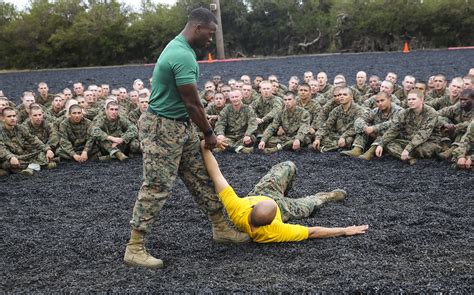
Lance Cpl. Bryan Polonia, class participant and a Stamford, Conn., native, executes a hip throw on Lance Cpl. Zachary Acevedo, class participant and a Chicago native, during Marine Corps Martial Arts Program training aboard Marine Corps Air Station Miramar, California.
The Evolution of MCMAP
Although the program has now been around for almost two decades, the military has actually trained service members in techniques based in various martial arts forms for about 100 years. MCMAP comes from an evolution dating back to the creation of the Marine Corps, beginning with the martial abilities of Marine boarding parties, who often had to rely on bayonet and cutlass techniques.
Before WWI, Marine boarding parties trying to capture enemy ships were armed with bayonets and sabres. However, with the advent of brutal trench warfare, Marines began to use unarmed combat techniques to get the advantage over opponents. During World War I these bayonet techniques were supplemented with unarmed combat techniques, which often proved useful in trench warfare.
After WWI, those techniques were standardized based on boxing, wrestling, savate, and fencing. Between the world wars, Colonel Anthony J. Biddle began the creation of standardized bayonet and close combat techniques based on boxing, wrestling, savate and fencing. Officers who had learned Kung Fu techniques from Chinese American Marines spread their knowledge as well.
In 1956, Gunnery Sergeant Bill Miller developed “Miller’s Combat Curriculum,” a program based in many martial arts styles, including Okinawan karate. In 1956, at Marine Corps Recruit Depot (MCRD) San Diego, Lieutenant Colonel Ralph Hayward (captain of the Judo team at MCRD) made Gunnery Sergeant Bill Miller the new Non-Commissioned Officer in Charge of hand-to-hand combat. Miller was ordered to develop a new curriculum that any Marine could use to quickly kill the enemy. Miller created the program from various martial arts such as Okinawan karate, judo, taekwondo, boxing, and jujutsu. Every Marine recruit that went through MCRD was instructed in Miller's combat curriculum. This also included special operations forces from all branches of the military and civilian entities.
These techniques eventually developed into the LINE System in the early 1980s, which gave way to the Marine Corps Close Combat Training Program in the late 1990s. Eventually these different techniques evolved into the LINE System in the early 1980s. Later, the system was found to be lacking in flexibility and techniques for use in situations that did not require lethal force, such as peacekeeping operations. The Marine Corps began searching for a more effective system. The result was the Marine Corps close combat training program implemented in 1997-1999.