The history of Taekwon-Do begins with the name of one single solitary individual: Choi Hong-Hi. Any fair minded, thinking person that is informed of the actual events as they unfolded can only come to one conclusion after analyzing factual data. Since the bold and brash statement above singles out this person, the telling of the history of Taekwon-Do begins with introducing Choi Hong-Hi, a name that many students of Tae Kwon Do may already know.
General Choi Hong-Hi was born in 1918 in Hwa Dae Ri, Ham Kyung Buk Do, a Province in the northeastern part of Korea near Cheongjin. It is important to note that when General Choi was born, Korea was a unified Nation. However Korea was suffering under a brutal occupation by Imperial Japan. Koreans often refer to this time as the “Dark Period.” When he was born Korea utilized the Lunar calendar. Using the Lunar calendar his birthday was November 9, 1918. However on the Western calendar it was December 22.
Choi Hong-Hi is perhaps the Korean name that not only has wide global recognition, but it can be stated that perhaps no other individual Korean has ever done more to teach the world about Korea, its customs, culture and history. One of the tactics he used to accomplish this was to name the Korean Taekwon-Do Patterns or his Tuls after great Korean Patriots, significant events in Korea’s history or themes/spirit of the Korean people.
In a 1999 interview conducted by Maria Heron of The Times, a U.K. publication General Choi stated:
Q. How did the patterns of TAEKWON-DO come about?“When the Japanese invaded Korea they tried to remove the Korean nationality. You could not go to school and be educated if you were not Japanese. I was left a man with no country and therefore no national pride.”
Read also: Contributions to Wing Chun
“The Patterns of TAEKWON-DO represent the history of Korea from time in legend to this century. The propagation of TAEKWON-DO throughout the world has also enabled, through the patterns, a small part of Korean history to be learned by its practitioners.
As a youngster Choi became involved in a school protest spurred by the maltreatment of Koreans in Kwang Ju, a southern part of Korea. These protests spread throughout the Korean peninsular. As punishment for his independence fervor, he was expelled from school. Choi’s father sought alternative educational opportunities for his son. His father had him learn Calligraphy and the Chinese Classics from a local teacher. Eventually the teacher suggested to the family that Hong-Hi be sent to a well-known Master of Calligraphy named Han Il-Dong.
General Choi had been exposed to stories and some basic Taek Kyon techniques to bolster his health and confidence when he studied Calligraphy as a frail teenager. Ironically his Father sent him to study Calligraphy and the Chinese classics as he was expelled from his local Japanese controlled school for participating in protests as a youngster. This demonstrated early on his stubbornness, strong independence streak, affinity for justice and anti-Japanese sentiment, the latter influenced by his Father’s feelings that they shared.
Eventually Choi Hong-Hi would go to Japan to pursue higher academic education opportunities. While in Japan Choi also trained in Karate. He reports of having earned a II Dan Black Belt. Independent sources confirm he actually taught Karate at a YMCA there. However there is no real solid evidence confirming exact Degrees earned by any of the Kwan founders.During this time Japan was fully engaged in the Second World War. As the War raged on, mounting pressure was applied to Korean males to join the war effort. Already multiple thousands of Korean females, including teenage girls were kidnapped and forced into sexual slavery for the Japanese Imperial Military. Since Japan did not get a sufficient amount of volunteers the pressure was increased and Koreans faced conscription like tactics, compelling Koreans like Choi Hong-Hi into a forced servitude through no volition of his own. After completing the mandatory training he was assigned to Pyongyang Korea. As time passed these Korean student soldiers formed a group that plotted to overthrow the local leadership and join the Korean underground resistance movement. However a traitorous Korean collaborator discovered the plan and the leaders, including Choi, were arrested and convicted. Shortly after the liberation Choi Hong-Hi moved south to Seoul and participated in the fledging democratic anti-communist movement taking hold. Mr. Choi enrolled in the first Republic of (south) Korea’s (ROK) Military Academy and was assigned serial number 44. The class was made up of 110 officer candidates and he successfully graduated this initial class, becoming a founding member of their Army. This opportunity allowed him to fast track his way up the promotional ladder. It also gave him access to many subordinate soldiers that also became his martial art students. As he advanced in military rank, the amount of soldiers he commanded increased accordingly.
As a founding member of the south Korean Army he taught martial arts to the soldiers assigned to him from 1946. As a young 2nd Lieutenant he started to teach his soldiers Karate under the Tang Su Do label.
Read also: Muay Thai Training with Master Toddy
While a 1-Star Brigadier-General in 1953 he was tasked with forming a new division on JeJu Island. Gen. Choi looked to expand the martial arts training to the new division that he was forming. To help accomplish this he recruited Lieutenant Nam Tae-Hi and Sergeant Han Cha-Kyo. Lieutenant Nam was a senior student of the Chung Do Kwan. He was also somewhat a legend for his exploits on the battlefield and his proficiency in deadly hand-to-hand combat skills. Sergeant Han was his junior at the Chung Do Kwan and one of his students. The 29th Infantry Division was nicknamed the “Fist Division” and the Division Flag contained an image of General Choi’s fist superimposed over an image of the Korean peninsular. The martial arts training at the time was pretty much limited to basic karate with some of the beginning modifications and was called Tang Soo Do. After the completion of the recruit’s training the “Fist Division” relocated to the Korean mainland. Hence JeJu Island can be appropriately and accurately referred to as the “Womb of Taekwon-Do.”
In September of 1954 2-Star Major-General Choi arranged for a celebration to commemorate the formation of the 29th Infantry Division that was to coincide with the birthday of Dr. Rhee Seung-Man, PhD, who was the first president of south Korea. The festivities were to include a martial arts performance. Lieutenant Nam broke 13 roof tiles with his fore fist. This evidently impressed Dr. Rhee and prompted him to make inquiry of General Choi as to what part of the hand was utilized. It was reported that Dr. Rhee exclaimed this is Taekyon. General Choi however realized that this was Tang Soo Do, a name that was foreign in nature and lacking the Korean connection that Taekyon had. This provided the motivation to come up with a new name to better describe the Korean Martial Art that they were developing. This training was to be now taught to all the soldiers as per the comments by their President who was the Commander in Chief, Dr. Seung-Man Rhee.
General Choi used his extensive knowledge of Chinese gained through his Calligraphy training, learning the Chinese classics and higher education to conceive the new name of Tae Kwon Do. Once he had the name he realized that for such an important milestone, he needed to have it accepted by others and then seek presidential authorization. What was happening in Korea at the time was a national movement to re-instill Korean pride and reinvigorate Korean culture. In keeping with this movement, Korea needed to have their very own National Martial Art and General Choi’s vision was that Taekwon-Do would become just that. The process for obtaining the all-important presidential approval began with a series of meetings that included elected officials, top military personnel, businessmen, those influential in the media and other leading members of Korean society. When they approved the name Taekwon-Do that General Choi submitted, research would then be conducted before the name was to be sent to Dr. Rhee for presidential approval. The process proved successful when General Choi convinced staff at the Blue House and the president to have the name written in Calligraphy using Chinese HanJa characters. Dr. Rhee eventually fulfilled the request using his own hand and signing the Calligraphy with his penname U-Nam. However the use was limited to the Military and those in the Chung Do Kwan following General Choi.
The soldiers in the military trained through the Oh Do Kwan, which was co-founded by General Choi Hong-Hi and Captain Nam Tae-Hi. They decided upon the name, as its use avoided the controversy of the battling Kwans. Oh Do Kwan translates as gym of my way, or my gym. So the Oh Do Kwan was now your place to train when you served in the military, regardless of any previous Kwan training or lack thereof. The name sent a message that all were welcome. The Oh Do Kwan can be considered the first Taekwon-Do gym. It was in the Oh Do Kwan that some of the first overt changes took hold that would lead Taekwon-Do into becoming a uniquely new Korean Martial Art of Self defense.
These obvious changes were the creation of the first 3 Korean Tuls or Patterns, which some call forms and in Korea used to be called Hyungs. The first 3 patterns devised were Hwa Rang Tul, Chung Moo Tul and Ul Ji Tul. The first 3 Masters of Taekwon-Do, General Choi, Colonel Nam and Sergeant Han collaborated on all 3 Patterns. The Tuls were the brainchild of General Choi. He would go on to design 26 Tuls over his lifetime. He included a final total of 24 in the syllabus that he oversaw the creation of. Hwa Rang Tul had General Choi envisioning movements, sort of like a director, with Captain Nam and Sergeant Han working out the movements, much like actors taking cues from a movie director. Chung Moo Tul had Captain Nam mostly working through the movements with General Choi. Ul Ji had Sergeant Han being the primary assistant helping General Choi or at times Captain Nam. The aforementioned order was also the chronological sequence of development, circa 1955-6. Prior to this the Korean Karate Kwans simply trained using Karate Katas, learned by Koreans in Japan or from Japanese sources.
Read also: The legend of Claria's Martial Master
General Choi had his instructors shout TAE KWON when they saluted during training in order to help cement the new name for the martial art that they were developing. While he insisted on respecting military ranks, during Taekwon-Do training all the soldiers were to respect the higher Black Belt Dans. The training began to spread throughout the Army. Master-Sergeant Kim Bok-Man was one of the instructors that would travel to different units to teach. Captain Nam would put some of his focus on training new instructors. Many of the early instructors were members of the highly influential Chung Do Kwan. The Chung Do Kwan was a civilian gym that was founded by Grandmaster Lee Won-Kuk. It opened as the Chung Do Hwe in Seoul towards the end of the occupation on September 15, 1944. This was several months after the Song Moo Kwan opened on March 11, 1944 in Kaesong. Neither school was able to stay open continuously. Over the next several years 3 other schools opened, the Moo Duk Kwan, Jido Kwan and Chang Moo Kwan. The last two opened initially under different original names and their founders disappeared during the Korean Civil War.
Connection to the political power structure in Korea has seemed to help Taekwon-Do from its inception. At the same time opposition to the political powers to be, caused much heartache for those that were not in sync with the totalitarian regimes that were in place. For example Gen. Choi was a member of the ruling Liberal Party in Korea during the authoritarian rule of Dr. Rhee. So he enjoyed the trappings of power early on. However Grandmaster Lee, founder of the Chung Do Kwan suffered terribly during this heavy-handed rule. There were rumors of him being a Japanese sympathizer as he was actually granted permission to open his Korean Karate School during the occupation period. Grandmaster Lee claimed that he simply refrained from allowing the Ruling Party to use his students for their political means. In any event Grandmaster Lee claimed he was beaten, along with some of his students, arrested and jailed. U-Nam, the pen name of Dr. Rhee was a name Gen. Choi utilized for one of his early patterns to help garner favor of the president in hopes of securing continued support for his Taekwon-Do. Sam-Il Tul, which denoted the numbers 3 and 1 that is a common designation for March 1st, the Korean Independence Day, was another early pattern in place by 1959.
Gen. Choi used his power and influence to build up a strong base and foundation for his Korean Taekwon-Do. Because of his position he was picked as the Honorary Director of the Chung Do Kwan after their founder (GM Lee) fled to Japan in 1950. As an active military General it was impossible for Choi to serve in any other capacity but an honorary one. However this did not prevent him from becoming a real driving force by operating behind the scenes. General Choi became “sworn brothers” with the second Kwan Jang or head instructor of the Chung Do Kwan, Master Son Duk-Sung. They formed an alliance that would see the Oh Do Kwan and Chung Do Kwan lead the fledging Taekwon-Do movement. It needs to be noted at this time, only these 2 groups were both training under the Taekwon-Do label and leading the development under Gen. Choi’s leadership. The other Kwans on the civilian side were operating under the Tang Soo Do, Kong Soo Do, Kwan Bup and Hwa Soo Do names.
In 1957 Gen. Choi and Grandmaster Son formed a short-lived Taekwon-Do Association of Korea. Gen. Choi served as the Vice President while Grandmaster Son was the Secretary General. The president of the Association was a non-martial artist and politician named Lee Jae-Hahk. As Gen. Choi exerted more influence in the Chung Do Kwan his relationship with Grandmaster Son soured. It was General Choi who led the first ever Taekwon-Do Demonstration Team in March of 1959 to Vietnam and Taiwan. Accounts have Grandmaster Son upset that he was not included on this historic trip or as he stated wasn’t consulted in selecting the members. However General Choi was the ranking officer that commanded this military initiative and it was not open to civilians. Students of the Chung Do Kwan that were loyal to General Choi obtained new authorization Grandmaster Lee Won-Kuk naming Uhm Woon-Gyu, a former Sergeant in the military as the new Kwan Jang in early June 1959. About a week or so later, Grandmaster Son published a statement in a Korean periodical called Seoul Shinmoon, a Seoul newspaper, attempting to revoke an honorary certificate previously awarded to General Choi and expelling 3 key members of the Chung Do Kwan, Colonel Nam Tae-Hi Master Hyun Jong-Myun and Sergeant Uhm Woon-Gyu, who was by that time already in place as the new Kwan Jang. So in essence the declaration by Grandmaster Son had no effect as he had already been deposed. These 3 figures would go onto play pivotal roles in the continuing development of the 2 major styles or systems of Tae Kwon Do. It was Grandmaster Son only a short few years later would leave Korea and no longer play a prominent role in the development of Taekwon-Do in Korea, its birthplace. This was symbolic of the tensions and divisions within the growth period of Taekwon-Do.
On September 3, 1959 some of the tensions were eased when General Choi formed the first Korea Taekwon-Do Association (KTA). General Choi represented the Oh Do Kwan and Chung Do Kwan and became the first President.
He named Taekwon-Do and promoted it endlessly as the Korean Martial Art of Self Defense. General Choi would devise 26 Patterns or Tuls. These were the first Korean forms ever created.
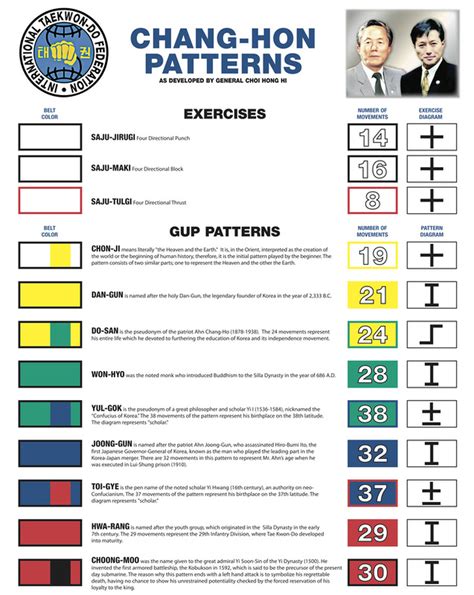
ITF Taekwon-Do patterns
That same year he established and became the first Director of the Martial Art Department in the Army. A couple of months later he authored the first book ever on Taekwon-Do, written in both Korean HanGul and Chinese HanJa. This book documented the first five Korean Patterns he created along with the assistance of the soldiers under his command. (Hwa-Rang, Chung-Mu, Ul-Ji, U-Nam and Sam-Il).
General Choi would go on to author several other books, including the 1972 textbook that became known as the “bible of Taekwon-Do”, the unprecedented 15 Volume Encyclopedia of Taekwon-Do in 1983, several condensed versions of that work, his 3 Volume Set of Memoirs, as well as a Guidebook on Moral Culture. His written texts have been translated into Korean, Chinese, English, German, Spanish, Russian, Japanese and Dari (Farsi or Afghan Persian).
In 1962 he personally introduced Taekwon-Do to Malaysia when he was assigned there as the first Korean Ambassador. While still Ambassador to Malaysia he flew to Vietnam in 1964 to introduce his new Tuls to the Korean Military Instructors there for further dissemination. He also sent the manuscripts back to Korea where they were instituted there as well.
After completing his diplomatic assignment he returned to Korea and in January of 1965 was elected the 3rd President of the Korean TAE SOO DO Association. He was successful in getting them to change the name to Tae Kwon Do by August of 1965, by a reported 1-vote margin. He then led as Ambassador-At-Large a Korean Government sponsored Kukki Taekwon-Do Goodwill Tour around the world later in the fall of 1965. On that global tour he also distributed his English book on Taekwon-Do: The Korean Art of Self Defense.
In 1965 he led a Korean government sponsored Kukki Taekwon-Do Goodwill tour around the world. The tour formed the base in 1966 for creating International Taekwon-Do Federation (ITF), the world’s first global governing body for Taekwon-Do. This marked the first time ever that Korea was home to any international organization. The ITF would grow to have millions of members in well over a hundred countries and he would preside over 17 of their World Championships during his lifetime.
Ambassador Choi moved the ITF Headquarters to Toronto Canada, a city that is a very diverse major metropolitan area in North America. This new location afforded him a geographically advantaged position half way between Asia and Europe, as well as due north from South America and the Caribbean. Strategically this would help to further the internationalization of Taekwon-Do as a global martial art. In 1985 he again relocated the ITF Headquarters to Vienna Austria. Vienna is located in Central Europe and Austria maintains a long-standing neutral posture that allows equal access politically. This was especially important during the “Cold War” era and the days of the “Iron Curtain” divide of Europe and the global political polarization that resulted from competing political ideologies. This brilliant move helped Ambassador Choi to further his dream of spreading his Taekwon-Do all around the world, without regard for political ideology, national boundaries, race, religion or creed.
General Choi traveled the world tirelessly to teach and promote the original Taekwon-Do.
Today there are numerous national headquarters, national and allied associations of the ITF all around the planet.
General Choi died of cancer on 15 June 2002 in Pyongyang, North Korea.
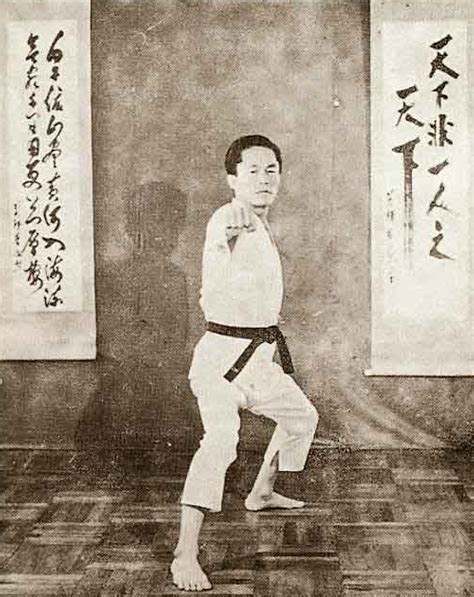
Grave of Choi Hong Hi
Timeline of Key Events in General Choi's Taekwon-Do Journey
Here's a timeline highlighting some of the key events in General Choi's journey to establish and promote Taekwon-Do:
| Year | Event |
|---|---|
| 1946 | Began teaching Korean Martial Arts under the Tang Su Do label to soldiers. |
| 1954 | Obtained official authorization for the Taekwon-Do name from the 1st ROK President Dr. Rhee Syngman. |
| 1955-56 | Created the first two Korean Tuls or forms, Hwa Rang Tul & Chung Mu Tul. |
| 1959 | Led the Military Taekwon-Do Demonstration Team to Vietnam & Taiwan, the 1st time Taekwon-Do was exhibited abroad. Formed the Korea Taekwon-Do Association & was elected 1st President. Wrote the 1st book ever on Taekwon-Do. Established and became the 1st Director of the Martial Art Department in the Army. |
| 1962 | Personally introduced Taekwon-Do to Malaysia when assigned there as the 1st Korean Ambassador. |
| 1966 | Formed the International Taekwon-Do Federation (ITF) in Seoul, Korea with the consent of 9 Nations around the world. |
| 1972 | Wrote a Textbook that was commonly referred to as the “bible of Taekwon-Do”. |
| 1983 | Completed the 15 Volume Set of Encyclopedia of Taekwon-Do. |