Mike Tyson, born Michael Gerard Tyson on June 30, 1966, in Brooklyn, New York, is a retired professional boxer who became the youngest heavyweight champion of the world in 1986 at the age of 20. His life has been marked by both incredible achievements and significant controversies, including a stint in prison.
Tyson's journey from a troubled youth to a boxing legend and, later, a more introspective figure, is a compelling narrative of transformation and resilience.
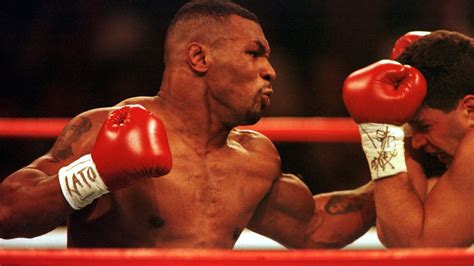
Early Life and the Streets
When Michael was 2 years old, his father abandoned the family, leaving Lorna to care for Michael and his two siblings, Rodney and Denise. Struggling financially, the Tyson family moved to Brownsville, a Brooklyn neighborhood known for its high crime. Small and shy, Tyson was often the target of bullying. To combat this, he began developing his own style of street fighting, which ultimately transitioned into criminal activity.
His gang, known as the Jolly Stompers, assigned him to clean out cash registers while older members held victims at gunpoint. He was only 11 years old at the time. Tyson frequently ran into trouble with police over his petty criminal activities, and by age 13, he had been arrested more than 30 times.
His bad behavior landed him in the Tryon School for Boys, a reform school in upstate New York. At Tryon, Tyson met counselor Bob Stewart, who had been an amateur boxing champion. Tyson wanted Stewart to teach him how to use his fists. Stewart reluctantly agreed, on the condition that Tyson would stay out of trouble and work harder in school. Previously classified as learning disabled, Tyson managed to raise his reading abilities to the seventh-grade level in a matter of months. He also became determined to learn everything he could about boxing, often slipping out of bed after curfew to practice punches in the dark.
Read also: Mike Tyson vs. Brock Lesnar?
The Rise of "Iron Mike"
In 1980, Bob Stewart felt he had taught Tyson all he knew. He introduced the aspiring boxer to legendary boxing manager Constantine “Cus” D’Amato, who had a gym in Catskill, New York. The relationship between D’Amato and Tyson was more than that of a professional trainer and a boxer-it was one akin to father and son.
D’Amato took Tyson under his wing, and when the 14-year-old was paroled from Tryon in September 1980, he entered into D’Amato’s full-time custody. D’Amato set a rigorous training schedule for the young athlete, sending him to Catskill High School during the day and training in the ring every evening. D’Amato also entered Tyson in amateur boxing matches and “smokers,” non-sanctioned fights, to teach the teen how to deal with older opponents.
On March 6, 1985, Tyson made his professional boxing debut in Albany, New York, against Hector Mercedes. The 18-year-old knocked Mercedes out in one round. Tyson’s strength, quick fists, and notable defensive abilities intimidated his opponents, who were often afraid to hit the fighter. This gave Tyson the uncanny ability to level his opponents in only one round, and earned him the nickname “Iron Mike.”
By 1986, Tyson had garnered a 22-0 record, winning 21 of the fights by knockout. November 22, 1986, was a particular auspicious day. Tyson faced Trevor Berbick in his first title fight for the World Boxing Council heavyweight championship. Tyson won the title by a knockout in the second round. At the age of 20 years and 4 months, he broke Floyd Patterson’s record to become the youngest heavyweight champion in history.
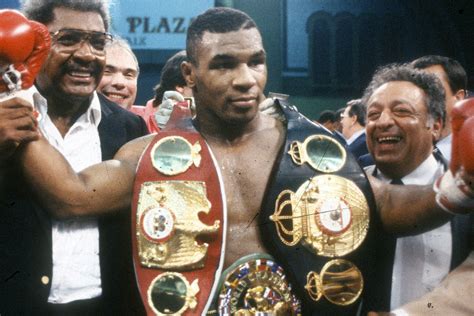
Tyson's success in the ring didn’t stop there. He defended his title against James Smith on March 7, 1987, adding the World Boxing Association championship to his list of victories. On August 1, he became the first heavyweight to own all three major boxing belts when he seized the International Boxing Federation title from Tony Tucker.
Read also: Mike Tyson vs. Jake Paul
The Downfall and Prison Sentence
But Tyson’s game seemed to be on the decline. Once known for his complicated offensive and defensive moves, the boxer seemed to continually rely on his one-punch knockout move to finish his bouts. He blamed his trainer for his struggles in the ring and fired Rooney in mid-1988. Tyson defended his title twice more before his winning streak came to an end on February 11, 1990, when he lost his championship belt to Buster Douglas in Tokyo. Tyson, the clear favorite, sent Douglas to the mat in the eighth round, but Douglas came back in the 10th, knocking Tyson out for the first time in his career.
After several successful fights, Tyson came head-to-head with his next big challenger: Evander Holyfield. On November 9, 1996, Tyson faced Holyfield for the heavyweight title. The evening didn’t end successfully for Tyson, who lost to Holyfield by a knockout in the 11th round. Instead of Tyson’s anticipated victory, Holyfield made history by becoming the second person to win a heavyweight championship belt three times. Tyson claimed he was the victim of multiple illegal head butts by Holyfield and vowed to avenge his loss.
Tyson trained heavily for a rematch with Holyfield, and on June 28, 1997, the two boxers faced off again. The fight was televised on pay-per-view and entered nearly 2 million households, setting a record at the time for the highest number of paid television viewers. But the match took an unexpected turn in the third round. Tyson shocked fans and boxing officials when he grabbed Holyfield and bit both of the boxer’s ears, completely severing a piece of Holyfield’s right ear. Tyson claimed that the action was retaliation for Holyfield’s illegal head butts from their previous match. Judges didn’t agree with Tyson’s reasoning, however, and disqualified the boxer from the fight.
On July 9, 1997, the Nevada State Athletic Commission revoked Tyson’s boxing license in a unanimous vote and fined the boxer $3 million for biting Holyfield.
For many years, Mike Tyson was known as the most feared man in boxing. Even though Tyson was infamous for his flamboyant style and powerful knockout punches, he was also notorious for being extremely violent and short-tempered.
Read also: The Legend of Iron Mike
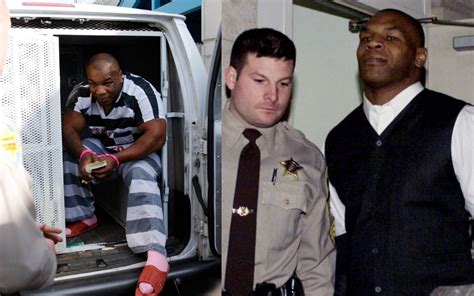
In 1992, Tyson was sentenced to prison. While locked up, Tyson lived a wild lifestyle that was almost comparable to his life outside of prison.
Indiana's embattled prisons have been marked by violence and seethe with racial unrest. Inmates believe Tyson's high profile will make him a threat to gang leaders. At the Indiana Youth Center - a facility that houses both lifers and short-term offenders for which Tyson likely would be eligible - three black inmates raped a young white inmate last week.
"Indiana's prison system stinks," says Richard Waples, who heads the Indiana Civil Liberties Union. "We fairly regularly are forced to bring these administrators back to court for violations of court orders.
Despite the challenges, Tyson found a way to navigate the complex social dynamics of prison life.
Finding Peace Behind Bars
Notable PeopleMike Tyson was known for being very violent throughout much of his career, but the former heavyweight champion ended up becoming a peacemaker when he was sentenced to prison in 1992. “I just convinced everybody that we’re all brothers, we’re here together, we’re doing this time and no one cares,” Tyson said.
Later in the interview, Tyson admitted that he understood many of the men in the racist Aryan Brotherhood prison gang because he knew that their hate was fueled by pain. “I’m one of those guys,” Tyson said. “I never experienced love, my love was hurting people.
Even though he enjoyed his time away, Tyson struggled to reintegrate with society after his release from prison. “I really didn’t know what I was doing when I came out of prison … I had so much f-king venom in me, I wanted revenge.
Life After Prison
In October 1998, Tyson’s Nevada boxing license was reinstated and he returned to the ring the next year. Tyson only fought three more times. After losing to Danny Williams via knockout in July 2004, he faced Kevin McBride just under a year later. Tyson immediately announced his retirement. “I don’t have the stomach for this anymore,” he said. “I felt like I was 120 years old.”
In June 2011, Tyson was inducted into the International Boxing Hall of Fame. He began a stint as a boxing promoter in 2013 after forming Iron Mike Productions.
The former heavyweight champion is briefly stepping out of retirement for an eight-round sanctioned match against Jake Paul. The bout, which will stream live on Netflix, was originally scheduled for July 20, 2024, but later postponed to November 15 due to an ulcer flare-up Tyson experienced.
In his prime, the 5-foot-10 Tyson generally competed at just under 220 pounds. His day-to-day weight became much higher after retirement. He revealed in November 2020 he had lost around 100 pounds, thanks to a new vegan diet and a lot of time on a treadmill, ahead of an exhibition fight against Roy Jones Jr.
Mike Tyson's Boxing Record
| Total fights | Wins | Losses | Wins by knockout |
|---|---|---|---|
| 58 | 50 | 6 | 44 |
According to Forbes, Tyson competed in 58 fights during his professional career. His official record is 50 wins and six losses, with two no-contests. Of his victories, 44 were via knockout. Tyson won his first 37 bouts before his memorable first loss to Buster Douglas in February 1990.
Tyson is currently married to his third wife, Lakiha “Kiki” Spicer. The couple wed in 2009. They have two children together: a daughter named Milan, born in 2008, and a son named Morocco, born in 2011.
Altogether, Tyson is a father to seven children, including three daughters, three sons, and a nonbinary child. His firstborn, a daughter named Mikey, arrived in 1990. Tyson had Mikey with Kimberly Scarborough. The boxer and his second wife, Monica Turner, welcomed Rayna, who is nonbinary, and Amir, their son, in 1996 and 1997, respectively. Next, Tyson had a son named Miguel in 2002 and a daughter named Exodus in 2005 with his former girlfriend Sol Xochitl. Milan and Morocco round out Tyson’s brood.
In March 2009, 4-year-old Exodus tragically died after accidentally strangling herself on a treadmill cord at her mother’s home in Phoenix. Tyson spoke about the incident later that year in a TV interview with Oprah Winfrey. “My first instinct was a lot of rage, and I am so happy I had the tools in life [from attending rehab] not to go in that direction,” he said. “There was no animosity. There was no anger towards anybody. I don’t know how she died, and I don’t want to know.”
Tyson partied hard and stepped out with various Hollywood stars early in his career. In the 1980s, Tyson set his sights on actor Robin Givens. The couple began dating, and on February 7, 1988, they got married in New York.
However, allegations of spousal abuse began to surface in the media in June 1988, and Givens and her mother demanded access to Tyson’s money for a down payment on a $3 million home in New Jersey. That same year, police were called to Tyson’s home after he began throwing furniture out of a window and forced Givens and her mother to leave the home.
Tyson’s behavior during this time became increasingly violent and erratic.