Jon Jones, one of MMA’s best fighters, has captured the fascination of the sport en route to stealing the throne. Today we’re going to analyze how he did it. He is known for seamlessly blending wrestling and Brazilian Jiu-Jitsu, showcasing exceptional grappling skills.
One of the most overlooked philosophers of the 20th century is judo’s founder, Jigoro Kano. After codifying his martial art, he took the time to publish the thoughts, principles, and philosophies that birthed judo. Most notably is guiding light of the art, “seiryoku zenyo”, or, maximum efficiency. This simple maxim moved judo away from other fighting systems that asked for acrobatic jumps, spinning kicks, and other, energy intensive means of disarming opponents.
Maximum efficiency is the first principle of judo. It is the foundation of the sport’s techniques. That doesn’t mean it’s easy to achieve against resisting opponents. The way we learn to achieve maximum efficiency is through what Kano called the most important part of training, developing a quick, freely moving body. This is broadly known as tai-sabaki, roughly translated as whole body movement, or repositioning. I’m not sure if I’ve ever seen an athlete use repositioning to achieve maximum efficiency through high amplitude grappling better than the man headlining this week’s UFC fight. The former light heavyweight kingpin Jon Jones.
The point of this series is to dig into the performances and training of the absolute best fighters in the world and look for exploitable habits. The choice to not use the word “flaws” there was very deliberate. Looking for flaws in UFC champions is often a thankless task, habits are where the money can be made. There aren’t too many doofuses out there tripping over their own feet or throwing their chin up in the air every time they punch but winning UFC titles in spite of it. Yet for all the talk of being formless and shapeless like water, the fighter without habits does not yet exist.
The pillar of stability throughout this time has been Jon Jones-as reliable in the cage as he is disaster prone outside of it. He has been the champ, not the champ, and the sort-of-champ in that time, but he has never lost and it has not even looked close.
Read also: Aspinall-Jones Dream Matchup
Because of the existing material we have produced on Jones, I want to take this opportunity to consider him specifically in the light of his only two rematches. In his four bouts with Daniel Cormier and Alexander Gustafsson we saw Jones genuinely tested through very different tactics and fighter types. While those will be the focus of today’s analysis, it is probably worth beginning with a recap of Jones’ usual style.
The Staples of Jon Jones' Fighting Style
Jon 'Bones' Jones | 5 Techniques Done Effectively | Hacking MMA
One of the main tenets has been that if you don’t know where to start, work on taking away the fighter’s A game. Take away a fighter’s absolute favourite thing to do and you make him fight a less practised, less comfortable game. That is a solid foundation from which to start.
When Jon Jones burst onto the UFC scene he was a blur of spinning techniques, fancy trips, and punishing ground and pound. He won the UFC title while still mostly throwing anything he wanted out there and seeing what stuck. Once he held the UFC light heavyweight strap though, Jones quickly matured into a more methodical, tactical fighter and took on many of the looks we associate him with today. The difference between what we might call “Rising Superstar Jon” and “Championship Jones” was that the former seemed largely concerned with seeing what he could get away with in the course of winning, while the latter builds his performances around never even allowing his opponent into the fight.
Even now, after a decade of dominance and with his hairline retreating to the back side of his head at a rate of knots, Jones relies on the same few staples to undo opponents of markedly different builds, styles and abilities. At his core Jones is an attrition fighter who sets himself up to keep fighting for the full five rounds, then drives up the pace when he sees his opponent is flagging. For the most part he does this with his distance kicking game.
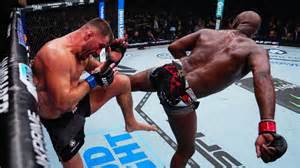
Jones always relied on his kicks, and particularly his low round kicks, but Jones’ fights against Quinton ‘Rampage’ Jackson and Vitor Belfort introduced much of the MMA world to the low line side kick and oblique kick. Jones’ kicking doesn’t work in isolation though, it is his management of distance that makes all the difference. Whether it is cautiously drifting around the cage or breaking into a sprint to get away from the fence, Jones knows where he needs to be at all times and even if his hands are the least impressive facet of his game, Jones demonstrates mastery of all the elements of the sweet science of boxing that aren’t just throwing hands.
For the most part the low line side kick and the low line oblique kick is a jamming weapon. That is why it made such easy work of Belfort and Jackson. Jackson’s plan was always going to be to plod into punching range and start swinging. Belfort’s style is largely based around blitzing in on a straight line. Neither can do that without putting their lead leg into range first and then, as Bruce Lee said in that one episode of Longstreet-longest weapon, nearest target.
No tactic is unstoppable though and there are now a number of ways to defuse the straight kicking on show in MMA. One of the smarter ones was T.J. Dillashaw’s stance switch before entering. After Assuncao started jamming him with low line side kicks Dillashaw got in the habit of showing one leg as the leg to be jammed and quickly switching before he entered with strikes. Dillashaw also did well faking an entry and then physically reaching down to parry and slide down the side of the low line side kick.
Thinking outside the box, Robert Whittaker surprised many of us by answering Yoel Romero’s side kicks with leaping, rear footed front kicks. In the course of that fight Whittaker threw more front kicks than almost all his other strikes combined and it looked bizarre, though it proved to be an in-the-moment adjustment to Romero injuring Whittaker’s knee on the very first kick. The thinking has always been that taking a straight kick in the standing leg while kicking could be disastrous, but by throwing himself bodily into the front kick from then on, Whittaker was able to drive Romero’s weight back any time the two came together-paradoxically protecting his standing leg by leaping into Romero on one foot.
The truth of the low line kicking game is that the opponent’s kick is only effective within a very small space in the cage. They need to find your lead leg and if your lead leg is a little less predictable, they run the risk of getting on one leg and locking themselves on the spot for nothing.
Read also: Edinboro Wrestling Legend: Tony Robie's Story
The other area where Jones really excels is in the clinch. Jones is one of the most creative and smothering clinch fighters in MMA history. He basically invented the spinning elbow in an MMA context. Guys occasionally tried to time it as a counter out in the open, as is the most common application in Muay Thai, but it was Jones who realized that by posting his head and freeing his hands with the opponents back to the fence, he could spin for elbows with a static target and no repercussions. You will see everyone from Alexander Volkanovski to Rafael Lovato attempting this move nowadays.
That head post is incredibly important because it allows Jones to stand his opponent bolt upright while he can move his hips back and create power on both punches and knees with his whole body. While Jones’ hands look sloppy and wide on the outside, his infighting has been magnificent. Notice that by posting his head on his opponent Jones can drive them into the fence and flatten them out, while maintaining a stance from which he can hit with power. Again, posting his head beneath his opponent’s he digs body shots like a boxer from the 1940s, but turns over elbows to the head as well-then folds down behind them to defend himself from returns. It is absolutely beautiful stuff and it shocked many that he was so comfortable doing it against the powerful slugger, Glover Teixeira.
But that’s the beauty of it, by driving the opponent into the fence and posting his head he has pushed them up out of their stance, removing much of their power. And that is the point of the classical infighting “inside position”: there aren’t many men who can hit hard directly in front of their own head and chest-where the infighter’s head is posted.
Once Jones had tasted Daniel Cormier’s bus driver uppercut in the early rounds of their first fight, he committed to shutting Cormier’s right hand down in the clinches. This is where Jones’ ability to lean on opponents is quite wonderful. Not leaning in the way that “Andrei Arlovski going to a decision” sense, but being able to get his hips away from his opponent and put his weight on them even when using overhooks to control them.
When Jones isn’t posting his head to create distance to strike effectively in the clinch, he will go to a shoulder butt to his opponent’s face. Sometimes he will even jump when doing this, like Fireman Jim Flynn headbutting Jack Johnson. Jones leaves the floor to slam his shoulder into Anthony Smith.
That’s the Jon Jones set list. You can rely on him to play those hits when he gets in the cage and while there is more to him, when he goes past these it is pretty much his own choice. Most of the opponents he meets cannot cope with him at range or in the clinch. Yet two of Jones’ opponents did an excellent job of complicating his A game. You didn’t miss some kind of Anderson Silva type implosion, he still won, and that brings us onto our focus today: Jones’ toughest opponents and his adaptations in the only two rematches on his record.
Alexander Gustafsson: A Formidable Challenge
Gustafsson’s chances weren’t highly rated coming into the first fight, and you might subscribe to the idea of Jones partying his camp away and not taking Gustafsson seriously. None of that actually matters to the specific ways that Gustafsson troubled Jones. Gustafsson’s performance was built around lateral movement and being difficult to read.
Watch through the first round of Gustafsson vs Jones 1 and you will see almost no effective low line straight kicks because Gustafsson is so laterally mobile. Kicking the lead leg is easy when you know it is stepping in straight in front of you, it is much more difficult when you’re busy trying to follow someone who is skipping sideways around the cage with their feet almost level. Not only did Jones throw his low line kicks less frequently, he often mistimed them because of Gustafsson’s constant movement and feinting. Many times this meant that he would step on Gustafsson’s thigh but be unable to extend into the kick and Gustafsson would push right through into his boxing.
As we have already said, low line kicks aren’t a straight line of unstoppable power extending from the fighter’s hip, they have a small area of actual effectiveness and if you connect too close or too far away the kick isn’t going to have the desired jarring / jamming effect.
Mistiming a low line kick actually saw Jones suffer the first takedown of his career. If a man who can comfortably prevent Daniel Cormier from taking him down through two fights is being taken down by a Swedish boxer with no wrestling credentials, you know that getting out of position on a kick really makes a difference. Gustafsson also ruthlessly exploited Jones’ tendency to reach for his opponent and to try to frame off their face.
Jones’ adaptations in the rematch were remarkable because he made Gustafsson look completely unthreatening, while still displaying all the loopy punches and awkward reaches that he showed in the first fight. The difference was that this time, Jones didn’t take the centre of the cage and he forced Gustafsson to pursue him. And where Jones had his successes in the first fight out of orthodox stance (spinning for a back elbow against a slipping Gustafsson, throwing a switch high kick at the same opening), he fought the rematch almost entirely southpaw.
As a southpaw, Jones was able to check Gustafsson’s lead hand and deny the jab. Each time Gustafsson tried to advance and slide down the outside of Jones’ lead foot to line up the right straight, Jones simply retreated and circled out to his left. This spiralling out-retreating and breaking the line of attack at the same time-is a constant in Henry Cejudo’s recent fights against southpaws, but was also on show in the Valentina Shevchenko vs Jessica Eye massacre. Each time Eye moved to close the distance, Shevchenko broke the line of attack and turned her. As Eye advances, Shevchenko gives ground and circles towards her own left. As Eye turns to face her she can score body kicks into the open side, where only Eye’s forearm protects her. After every turn, a gut munching kick came up to wind Eye or pin her right elbow to her side. This circle-and-kick was much of Jones’ performance in his second fight against Gustafsson, and it hampered Gustafsson’s ability to throw his right hand comfortably.
There were even instances where Gustafsson switched stances on Jones and Jones would switch stances just to maintain that open guard match up and circle out. The beauty of Jones’ performance was that Gustafsson could not cut angles on him and follow him at the same time. In their first meeting Gustafsson was floating around Jones, who slowly pursued from the centre of the cage. Jones had to put a lead on Gustafsson and try to time him circling with back kicks.
In the rematch, Jones forced Gustafsson to be the pursuer instead and, in doing so, could predict where Gustafsson would be far more accurately. Reviewing that fight you will notice that while Jones deliberately didn’t lean as heavily on his famous low line straight kicks, he was able to connect them successfully after drawing Gustafsson into following him.
Also worth noting was Jones’ constant threat of a takedown as Gustafsson moved towards him. By ducking in on Gutafsson’s hips just as Gustafsson was stepping in, Jones could both put the fear of a reactive takedown into the Swede, and smother any combination work.
Jon Jones' Versatile Martial Arts Repertoire
Jon Jones, a formidable mixed martial artist, masters several martial arts disciplines to amplify his prowess in the octagon. We’re looking at a fighter who seamlessly blends wrestling and Brazilian Jiu-Jitsu, showcasing exceptional grappling skills. His striking game is elevated through Muay Thai, known for its powerful clinch work, and boxing which enhances his precision. Additionally, he incorporates the dynamic kicks from taekwondo and the strategic footwork of kickboxing. Complementing this arsenal, judo throws and karate principles enrich his versatility and tactical depth.
We observe how Jones effectively integrates various wrestling styles to create a versatile fighting repertoire. He combines elements from freestyle and Greco-Roman wrestling, adapting them to suit mixed martial arts’ dynamic environment. Jones’ mastery in this discipline is highlighted by his adept use of submission techniques and grappling strategies. In the octagon, Jones employs chokes, joint locks, and positional control, often dictating the pace of the fight. In the clinch position, Jones demonstrates exceptional control and awareness.
In the domain of Muay Thai striking, Jon Jones’ use of elbow and knee strikes is unparalleled. Elbow strikes, executed with precision, allow Jones to inflict significant damage at close range, disrupting his opponents’ rhythm. We observe his ability to integrate defensive strategies that keep him elusive and effective in the octagon.
Jon Jones’ mastery of punching techniques is a demonstration of his deep understanding of boxing fundamentals. We see how his footwork and body mechanics contribute to the force behind each punch. Timing accuracy plays a significant role in his approach, allowing him to land effective strikes at the perfect moment. Jones excels in using angles to enhance his reach and efficiency. By analyzing his movements, we observe how he maximizes impact while maintaining balance.
Having examined Jon Jones’ mastery of punching techniques, we now explore the essential aspect of his defensive maneuvers within boxing fundamentals. Jones effectively maintains a stance that shields critical areas while allowing rapid shifts into counterattacks. Evasive actions, such as slips, ducks, and rolls, are integral to Jones’ defense strategy. To achieve mastery, we must focus on footwork drills that enhance agility and precision.
Kickboxing, with its rich history rooted in combining techniques from karate and Muay Thai, offers fighters a broad array of striking combinations. His ability to integrate these techniques into his fighting style creates a dynamic offense that confounds opponents. Karate philosophy emphasizes balance, precision, and fluid motion, which are evident in Jones’ strategic approach.
We can incorporate mental training into our martial arts practice by using visualization techniques to anticipate challenges and build mental resilience. We focus on Jon Jones’ daily training routine, which emphasizes conditioning exercises and skill drills. We focus on injury prevention through tailored exercises and proper nutrition. When injuries occur, recovery techniques like physical therapy, massage, and rest are essential. When it comes to Jon Jones’ diet strategies, we walk a tightrope to balance nutrition plans that fuel his martial arts prowess. We balance strength conditioning and technique refinement by integrating them into a cohesive routine.
In our exploration of Jon Jones’ martial arts repertoire, we find a fascinating juxtaposition of disciplines. His wrestling roots provide a solid foundation, while Brazilian Jiu-Jitsu adds a nuanced complexity. Muay Thai and boxing offer contrasting striking styles-precision meets power. Kickboxing and Taekwondo bring dynamic kicks into the mix, blending fluidly with Judo’s throws. Meanwhile, Karate’s principles of discipline subtly underpin his approach.
The Dark Side and Redemption
Writing about Jon Jones’s poor behavior and personal life is a sport all its own, these days. Jon knew he was cheating against his opponents. He upended an entire card, forcing every fighter that wasn’t him to make mind boggling accommodations for his inability to pass a drug test.
There is a certain kind of intimacy in combat sports fandom. You see fighters in tears over victories even more than in loss. I care about these athletes and their struggles, so watching their failures brings an empathy. You see the pain of a loss directly in the octagon and it’s always a truly vulnerable moment. Then you see other losses play out in real life, not in the cage but through the press and social media.
I feel bad for the people who are negatively affected by Jones’s bad behavior, not as a fan but as a human who knows what it’s like to be disappointed by someone you believe in. I also know what it’s like to disappoint people who believe in me, and so it’s easy to imagine Jones being trapped in a vicious cycle of his own making.
This isn’t written to try to explain away his behavior or to force any empathy, just to say that he knows the asterisk that will always appear next to his name when anyone talks about his legacy.
Too many times I’ve heard people write off Jones as washed. Whenever Jon Jones has had to fight from underneath low expectations and bad press, he tends to do so in the smartest, most calculated way possible, using his incredible fight IQ to play defense and retain his championship, or closer to this upcoming scenario, use brutal offense to secure a new title. We might see a return to Jones’s hungry days, figuratively speaking, with his move to heavyweight.
The Nasty Edge
The one word you can describe Jon Jones’s fighting style as, is nasty. Jon Jones never misses an opportunity to cause damage. His style relies on using the most damaging strikes at any given moment while advancing position.
Jones has never looked like a clean boxer. Jon’s striking is cultivated for maximum damage. He utilizes elbows over hands, seemingly to protect his hands while slashing his opponent’s face. His entire game is “I hurt you and you can’t hurt me.” Jones will choose to back out of the pocket and fight off of his back foot rather than stand and bang. He protects himself while he is throwing.
Jon Jones will smother his opponent from inside their guard. He throws perfect short elbows from everywhere. will spin with an elbow and if his opponent moves forward, as most fighters will, the elbows will land behind the ear or on the back of the head. He dropped Stephan Bonnar with an elbow like this in his second UFC fight. Elbows like that helped turn the tide against Alexander Gustafsson in their first fight. He will hold his fingers straight out and let his opponents run their faces into them while trying to close range.
It feels silly to type something so obvious, but Jon Jones is a fighter who loves hurting people. Sure, hurting people is something every fighter does, but some fighters look at hurting their opponents as an unfortunate byproduct of being a prize fighter. Jones looks like he relishes the fact that he gets to step into the octagon and harm another living creature. Jon Jones is the Carl’s Junior specialty menu item of harming another human being. Why have one onion ring on your burger when you can have six?
You can see this in full effect when he took the belt from Shogun Rua. Jones would bait a shot from Shogun, and either palm his head or clinch. In his plum clinch, he can keep his hips far back while still throwing knees. The second thing it does is wear out the low back of his opponent. It is astounding how fast that will wear out the back of your opponent, and without a strong back, it’s impossible to keep base.
Once Jon is on top, it’s the same story. The Jon Jones that we saw through his first title run looked unbeatable. After his first suspension and return, he put on some of the best fights I’ve ever seen. His last resurgence left people doubting. Instead of relying on fast, brutal striking to get into the clinch, Jones would hang out in boxing range and try to throw hands.
MMA is a brutal sport, and Jones has been at the top of the heap for over a decade. There is more evidence to support Jon still being in championship shape than would refute it, but we could see a Jones with more miles on him. If he wins, this will be his fourth title reign across two weight classes.