The modern martial art of Tang Soo Do is more than 55 years old. It commenced when Grandmaster Hwang Kee began teaching it in Seoul, Korea in the fall of 1945. The following is a brief history of Tang Soo Do Moo Duk Kwan, compiled from the many writings of the Grandmaster of Tang Soo Do Moo Duk Kwan, Hwang Kee.
Tang Soo Do (also known by the ancient name of Soo Bahk Do) is the name Hwang Kee uses for the original form of weaponless fighting. The Grandmaster wrote, “The history of Tang Soo Do is perpetual. It is difficult to indicate where it was started or who was the first person who originally practiced it.”
In order to understand the full meaning behind Tang Soo Do (Soo Bahk Do), and the Moo Duk Kwan Federations, we will have to look more closely into rich history of East Asia and the region that we today call Korea……
Here is what Grandmaster Kee said about his art: “It is not a sport. Though it is not essentially competitive, it has great combat applications. It is a classical martial art, and its purpose is to develop every aspect of self, in order to create a mature personality who totally integrates his intellect, body, emotions, and spirit. This total integration helps to create a person who is free from inner conflict and who can deal with the outside world in a mature, intelligent, forthright, and virtuous manner.”
Tang Soo Do Moo Duk Kwan means “a brotherhood and school of stopping inner and outer conflict and developing virtue according to the way of the worthy hand.” Some have shortened the definition to “Art of the knife hand.”
Read also: WTSDA: A Historical Overview
The Legacy of Won Kuk Lee | Founder of Tang Soo Do's Roots
Origins and Dynasties
Tang Soo Do was practiced during the Kokuryo Dynasty (37-668 A.D.), the Silla Dynasty (668-935 A.D.), the Koryo Dynasty (935-1392 A.D.) and Yi Dynasty (1392-1907 A.D.) The Japanese occupied Korea from 1907-1945 and did not allow the open practice of Korean martial arts. Tang Soo Do was practiced in private during the Japanese occupation. Hwang Kee introduced a modern version of ancient Tang Soo Do in 1945.
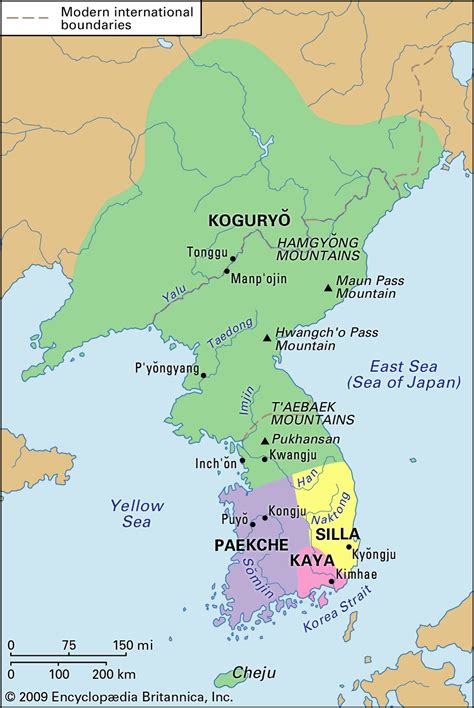
Map of Three Kingdoms of Korea
The Kokuryo Dynasty (37-668 A.D.)
In the first century B.C. Korea was actually three separate kingdoms known as Kokuryo (est. 37 BC) and Paekche (est. 18 BC) in the North and the Silla Dynasty (est. 57 BC) to the south. These are commonly referred to in historical and cultural texts as “the three kingdoms”. Open hand fighting styles were already popular at this time as evidenced by the art and writings of the era. “Bahk” was a fighting style alluded to in a text known as Joa Jun as early as the Chun Chu dynasty some 2700 years ago. In the 2nd century BC, some 500 years later and just prior to the establishment of the three kingdoms, a text known as Han Seo refers to a fighting style known as Soo Bahk. According to this text, Soo Bahk was used extensively during the examination of military officers. The first 6 centuries of Korean history were filled with war and turmoil.
The Silla Dynasty (668-935 A.D.)
The next three centuries were still far from peaceful. Although the period is often referred to as the period of Unified Silla, the peninsula was still divided (more or less) by the North and South - the Palhae and the Silla. The Tang Dynasty (China) even recognized the Palhae as a separate state, so the unification was a tenuous one at best. The Silla Dynasty was renowned for its prowess in the martial arts, and developed a corps of young aristocrats called the “Hwa Rang Dan” which proved to be instrumental to the unification of the Korean Peninsula in the 7th century.
The Koryo Dynasty (935-1392 A.D.)
In the 10th century, the Silla Dynasty was overthrown by the warlord Wang Kon. The new kingdom was called Koryo and it spanned the next 4 centuries. There are many historical and cultural texts available from that era which allude to the popularity of Soo Bahk Ki techniques which are the basis for Tang Soo Do.
The Yi (Choson) Dynasty (1392-1907 A.D.)
1392 marked the beginning of the Yi Dynasty, which lasted until 1907 AD. During this period several important developments occurred. The Moo Yei Do Bo Tong Ji (Military Arts Manual) was written about 1790 AD. This book, now a national Korean treasure, was “the culmination of several earlier publications or scrolls where an original description of six techniques was added to until its final content of 24 techniques was published.” (Tang Soo Do / Soo Bahk Do, by Kwan Jang Nim Hwang Kee, 1978)
Martial art training in the Yi Dynasty varied with the tastes of the current ruling family. Archery was popular during the reign of King Se Jo, for example, while Stick Art was popular during the reign of King Sun Jo. A book called “Hyun Rung Ji” described Sip Pal Ki (18 techniques) for the long spear. Sip Pal Ki later encompassed the arts of horsemanship. Near the end of the Yi Dynasty an open handed fighting technique known as Tae Kyun developed among street fighters. Tae Kyun incorporated many effective kicking techniques.
Japanese Occupation (1907 - 1945)
1907 marked the end of the Yi Dynasty and the beginning of the Japanese occupation which was to last until 1945. During this period all dimensions of Korean traditional cultural expression were prohibited. Much of the Korean culture was supplanted by the occupying forces, and the martial arts were no exception. Near the end of the occupation, the only widely known martial arts were Gum-Do (Kendo) and Yu-Do (Judo).
Kwan Jang Nim Hwang Kee, founder of Tang Soo Do, Moo Duk Kwan, was born November 9, 1914, and died in July, 2002. He began his study of the Tae Kyun at the age of 7. After High school, he studied Chinese Kung Fu under Master Yang in Manchuria, (specifically Seh Bop, the method of postures, Bo Bop, the method of steps, Ryun Bop, the method of conditioning, Dham Toi Sip E Ro and Tae Kuk Kwon - disciplines of form and its combat applications). He was later influenced by Okinawan Karate.
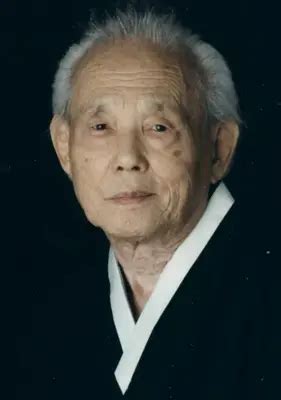
Grandmaster Hwang Kee and students
The Founding of the Moo Duk Kwan
At the end of the Japanese occupation, Kwan Jang Nim Hwang Kee was finally able to dedicate himself to teaching the martial arts, his lifelong dream. On November 9th, 1945, Kwan Jang Nim Hwang Kee established the Moo Duk Kwan Federation.
In the beginning, Kwan Jang Nim named his art “Hwa Soo Do”, art of the flower hand. He had meditated long and hard on this name, as there was no Korean historical documentation or any other visible evidence that would guide him into a proper name at the time. “Hwa Soo Do” referred to the celebration of flowering independence of the newly re-established state of Korea.
Kwan Jang Nim Hwang Kee tried very hard to perpetuate his teaching of Hwa Soo Do, but the general public refused to accept the new art, opting for the more popular Gum Do and Yu Do. One day Kwan Jang Nim Hwang Kee met two gentlemen in Seoul, both prominent martial arts instructors. One was the founder of Yeon Moo Kwan (later changed to Ji Do Kwan), and taught an art known as Kong Soo Do. The other gentleman founded the Choong Do Kwan and called his art Tang Soo Do (An open handed style heavily influenced by Okinawan Karate).
“After he met with these gentlemen, the Kwan Jang Nim meditated and re-evaluated the future of the Moo Duk Kwan.” (History of the Moo Duk Kwan, 1995) It was here where Kwan Jang Nim Hwang Kee discerned that the natural flow of the thoughts of the Korean people were centered on Japanese-influenced martial arts. Although Tang Soo Do was not as popular as Gum Do or Yu Do, it was at least recognizable to the public as a whole. “Kwan Jang Nim Hwang Kee humbly accepted and followed the law of the great nature”, and Tang Soo Do was then integrated into the teaching of the Hwa Soo Do discipline. (History of the Moo Duk Kwan, 1995)
Kwan Jang Nim Hwang Kee accepted his next group of students and taught them Tang Soo Do. Aspects unique to Kwan Jang Nim Hwang Kee’s teachings were integrated, such as the proper use of the hip in all techniques. After years of intensive training, Kwan Jang Nim Hwang Kee produced his first four Dan students. It was here that the Dan Bon system began, and is still in use today after over one-hundred Dan testing’s.
When Kwan Jang Nim later discovered the Moo Yei Do Bo Tong Ji, he had at long last uncovered the true Korean roots of the art. Many federations have begun to call (or revert back to) our art “Soo Bahk Do”, deferring to the rich culture and history it has evolved from. Soo Bahk Do is a traditional Korean martial art whose roots dig deep into the centuries past. Its nature is both hard and soft, offensive and defensive, passive and active.
Although steeped in tradition and the military spirit (Moo Do), Soo Bahk Do is a living art that is not afraid to change, to improve, to explore. Much of our technique is based on a clinical, scientific study of the principles involved and unique only to our style.
Soo Bahk Do is not a sport. It is a classical martial art, and as such has different aspirations than some of the more popular “sport styles”. The object is not for one person to become a champion over a herd of people who could not “make the grade”. “Its purpose is to enrich one’s life by developing every aspect of the self in order to create a mature person who totally integrates his/her intellect, body, emotions, and spirit. This integration helps to create a person who is free from inner conflict and who can deal with the outside world in a mature, intelligent, forthright and virtuous manner.”
These excerpts showcase the History of the founding of Moo Duk Kwan.
Modern Tang Soo Do
Modern Tang Soo Do derives its hardness from Soo Bahk Do and its softness from Chinese Kung Fu. Grandmaster Hwang said his art is 60% Korean (Soo Bahk Do), 30% Northern Chinese Kung Fu and 10% southern Chinese Kung Fu. Hwang Kee also incorporated some of the foot techniques of Tae Kyun in modern Tang Soo Do. Tae Kyun was a style of fighting that developed toward the end of the Yi Dynasty. It employed only foot techniques. Hwang Kee wrote that Tae Kyun was a form of street fighting and lacked mental discipline.
Hwang Kee further expanded his Moo Duk Kwan school of martial arts after in 1957 he was introduced to the Muye Dobo Tongji by a librarian at the Korean National University in Seoul. By 1960, Tang Soo Do was being practiced by almost 75% of all martial artists in Korea, but the art did face challenges particularly in expanding beyond Korea, including attempted mergers into Taekwondo.
Moo Duk Kwan is the name of a martial art organization founded by Hwang Kee in South Korea in 1945. Licensed Moo Duk Kwan schools teach Soo Bahk Do, formerly Tang Soo Do (and earlier 'Hwa Soo Do'). As a child, Hwang Kee witnessed a man using Taekyon to defend himself against a large group. The experience later inspired him to develop his own martial art.[2] Although the Korea Taekkyon Associate disputes Hwang's story, Hwang says that the man refused to teach him, leaving him to devise his own system based on what he had seen. Traveling between Manchuria and Korea during World War II, Hwang later successfully appealed to Chinese martial arts teacher Yang Kuk Jin for training, fusing together Chinese and Korean martial arts into a form he initially called Hwa Soo Do ("the Way of the Flowering Hand"), altering to Tang Soo Do after the November 9, 1945 opening of a training hall proved unsuccessful.
At its core, Tang Soo Do Moo Duk Kwan is essentially a Korean form of Japanese karate. Literally translated, the word “Tang” means the T'ang Dynasty of China, reflecting the shared cultural background between China and Korea (617-907 AD). “Soo” means hand, but it implies fist, punch, strike, defence, etc. “Do” means a way of life or art. Thus Tang Soo Do means " The way of the Chinese Hand".
For a complete history, visit the wiki page.
Timeline of Tang Soo Do Development
Below is a rough timeline of the development of Tang Soo Do and therefore Tae Kwon Do.
| Year | Event |
|---|---|
| 1800s | Okinawan Un-armed combat styles emerge |
| 1891 | Ankō Itosu is born (Okinawan Karate)
|
| 1868 | Gichin Funakoshi is born
|
| 1907 | Won Kuk Lee is born
|
| 1914 | Hwang Kee is born
|
| 1929 | Jae Joon Kim is Born
|
| 1939 | Gichin Funakoshi builds the “Shotokan” Dojo |
| 1940 | Chuck Norris is Born
|
| 1944-1946 | Pre-Korean War
|
| 1947 | Hwang Kee began teaching his new Martial Art, Tang Soo Do Moo Duk Kwan |
| 1953 | Post-Korean War The Second Generation Kwans
|
| 1952 | Hwang Kee forms The " Korean Tang Soo Do Association" |
| 1953 | The 5 Original Kwans formed the Korea Kong Soo Do Association |
| 1954 | General Choi Hong Hi performs a Tang Soo Do demonstration for Rep. History of Tang Soo Do |
The Spread of Tang Soo Do
The Moo Duk Kwan's first contact with Americans was with US Military personnel who served in Korea. The first American to earn a 1st Dan Black Belt in the Moo Duk Kwan was Master Dale Drouillard, Dan # 757. These servicemen then brought Moo Duk Kwan back to the United States. Many of them continued training and sponsored Korean Tang Soo Do Instructors to come to the United States. Michigan and Florida in particular both developed a large Tang Soo Do community that began in the 1960's and 70's and continues to this day. is proud to carry on this tradition.
Core Tenets and Principles
The principles of Tang Soo Do were created to instruct students of martial arts in the way their life and their art should be approached. Do your best to follow these principles.
Ten Articles of Faith:
- Be loyal to one's country.
- Be obedient to one's parents
- Be loving to one's husband or wife
- Be cooperative to your brothers
- Be respectful to elders
- Be faithful to your teacher
- Be faithful to friends
- Face combat only in justice and with honor
- Never retreat in battle
- Always finish what you start
Eight Key Concepts of Moo Duk Kwan
- Yong Gi- Courage
- Chung Shin Tong II- Concentration
- In Neh - Endurance
- Chung Jik - Honesty
- Kyum Son - Humility
- Him Cho Chung - Control of Power
- Shin Chook - Tension and Relaxation
- Wan Gup - Speed Control
Ten Principles of Tang Soo Do
- Every member should always seek truth and practice it.
- Promote the highest moral character through the training of Tang Soo Do.
- Respect and obey your parents, teachers, and seniors.
- Love your country and contribute to your community.
- Develop both great confidence and humility, and practice both inside and outside of class.
- Do your best to promote intellectuality.
- Do not hesitate to sacrifice yourself for justice.
- Do your utmost to develop Tang Soo Do as the most popular martial art in the world.
- Develop your endurance, be calm, and humble in mind.