The World Tang Soo Do Association's history is deeply rooted in the rich tapestry of Korean martial arts, tracing back over 2,000 years. Its story is one of cultural evolution, adaptation, and the dedication of martial artists who sought to preserve its heritage.
The very first evidence of this ancient form of Korean martial arts appeared during the Three Kingdom era (57 BC-935 AD) as Hwa Rang Do. Since then, 2,000 years have passed. The indigenous martial arts quietly developed through generations of the Korean people. During some eras it flourished and other times it diminished, according to the political, economic or cultural environment. The art was known by various names throughout the eras as Hwa Rang Do, Moo Sul, Kyuck Too Ki, Soo Bahk Ki, Soo Byuck Ki, Taek Kyun etc. respectively.
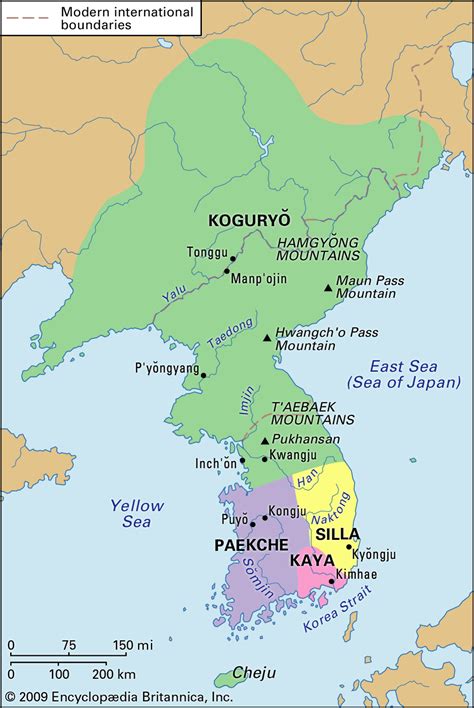
Map of the Three Kingdoms of Korea
Ancient Roots: The Three Kingdoms Period
The more ancient history of Tang Soo Do dates back to the period of the “Three Kingdoms”(57B.C.-935 A.D.). During this time, the Korean peninsula and part of what is now China was divided into three separate kingdoms. These were: Koguryo (37B.C.-668 A.D.),Baek-Je (18 B.C.-660 A.D.),and Silla (57 B.C.-935A.D.). Through out their development each of nation had periods of war and peace with each other and their other Asian neighbor.
During this time in China, the T’ang rose to power and overthrew the Sui Dynasty (589-618 A.D.). The T’ang Dynasty was instrumental in the development of the martial arts in China. Many martial arts theories, rituals, and techniques were developed during this time. It was during this time that early forms of Tae Geuk Kwon (Tai Chi Ch’uan) were being developed, and the monks of the So Rim (Shaolin) temple were beginning to craft their famous fighting systems. Many believe these early fighting systems grew out of exercises brought to China from India by a Buddhist priest called Dal Ma Dai Sa (Bodhidharma).
Read also: The Rise and Fall of WWA
The Silla formed an alliance with T’ang China, and conquered Baek-Je and Koguryo, uniting the Korean peninsula for the first time in 668 A.D. and began the Silla Dynasty (668-935 A.D.). The Hwa Rang warriors of the Silla Dynasty mastered many of the fighting techniques of the T’ang armies, and combined these techniques with the indigenous fighting systems of ancient Korea. These were sometimes referred to as Tang Soo Ki (Tang Hand Techniques). A monk named Won Kwa created a set of ethical precepts derived from Confucian principles, which the Hwa Rang used as a “warrior’s code.
The Evolution Through Dynasties
In 935 A.D., Silla surrendered to the Koryo nation, forming the Koryo Dynasty (935-1392 A.D.). At this time in China, the T’ang fell to the Sung rule in 906 A.D. The Sung Dynasty held tremendous influence over all cultural development in asia, including the martial development in Koryo. The Koreans began to refer to their indigenous fighting systems as Soo Bahk Ki (Hand Striking Techniques), while the Chinese arts were referred to as Kwon Bup (Fist Method).
During the Chosun Dynasty, by order of the Emperor, Lee Duk Moo compiled the first known comprehensive text of Korean martial arts, known as the Moo Ye Dobo Tong Ji (Illustrated Manual of Martial Arts). This is one of the oldest surviving texts documenting ancient Korean martial arts.
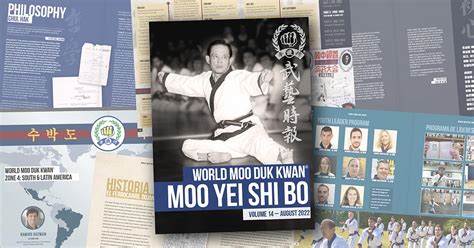
Moo Ye Dobo Tong Ji
Japanese Occupation and the Birth of Kwans
In 1910, the Japanese invaded the Korean peninsula as part of its imperial expansion into Asia. From 1910-1945, the Japanese occupied Korea exerting a tremendous amount of control over virtually all aspects of Korean culture. During the occupation, the practice of Korean martial arts was banned. The Koreans were only allowed to practice Japanese martial arts. Many Koreans traveled to Japan to study Japanese Karate, and brought Karate back to Korea. Karate, means “Empty Hand”, in the modern translation which is a homonym for an older term which meant “China Hand”, is a generic term used to describe the empty hand fighting systems developed in Okinawa based upon fighting techniques of the T’ang Dynasty in China. Japan was later introduced to Karate by Funakoshi Gichen, founder of Shotokan, performed a demonstration before the Japanese Emperor.
Read also: The Story of WBC Muaythai
After the Japanese occupation of Korea (1909 to 1945) restrictions on practicing martial art forms were lifted, and several schools were created. These schools have been called the "kwans" in reference material. In 1945 when Korea was liberated from the Japanese at the end of World War II, several Korean martial arts schools, known as “kwans” began to emerge. In the beginning, there were five kwans: (1) Chung Do Kwan, founded by Lee Won Kuk, (2) Moo Duk Kwan, founded by Hwang Kee, (3) Yeon Moo Kwan (later changed to Ji Do Kwan), founded by Chun Sang Sup, (4) Chang Moo Kwan, founded by Yun Byong In, and (5) Song Moo Kwan, founded by No Byong Jik.
The founder of Moo Duk Kwan, Hwang Kee was born during this era of strict Japanese control, on November 9th, 1914. Hwang was born Hwang Tae Nam, son of Yi Dynasty scholar Hwang Yong Hwan. Hwang’s first exposure to martial arts occurred at the age of seven, when he observed a tavern keeper defend himself against several young ruffians. He overheard several witnesses describing the techniques that the man used as being Tae Kyon. Hwang Kee was so impressed by the performance, that he sought out the tavern keeper and asked him to become his teacher. Hwang was turned away because his young age. Hwang was not easily discouraged and found a vantage point on a hilltop from where he could see into the man’s courtyard and observe his practice. There, Hwang imitated the man’s various movements.
Hwang Kee discovered the Moo Ye Dobo Tong Ji (Illustrated Manual of Martial Arts), in 1957, at the National Library in Seoul, Korea. Based upon references within the text, Hwang began to use the pseudonym Soo Bahk Do (Hand Fighting Way) along with Tang Soo Do to refer to his art.
Tang Soo Do, by Hwang Kee - A book review
The Emergence of Tang Soo Do and Tae Kwon Do
Following 1945 Korean independence, the Korean martial arts were again merged and flourished throughout the entire Korean Peninsula. Many organizations were founded with various names such as Soo Bahk Do, Tang Soo Do, Tae Soo Do and so on. At the beginning of the modern era of the Korean martial arts, Tang Soo Do was the most popular term for these arts, however, at that time, the Korean political leader was concerned about establishing Korean value based on Korean nationalism.
Read also: History of WoS Wrestling
The political leaders recognized the popularity of Korean martial arts around the world, but were opposed to the use of the name Tang Soo Do for the art, as it sounded like a Chinese martial art, because the first word “Tang” could be interpreted as representing the Chinese Tang Dynasty (617-907 AD). The World Tang Soo Do Association still respects the original term, Tang Soo Do, and intends to preserve its heritage and value as a traditional way or path. Unfortunately, many Tae Kwon Do instructors did not maintain the traditional values of the true martial arts.
On April 11, 1955, a conference of several of the kwan leaders and prominent martial artists was held in an effort to unify all of the kwans together under one umbrella organization. They decided to refer to their arts generically and collectively under the name of Tae Kwon Do (Foot Fist Way or Way of the Hand and Foot), a name suggested by General Choi Hong Hi, an influential political and military leader. Hwang Kee did not agree with the decision to consolidate and withdrew from the negotiations early on. Hwang remained autonomous and continued to call his art Tang Soo Do.
Rivalries eventually developed between Tang Soo Do and Tae Kwon Do. Factions within the Tae Kwon Do movement, allegedly supported by the Government, attempted to block the Soo Bahk Do Hoi from operating sucessfully.
The World Tang Soo Do Association: A New Chapter
In 1968 Master Jae Chul Shin came to the United States of America as the U. S. representative for the Korean Tang Soo Do Association. He formed the U. S. Tang Soo Do Federation in Burlington, New Jersey in 1968. This traditional Korean Martial Art was quickly accepted and soon grew in popularity throughout the World. The organization reformed to fit new demands internationally, and on November 13 and 14th, 1982, a charter convention of the World Tang Soo Do Association was held in Philadelphia, PA., USA.
Master Jae Chul Shin, one of Hwang Kee's students, travelled to the United States in 1968 as a representative of the Korean Soo Bahk Do Association. He formed the United States Tang Soo Do Federation which soon expanded across the country and to other countries of the world. In 1982, the organization was restructured to fit the needs domestically and internationally and a charter convention was held for the World Tang Soo Do Association on November 13-14, 1982. The association proclaimed mottos of Traditionalism, Professionalism, and Brotherhood.
The TGTSDA was founded on the principles taught to its leadership by the late Grandmaster Jae Chul Shin. Grandmaster Shin visited and later relocated to the United States from Korea, starting the United States Tang Soo Do Federation in 1968. At that time, he was under the guidance of the Korean Soo Bahk Do Association, but later left that association and started the World Tang Soo Do Association having a charter convention in 1982.
Many martial artists around the world who had interest in the Art rather than sport-orientated drive flocked to the WTSDA. Each individual club will be taught by an Association approved instructor with the minimum rank of Cho Dan (1st) and all students attend a regional testing to progress from one grade to the next.
In January 2012 the Association moved its new headquarters to Burlington, North Carolina fulfilling one of Grandmaster Shins dreams of a purpose built headquarters for the World Tang Soo Do Association. In Great Britain the Association is led by Grandmaster Mujahid Khan who is also the Regional Director for Region 11 (Europe). Students in the Association will learn many aspects of the martial arts, and although Tang Soo Do is a predominantly kicking style, it is very rounded by the fact that included in its syllabus are kicking, blocking, punching, hyungs (patterns), self defence, fighting, weapons (at higher grade). A core part of our association is the etiquette which is taught in every class, the discipline, humility, integrity, respect, self control so often missing from todays society.
| Key Figure | Contribution |
|---|---|
| Hwang Kee | Founder of Moo Duk Kwan, instrumental in preserving and promoting Tang Soo Do. |
| Jae Chul Shin | Established the World Tang Soo Do Association, bringing traditional Tang Soo Do to the global stage. |