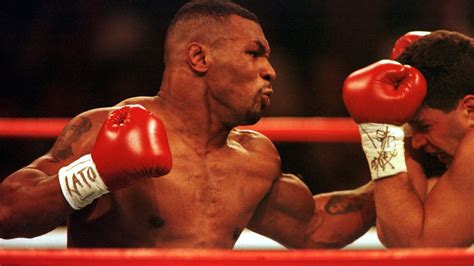
Michael Gerard Tyson, born on June 30, 1966, is an American former professional boxer who competed from 1985 to 2005. Nicknamed "Iron Mike" and "Kid Dynamite" in his early career, and later known as "The Baddest Man on the Planet", Tyson is considered to be one of the greatest heavyweight boxers of all time.
Tyson's story involves incessant drug abuse, visits to prison, theft & deceit, childhood adoption and of course, one of the greatest boxing careers of all time.
Overview
- Birth Name: Michael Gerard Tyson
- Born: June 30, 1966
- Nicknames: "Iron Mike", "Kid Dynamite", "The Baddest Man on the Planet"
- Height: 5'10" (178 cm)
Early Life
Michael Gerard Tyson was born in Brooklyn, New York, in June of 1966. He never knew his biological father, Purcell Tyson - and his stepfather, Jimmy Kirkpatrick, abandoned the family when Tyson was just two years of age.
After his stepfather left, Tyson's mother moved the family to Brownsville, on the eastern side of Brooklyn. Brownsville was renowned for being the murder capital of New York, whilst also boasting the highest rate of incarceration and violent crime of anywhere in New York. It was here that Tyson's life would descend into a murky world of crime and rebellion.
"Everything was so hostile, cops always stopping you, ambulances always coming to pick up somebody, guns always going off, people are getting stabbed," he recalled.
Read also: Mike Tyson vs. Brock Lesnar?
As a timid and pudgy kid with a lisp and glasses, in one of the roughest areas in the country, it was either fight back or fade away. When he was 10, Tyson joined a local gang called the Jolly Stompers. By 11, he'd already been introduced to acid and cocaine. He'd also been arrested more than 30 times before he was even a teenager.
His early years were spent in a high crime neighborhood where bone crushing fights were a common occurrence. Since death was always around the corner and self-defense as necessary as bread and butter, Mike was inducted into the art of fighting at a very early age.
By the time he was 13, he had been arrested 38 times and petty crime became an everyday occurrence in his life. His latent boxing talent came to his aid in street fights and would later emerge as a fundamental aspect of his personality, thereby making him a boxing icon.
During this time he was enrolled at the Tryon School for Boys in Johnstown, New York, where he was discovered by the former boxer Bobby Stewart. Stewart trained him for a few months before introducing him to Cus D'Amato, the man who would launch Tyson into boxing greatness and become his legal guardian.
Amateur Career and the Influence of Cus D'Amato
In 1981, a 12-year-old Tyson was sent to Tyron school for boys in upstate New York. A certain Bobby Stewart was offering boxing lessons to inmates of the juvenile centre - the same Bobby Stewart who fought at light-heavyweight, on the undercard of 'The Rumble in the Jungle' in 1974.
Read also: Mike Tyson vs. Jake Paul
Stewart reached out to legendary boxing manager Cus D'Amato, who had led people like Jose Torres and Floyd Patterson to world titles. D'Amato immediately took Tyson under his wing, eventually adopting him, and moving him into his family home after his mother died. Teddy Atlas and Kevin Rooney were brought in to oversee training, and a young Tyson became infatuated with the sport, watching old boxing videos religiously, learning the tricks of the trade from legends of a bygone era.
As an amateur, Tyson won gold medals at the 1981 and 1982 Junior Olympic Games, defeating Joe Cortez in 1981 and beating Kelton Brown in 1982. Brown's corner threw in the towel in the first round. In 1984 Tyson won the gold medal at the Nation Golden Gloves held in New York, beating Jonathan Littles.
Tyson's life seemed to be looking up, but in 1982, he suffered a couple personal losses. That year, Tyson’s mother died of cancer. “I never saw my mother happy with me and proud of me for doing something,” he later told reporters. “She only knew of me as being a wild kid running the streets, coming home with new clothes that she knew I didn’t pay for. I never got a chance to talk to her or know about her.” Around this same time, Tyson was expelled from Catskill High for his erratic, often violent behavior. He continued his education through private tutors while he trained for the 1984 Olympic trials.
Tyson’s showing in the trials didn’t make the cut. He lost to Henry Tillman, the eventual gold medalist, and failed to make the Olympic team. After that, D’Amato decided that it was time for his fighter to turn professional.
Professional Boxing Career
Tyson made his professional debut as an 18-year-old on March 6, 1985, in Albany, New York. He defeated Hector Mercedes via first-round TKO.
Read also: A Look at Tyson Sausage Patties' Nutritional Value
By late 1981, still just 15 years of age, Tyson had already become World Junior Olympic champion, knocking out Joe Cortez inside eight seconds. A record, by the way, which still stands today!
With the help of his new team, he'd learned to channel the anger and frustration from his childhood, and turn it into controlled yet frightening aggression in the ring.
From the second the bell rang he would fly recklessly forward, like a wild animal released from its cage. He had a super stiff jab, with devastating yet hauntingly accurate left and right hooks. He loved to get up close, snapping brutal uppercuts to the head and body, and, when he smelt blood, he was simply relentless.
Between his first fight on March 6th, 1985 and September 6th, 1986, Tyson fought and won 27 times, with a KO or TKO victory on 25 occasions.
After that fight he had a number of continuous successes that would lead to both an improvement in the standards of his opponents as well as a corresponding increase in the media’s interest into the rising boxing star.
Although Cus D’Amato's death in 1985 hit Tyson hard, his boxing success kept increasing due to his increased speed and accuracy. His name was included alongside fighters such as Dempsey and Ali, and many of his opponents were intimidated by him.
His “peek-a-boo” style entailed moving in and out of opponents' punches while shortening the distance between his own punches and the opponent. This style led him to deliver crushing defeats to many of boxing's big names.
The year was a successful one for Tyson, but it was not without its tragedies: On November 4, 1985, his trainer and surrogate father, Cus D’Amato, died of pneumonia. Kevin Rooney took over for D’Amato and, less than two weeks later, Tyson continued his climb up the heavyweight rankings. He recorded his thirteenth knockout in Houston and dedicated the fight to the man who had molded him into a professional. Those close to Tyson have said he never fully recovered from D’Amato’s passing.
Tyson won his first 19 professional fights by knockout, 12 of them in the first round. Claiming his first belt at 20 years, four months, and 22 days old, Tyson holds the record as the youngest boxer ever to win a heavyweight title.
He was the first heavyweight boxer to simultaneously hold the WBA, WBC and IBF titles, as well as the only heavyweight to unify them in succession.
In his initial years, he won Junior Olympic Championship gold medals against Joe Cortez in 1981 and Kelton Brown in 1982, but his real professional break came on March 6, 1985 when he knocked out Hector Mercedes in the first round.
Heavyweight Championship Reign
On the 22nd of November 1986, less than two years after turning pro, he became the youngest heavyweight champion in boxing history. The 20-year-old pugilist put on a chilling display of aggression and precision, snatching the WBC title from reigning champion Trevor Berbick. Less than a year later, he became the first heavyweight to simultaneously hold the WBC, WBA and IBF championship belts. In his prime, Tyson would reign as the undisputed champion for two years, six months and 10 days, conquering future legends of the sport such as Larry Holmes, Tyrone Spinks and Frank Bruno along the way.
On November 22, 1986, Tyson was given his first title fight against Trevor Berbick for the World Boxing Council (WBC) heavyweight championship. Tyson won the title by TKO in the second round, and at the age of 20 years and 4 months became the youngest heavyweight champion in history.
He added the WBA and IBF titles after defeating James Smith and Tony Tucker in 1987.
On August 1, he became the first heavyweight to own all three major boxing belts when he seized the International Boxing Federation title from Tony Tucker.
Tyson's dominant performances brought many accolades. Tyson intimidated fighters with his strength, combined with outstanding hand speed, accuracy, coordination and timing.
Expectations for Tyson were extremely high, and he was the favorite to win the heavyweight unification series, a tournament designed to establish an undisputed heavyweight champion.
However the zenith of his boxing career was his 1988 fight against the celebrated Michael Spinks, a previously unbeaten boxing guru who Tyson defeated after 91 seconds in the first round.
On June 27, 1988, Tyson faced Michael Spinks. Spinks, who had taken the heavyweight championship from Larry Holmes via fifteen-round decision in 1985, had not lost his title in the ring but was not recognized as champion by the major boxing organizations.
The bout was, at the time, the richest fight in history and expectations were very high. Boxing pundits were predicting a titanic battle of styles, with Tyson's aggressive infighting conflicting with Spinks's skillful out-boxing and footwork.
| Title | Opponent | Date | Result |
|---|---|---|---|
| WBC Heavyweight Championship | Trevor Berbick | November 22, 1986 | Won by TKO |
| WBA Heavyweight Championship | James Smith | March 7, 1987 | Won by Decision |
| IBF Heavyweight Championship | Tony Tucker | August 1, 1987 | Won by Decision |
| Lineal Heavyweight Championship | Michael Spinks | June 27, 1988 | Won by KO |
Fall from Grace
By the late 1980s, Mike Tyson had undoubtedly written his name into boxing folklore. Many believed him to be the hardest-hitting heavyweight of all time, and on the surface, he seemed to be relishing the life of luxury which his sporting talents had provided.
Behind the scenes, however, things were not as happy and stable as they seemed. The passing of Cus D'Amato in 1985 hit the fighter particularly hard. Shortly afterward, renowned boxing manager Don King ingratiated himself into Tyson's favour, eventually becoming his manager.
Rumours of increased cocaine and alcohol abuse were rampant, and it turned out, very much true. His new promoter and manager would fuel the darker side of Tyson's personality, encouraging partying, drugs, alcohol and women.
In 1990, a year after his messy divorce from Robin Givens, Tyson would suffer his first defeat in the ring, a relatively one-sided clash with James 'Buster' Douglas, which genuinely shocked the world.
First Loss to Buster Douglas
By 1990, Tyson seemed to have lost direction, and his personal life was in disarray amidst reports of less vigorous training prior to the Buster Douglas match.
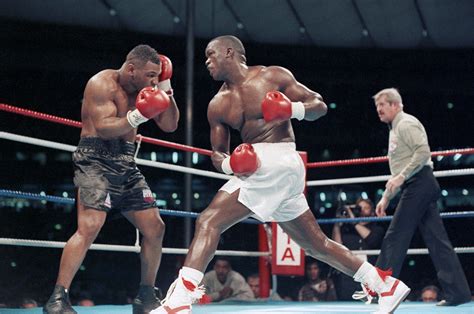
In a fight on February 11, 1990, he lost the undisputed championship to Douglas in Tokyo.
Tyson was a huge betting favorite; indeed, the Mirage, the only casino to put out odds for the fight, made Tyson a 42/1 favorite. Tyson failed to find a way past Douglas's quick jab that had a 12-inch (30 cm) reach advantage over his own.
Tyson did catch Douglas with an uppercut in the eighth round and knocked him to the floor, but Douglas recovered sufficiently to hand Tyson a heavy beating in the subsequent two rounds. After the fight, the Tyson camp would complain that the count was slow and that Douglas had taken longer than ten seconds to get back on his feet.
Just 35 seconds into the tenth round, Douglas unleashed a brutal uppercut, followed by a four-punch combination of hooks that knocked Tyson down for the first time in his career.
Despite the shocking loss, Tyson has said that losing to Douglas was the greatest moment of his career: "I needed that fight to make me a better person and fighter.
A Damaged Legacy
Tyson would never recover from the loss to Douglas, and it was but the start of a meteoric downfall. Following allegations from Desiree Washington in July of 1991, Tyson was charged with rape, and subsequently sentenced to six years in prison.
After being released, and maintaining his innocence, Tyson mounted a comeback, but it was short-lived. A rivalry with Evander Holyfield resulted in back-to-back losses, the second via disqualification for biting his opponent's ear off.
It was, ultimately, a rather sad and anti-climactic end for one of the greatest heavyweight fighters of all time, and his legacy will be forever tarnished.
Recent Events
Former heavyweight champion Mike Tyson’s highly anticipated fight against Jake Paul is rescheduled for November 15 in Arlington, Texas. The sanctioned eight-round match against Paul, 27, will stream on Netflix and mark Tyson’s first competitive bout since June 2005.
The fight was originally scheduled for July 20 but postponed because of a recent ulcer flare-up for the 58-year-old Tyson.
Tyson only fought three more times. After losing to Danny Williams via knockout in July 2004, he faced Kevin McBride just under a year later. A journeyman fighter from Ireland, McBride was considered a heavy underdog and offered only $150,000 for the bout. He responded to taunts from Tyson by saying “when I hit you on the chin, you’re going to take the whole of Ireland.” McBride backed up the talk by winning via technical knockout in the sixth round. Tyson immediately announced his retirement.