“Iron” Mike Tyson was a boxer, and an especially successful one.
In 2003, he got a really cool, really big tattoo on his face.
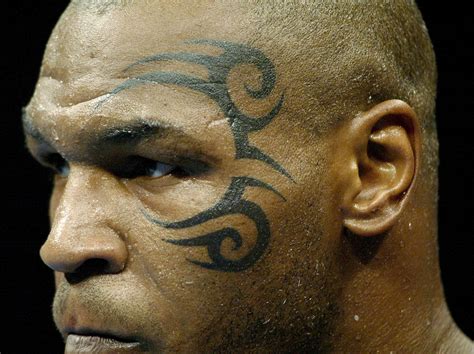
Mike Tyson's iconic face tattoo. Image: Wikimedia Commons
This tattoo later became the center of a fascinating legal dispute when it was reproduced in the movie "The Hangover Part II."
The Hangover Part II Controversy
One of the characters in The Hangover is a milquetoast dentist.
Read also: Decoding Shevchenko's MMA Tattoo
In The Hangover Part II, from what one can see in the trailers and other publicity material, Stu gets a tattoo exactly like the one that Mike Tyson has.
The release of The Hangover Part II was in danger of being enjoined by a federal judge.
The tattoo artist, S. Whitmill claims that reproduction of the tattoo (that he gave Mike Tyson) on the face of the character in the new movie played by Ed Helms (and also use of Helms’s likeness, with tattoo, on promotional merchandise) infringes upon his, Mr. Whitmill’s, exclusive rights in the work (the tattoo).
Whitmill is claiming not just copyright infringement, but also libel (although that might not be what he means, exactly), because the person from whom the character Stu gets his Tyson tattoo in Part II is a shady character, and Whitmill argues that he might be harmed in his reputation if moviegoers assume that the tattoo artist in the movie shares a personality with the real tattoo artist.
The Copyright Argument
Warner Bros. argued that a tattoo is not a work warranting copyright protection.
Read also: Exploring Lucha Libre Mask Culture
Judge Perry evidently scoffed at such a notion, and well she should.
“Of course tattoos can be copyrighted,” Judge Perry said.
A tattoo is no different from a watercolor, except that it’s on someone’s body.
Ah, argued Warner Bros. Whitmill is not remotely trying to control another’s body.
Second, are you familiar with the first-sale doctrine? It’s what lets you do what you want, more or less, with a copy of a book that you’ve bought, even though you don’t hold the copyright to the contents.
Read also: Mike Tyson vs. Brock Lesnar?
Tyson is in no way restricted in what he may do with his face, even if he isn’t permitted to license uses of the artwork on it.
That said, there is a suggestion that because Tyson has in fact negotiated licensed uses of his tattoo design, allegedly with Whitmill’s knowledge and/or permission, something is indeed awry here… and, according to the studio, Tyson himself gave Warner Bros. permission to use the design.
In his testimony (presumably, because it is not in his motion papers), Whitmill explained that he and Tyson had decided on the ultimate design together, back in 2003.
Although Whitmill alone committed that design to Tyson’s skin, it is possible that Tyson and Whitmill could be co-copyright holders, which scenario would give Tyson the prerogative to license uses of the work even without Whitmill’s approval.
This, however, doesn’t seem to have been an issue… although Warner Bros. might have raised it.
Fair Use and Parody
Warner Bros. also argued, wisely, that its use of the tattoo in Part II—on the face of the timid dentist—is fair use, parody specifically.
At first blush, this is a solid argument: Having a character diametric to Tyson sport the same ink is parodic, and it requires that the tattoo be identical, moreover.
The problem is that there is no change to the work in question… only to the canvas, as it were.
Perhaps for this reason (in part, anyway), Judge Perry appears not inclined to find fair use.
“This was an exact copy,” she said.
There was no change to this tattoo or any parody of the tattoo itself.
Any other facial tattoo would have worked as well to serve the plot device.
Judge Perry—despite finding that Whitmill was likely to succeed in his claim on the merits, because there really can be no question that (a) Whitmill owns the copyright in the tattoo, and (b) Warner Bros. copied it—denied the motion.
Nota bene: Unfortunately, while the short form order denying Mr. Whitmill’s motion is not available online, the Times summarizes Judge Perry’s reasoning.
The immediately interesting thing about the denial of the motion is that, at least according to the Times summary, Judge Perry based her decision on two factors: First, the public interest in the release of the movie; and second, the fact that Mr. Whitmill has an adequate remedy at law.
If this writer may offer an opinion: What? Really? Can the release of a movie ever be in the public interest? It’s a movie.
Now, Judge Perry does seem to have told everyone involved that, at the end of the day, Whitmill is going to recover from Warner Bros. some money.
Here’s a summary of the key arguments and findings in the case:
| Issue | Argument | Finding |
|---|---|---|
| Copyright of Tattoo | Warner Bros. argued tattoos are not copyrightable. | Judge Perry stated tattoos are copyrightable, like watercolors. |
| Fair Use/Parody | Warner Bros. claimed the use was fair use through parody. | Judge Perry was not inclined to agree, as there was no change or parody of the tattoo itself. |
| Public Interest | Warner Bros. implied delaying the movie release would harm public interest. | Judge Perry considered the public interest in the movie's release. |
LeBron's Ink: Legal Explorations of Tattoo Copyrights
The Outcome
So the movie will open this weekend… but the lawsuit will continue.
UPDATE: Settled.
As usual, it’s secret, and we learn nothing for our trouble!
By the way : Previous posts about IP rights in tattoos here include one about NBA star Rasheed Wallace’s tat; another post was somewhat further afield but implicated the tattoo version of the Prince symbol-thing.