Wing Chun, a traditional Chinese martial art, is renowned for its emphasis on close-range combat, efficient movements, and practical self-defense techniques. At the heart of Wing Chun training lies a unique and iconic apparatus known as the Wing Chun dummy, or 'Muk Yan Jong'. This tool not only represents the art's physical aspects but also embodies its philosophical depth.
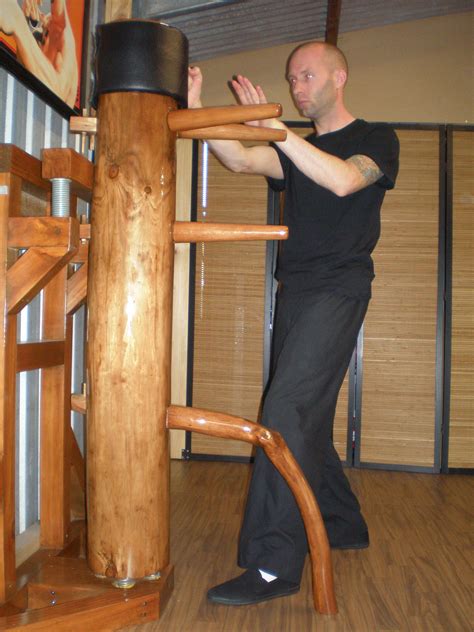
What is a Wing Chun Dummy?
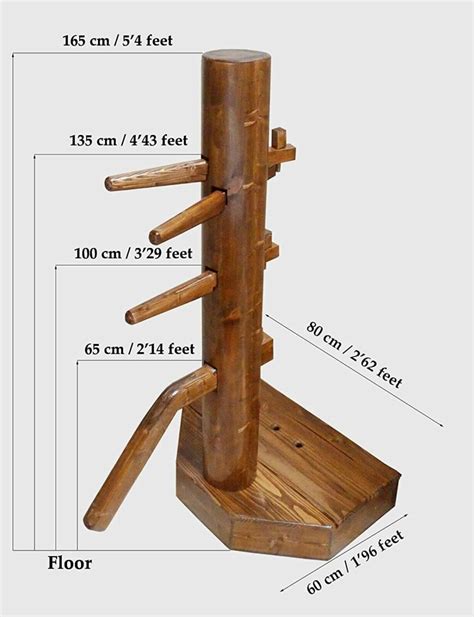
The Wing Chun dummy is a wooden training apparatus used extensively in Wing Chun Kung Fu. Made traditionally from hardwoods like teak or oak, it consists of a cylindrical body with three arms and a leg, designed to represent an opponent's limbs and torso. The arms are set at various angles and heights, simulating different lines of attack or defense. The dummy is typically mounted onto a frame that allows for limited movement, adding a dynamic and more realistic element to the training.
The Structure and Design of the Wooden Dummy
The wooden dummy consists of a solid wooden trunk with three arms and a leg. These components are designed to simulate an opponent's limbs, offering various angles and positions to practice strikes, blocks, and movements. Notably, the ends of the wooden dummy's arms simulate an opponent's elbows, helping practitioners maintain ideal distances during practice. The structure of the dummy is carefully crafted to withstand rigorous training while providing realistic feedback to the practitioner.
Training with a Wing Chun dummy is a cornerstone of advanced Wing Chun practice.
The Importance of Foundational Training
Before embarking on wooden dummy training, it is crucial to understand the foundational aspects of Wing Chun. The wooden dummy is not just a punching bag; it is a sophisticated tool designed to significantly improve your technique. Foundational training includes mastering basic stances, footwork, hand techniques, and forms such as Siu Nim Tao and Chum Kiu. These elements provide the necessary groundwork, ensuring that practitioners can fully benefit from the advanced training offered by the wooden dummy.
Read also: Transform Your Life with MMA
Techniques Practiced on the Wooden Dummy
- Striking: The wooden dummy allows practitioners to execute various strikes, including punches, palm strikes, and elbow attacks. The solid structure helps develop striking power and accuracy.
- Blocking and Deflecting: Practicing blocks and deflections on the dummy improves timing and coordination. The arms and leg of the dummy provide realistic targets for these defensive techniques.
- Footwork and Positioning: The dummy aids in refining footwork and positioning, crucial aspects of Wing Chun. Practitioners learn to maintain proper distance, angles, and stances while engaging with the dummy, enhancing their balance and ground connection.
- Trapping and Controlling: Wing Chun emphasizes trapping and controlling an opponent’s limbs. The wooden dummy's arms and leg are ideal for practicing these techniques, enhancing a practitioner’s ability to control and neutralize an opponent.
- Forms: The Muk Yan Jong form, a sequence of movements performed on the dummy, encapsulates essential Wing Chun techniques and principles. Practicing this form helps integrate various aspects of the art into a cohesive practice.
Benefits of Training with the Wooden Dummy
Wing Chun Dummy workouts assist you to grow all the skills you need to actualize wing chun’s avoid-using-force-against-force principle: right angle (of deflection), balance, accuracy, timing, mobility, positioning, speed, stream and power.
Here are some of the key benefits:
- Technique Refinement: The dummy provides immediate feedback on the precision and effectiveness of techniques. Practitioners can adjust and refine their movements for maximum efficiency and impact.
- Conditioning: A nice byproduct of wooden dummy training is the conditioning of muscles, tendons, and bones, enhancing overall physical strength and resilience.
- Spatial Awareness: Training with the dummy develops spatial awareness, teaching practitioners to navigate around an opponent and exploit openings effectively.
- Coordination and Timing: The structured practice on the dummy improves coordination and timing, essential for executing techniques fluidly and responsively.
- Balance and Ground Connection: The stationary nature of the dummy reveals a practitioner's ability and knowledge of balance and ground connection. Proper footwork and alignment are essential, as the dummy's unyielding presence quickly exposes any flaws in technique-providing a humorous yet humbling experience for many.
Perhaps the most evident trait you obtain or benefit from Wooden-Dummy training is definitely toughness.
Wing Chun Muk Jong Helps With Your Structure
Because this particular art was designed for a smaller weaker person using a wing chun practitioner’s structure is critical to the success of the technique. There is a specific form consisting of 108 wing chun wooden dummy techniques that help develop the essential techniques a person needs to competently pull off many of the techniques they learn from Sil Lum Tao through Bil Gee. Another structural benefit of training on a wooden dummy is that you are able to develop your close-quarter footwork.
Using The Dummy Helps With Bone Conditioning
One of the more overlooked aspects of martial arts training is bone conditioning. By continually striking at the wing chun muk jong your bones begin to toughen up. It’s not recommended to hit it to hard. You are most likely going to bruise. A good rule of thumb is to allow time for your limbs to heal before bone conditioning again.
Read also: Keeping a BJJ Journal
For centuries, Kung Fu practitioners have been aware of the benefits of strengthening bones. The physical training in Wing Chun is designed to strengthen and condition the entire body. Exercises develop strength in different parts of the body, including the arms, legs, core, and back. For example, stance and footwork drills work the legs and upper body.
Bone Conditioning Tips
There are several things you can do to improve your bone density. One of the most important tips is to start doing exercise that causes your body to use muscle and bone tissue to increase your bone density. This is a process called resistance training. Exercise helps build bone mass and is a great way to stimulate anabolic hormones. Doing compound movements, such as lifting heavy weights, can help strengthen bones and stimulate the production of anabolic hormones. High-impact weight-bearing exercises, such as kickboxing and muay thai, can also help you build bones. In addition to strengthening bones, a good workout also helps the body to build stronger muscles. The human body has an incredible ability to heal itself. It can break down tendons and muscles and rebuild them. The theory behind bone remodeling was developed by German Anatomist/Surgeon Julius Wolff, who explained that a healthy bone will adapt to the loads it is put under.
Another benefit of the Wing Chun muk jong is that it increases your blood flow. It also improves your mental health. It removes stress and helps you focus your energy on blocking and landing a strike. In a way, it’s like a form of meditation.
Wing Chun training also helps students improve their focus and ability to handle chaos. In addition to improving focus, Wing Chun helps adults sharpen their life skills and focus. It teaches students to become more confident and calm, enabling them to handle any situation. Additionally, students learn to control their body language, which is the number one way we communicate.
Practicing Techniques
Perhaps the strongest argument for buying a wing chun muk jong is practicing your techniques. You can work on your paks, tans, bongs, fuks, huens and everything in between. Because the muk yan jong has 3 fixed arms and 1 fixed leg simply practicing on it will help with your muscle memory. The ability to repetitively practice these techniques will ingrain the motions into your brain so that when you need to use them in a real-world situation you will easily be able to recall the skill. This is especially important because when the adrenaline starts flowing your motor skills have a tendency to slow down. Through consistent practice, you will be able to increase your speed while under pressure.
Read also: Training Like Kevin James
I actually bought a wing chun muk jong after about a year of training. I didn’t actually learn the Dummy form until after I learned the Chum Kiu form which was about 5 years into my training. I did however use the Wooden Dummy to condition my limbs as well as work on my basic techniques. I felt that it was a great training aid. While it was pretty pricey to buy a wall-mounted jong it was worth every penny. I still hit mine regularly some 27+ years later.
The Wooden Dummy is recognised as the highest skill in Wing Chun. Hence, the majority of Wing Chun learners consider that learning the moves of the Wooden Dummy will automatically make them a good Wing Chun fighter. The moves of the Wooden Dummy are all good for fighting. However, those moves are actually formed by the basic movements of Siu Nim Tau, Chum Kiu and Biu Gee. In fact, the practice of this form is taken as an auxiliary measure for the training of the Wing Chun forms.
If your purpose is to practice the skill of the three forms then you should treat the Wooden Dummy as a piece of equipment. Also, try your best to practice the moves and the skill of the three forms on it. You should also try to feel if your goal has been achieved. That is, trying to concentrate the force of the whole body to a particular point.
Additionally, induce the opponent’s force for your own use. (That is, to induce the opponent’s force for your own use is one of the basic structure of Biu Gee. It’s the combined effect of you rotating your body and the formation of the whirlpool effect). If you treat the Wooden Dummy as your opponent, you should try to concentrate your own force.
Traditional wing chun masters stress the need for practice simply by putting an emphasis on to their pupils that establishing their particular reflexes is very essential. They indicate, as well, that a person should never really rely simply on any sort of pair of recurring movements in protecting one’s self.
As simply by carrying out thousands and thousands of repetitions of your style’s blocks, attacks and kicks are you going to be able in using your strategies and techniques in an almost second nature and natural way. missing such type of preparation, in a fight you will end up compelled to think about what you need to be accomplishing next when you really should be already performing it.
For the reason that Wing Chun dummy is generally made from teak, it is therefore critical to practice any of your offensive and defensive techniques as slowly and softly as you can in the early stages in an effort to minimize the impacts your body is absorbing.
In Wing Chun dummy training, the most common blocking sections of the arms tend to be the palms and also the inside and outside of the forearms. If attacking when using the hands, your main weapons could be the heel of your palm, the side of your palm, your knuckles and your phoenix knuckles. when it comes to feet, the ball of your foot, the side of your foot and your heel are suggested. If the Wing Chun wooden dummy is nicely cushioned, you can use your elbows and knees in training, as well.
At all times take in mind that deflecting the arriving force is normally the main goal. You mustn’t try to meet an resisting force head-on. Novices could without doubt utilize the Wing Chun dummy minus the unneeded risk of injuries as long as they can be patient enough and especially mindful during the starting stages of the training.
The ultimate goal of Wing Chun Dummy training is to begin a very good basic skill set that you could take advantage of when the time occurs that you train with a live companion. That may subsequently assist you to react along with the correct movements and principles not having too much thought.
The Philosophy Behind the Wooden Dummy
The wooden dummy embodies the core philosophies of Wing Chun, emphasizing simplicity, directness, and efficiency. Training with the dummy encourages practitioners to:
- Seek Efficiency: The wooden dummy teaches the importance of economy of motion, reinforcing the idea that the simplest techniques are often the most effective.
- Adapt and Flow: The fixed structure of the dummy encourages adaptability. Practitioners learn to flow around the dummy's limbs, reinforcing the principle of adaptability in combat.
- Develop Internal Strength: The solid resistance of the dummy helps cultivate internal strength and structure, essential for delivering powerful and controlled techniques.
- Focus on Precision: The dummy's fixed nature requires precise targeting and execution. Practitioners learn to strike and block with accuracy, enhancing the effectiveness of their techniques.
Practical Application of the Wooden Dummy
To incorporate wooden dummy training into your martial arts practice:
- Master the Basics: Ensure a solid understanding of foundational Wing Chun principles and techniques before beginning wooden dummy training.
- Train to Relax: Focus on relaxation during drills and forms. Tension impedes fluid, natural movement. Practice breathing techniques and mindfulness to maintain a relaxed state.
- Develop Sensitivity: Engage in partner drills like Chi Sau to cultivate the ability to sense and respond to your partner’s movements without premeditation. This enhances your ability to react spontaneously.
- Focus on Efficiency: Refine your techniques with an emphasis on efficiency and directness. Remove any extraneous actions that do not contribute to the effectiveness of the technique.
- Embrace Spontaneity: Trust in the muscle memory and instincts developed through consistent practice. Allow your responses to emerge naturally during sparring or self-defense situations, without overthinking or hesitation.
- Monitor Tension: If you feel strain or tension in your shoulders during Chi Sau, you are doing it wrong. Tension is a sign that your body is blocking the flow of energy. Relax and start again until your body redirects the incoming force to your advantage and output. This practice will help you truly embody the principle of Wu-Wei.
- Hone Footwork and Balance: Use the dummy to refine your footwork and balance. The stationary nature of the dummy reveals any flaws in your stance and movement, pushing you to improve your ground connection and stability.
Even though the Wing Chun dummy is not really as exciting as an actual sparring companion, it contains as much potential in training one to develop your visual and contact reflexes in the course of wing chun training. It does this simply by teaching a person the way to carry out blocks and strikes in relation with each other, therefore causing them to be nearly simultaneous dodge-and-counter combinations.
In advance of you carry out your counterstrike, there is a short time of contact when your block deflects the arriving strike - or the arm of the wooden dummy that symbolizes the limb of the adversary. This contact is usually the cue to carry out your attack. In due time, creating contact with the Wing Chun dummy gets to be your trigger to let out a counterattack.
When using the Wing Chun dummy in your wing chun training additionally trains your visual reflexes. It might call for a much more creativity and concentration than in the sharpening of your contact reflexes, though, as you ought to imagine that you don’t know what occurs next in the form you are doing.
Complete Wing Chun Wooden Dummy Form
Absolutely, the Wing Chun dummy is a highly effective tool for self-defense training. The techniques and drills practiced on the dummy are directly applicable to real-life self-defense situations. Training on the dummy helps develop quick reflexes, precise and powerful strikes, efficient blocks and deflections, and the ability to anticipate and react to an opponent's moves.
How Can Beginners Start Training with a Wing Chun Dummy?
For beginners, starting with basic drills and understanding the dummy's layout is crucial. Initial training often involves familiarizing oneself with the positions of the dummy's arms and leg, learning basic striking techniques, and practicing simple footwork patterns. As beginners progress, they can gradually be introduced to more complex drills, eventually working up to the full Muk Yan Jong form.
Is Wing Chun Dummy Effective for Self-Defense?
Absolutely, the Wing Chun dummy is a highly effective tool for self-defense training. The techniques and drills practiced on the dummy are directly applicable to real-life self-defense situations. Training on the dummy helps develop quick reflexes, precise and powerful strikes, efficient blocks and deflections, and the ability to anticipate and react to an opponent's moves.
“I fear not the man who practices 10,000 techniques once, but the man who practices one technique 10,000 times has my respect.” What the classic Chinese expression usually means is certainly apparent: Practice is important in order to achieve the best level of any sort of martial arts.
Grandmaster Chu Shong Tin
Chu Shong Tin trained in Ip Man’s school for 14 years and was the main teacher there, teaching for up to 12 hours on some days. The major focus in the early years of his training was the practice of “Siu Nim Tao” (meaning “Tiny Idea”). Which is the first empty-hand form and the essence of Wing Chun.