Professional wrestling holds include a number of set moves and pins used by performers to immobilize their opponents or lead to a submission. Some wrestlers use these holds as their finishing maneuvers, often nicknaming them to reflect their character or persona. This article covers the various pins, stretches and transition holds used in the ring.
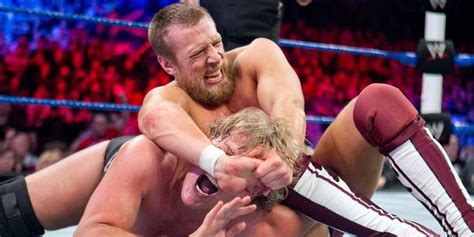
Stretches and Submission Holds
An element borrowed from professional wrestling's catch wrestling origins, stretches (or submission holds) are techniques in which a wrestler holds another in a position that puts stress on the opponent's body. Stretches are usually employed to weaken an opponent or to force them to submit, either vocally or by tapping out: slapping the mat, floor, or opponent with a free hand three times. Many of these holds, when applied vigorously, stretch the opponent's muscles or twist their joints uncomfortably, hence the name.
Chokes, although not in general stress positions like the other stretches, are usually grouped with stretches as they serve the same tactical purposes. In public performance, for safety's sake, stretches are usually not performed to the point where the opponent must submit or risk injury.
Examples of Submission Holds
- Camel Clutch: The wrestler begins the hold by standing over a face-down opponent, reaches down to pull the opposing wrestler up slightly, sits on the opponent's back, and places both of the opponent's arms across their thighs, usually locking at least one by placing the arm in the crook of their knee. The wrestler then reaches forward, cups their hands with their fingers interlocking, grabs the opponent's chin in their cupped hands, and leans back while pulling on the opponent's chin and applying pressure to their back. A camel clutch can also refer simply to a rear chinlock while seated on the back of an opponent, without placing the arms on the thighs. The move was invented by Gory Guerrero in Mexico, where it was called la de a caballo (horse-mounting choke), but got its more common name from The Sheik who used it as his finisher. The Iron Sheik also used this version while a heel champion in the WWF. Jinder Mahal also uses this move called the Punjabi Clutch. Miro performs a variation he calls Game Over, where he stomps on his opponent's back before applying the hold, this move was previously called The Accolade when Miro was Rusev in the WWE. A standing variation of the camel clutch is also used, with this variation popularized by Scott Steiner in the late 1990s as he used it as his finisher, dubbed the Steiner Recliner. His nephew Bron Breakker has also used the standing version as well. Another version of this move sees the wrestler standing over the opponent who's face-down reaches for and places the opponent's nearest arm around the wrestler's far waist before applying the hold. WWE wrestler Veer Mahaan uses this move as a finisher calling it the Cervical Clutch. A rolling variation of the camel clutch is also used, with this variation popularized by Maryse Ouellet, dubbed French Pain.
- Stepover Armlock: The attacking wrestler stands over a face-down opponent, facing the same direction. The wrestler then grabs one of the opponent's arms in a stepover armlock, turning 360° so the opponent's arm is bent around the leg of the attacking wrestler. The wrestler will then sandwich the arm between their own leg and the side of the opponent's body.
- Rear Chinlock: Also known as a rear chinlock, the attacking wrestler crouches down behind a sitting opponent and places their knee into the opponent's upper back, then reaches forward and grasps the opponent's chin with both hands.
- Neck Crank: A maneuver similar to a neck wrench where the wrestler faces a bent-over opponent. The attacking wrestler tucks the opponent's top/back of the head into their own chest and wraps an arm around the opponent's neck so that their forearm is pressed against the opponent's throat. The wrestler then places their own spare arm under the other hand and over the opponent's back to lock in the hold, compressing the opponent's neck.
- Inverted Facelock: In this hold, a wrestler who is facing away from an opponent wraps their arm around the neck of an opponent. This is also called a "reverse chancery". The wrestler stands in front of the opponent while both people are facing the same direction, with some space in between the two. Then, the wrestler moves slightly to the left while still positioned in front of the opponent. The wrestler then uses the near hand to reach back and grab the opponent from behind the head, thus pulling the opponent's head above the wrestler's shoulder. Sometimes the free arm is placed at the top of the opponent's head. The move is also referred to as a "European headlock", due to its prominence in European wrestling. The two-handed version sees the wrestler use both hands and is sometimes referred to as a "¾ chancery", "side head chancery" and, most often, a "cravate". This hold is a staple of European style wrestling and technical wrestling influenced by European wrestling. An inverted version of the cravate is used by Chris Hero as part of his "Hangman's Clutch" submissions in which the hand positioning is the same as a normal cravate but the facelock is connected around the face of the opponent, not from behind the opponent's head, thus pulling the opponent's head backwards rather than forwards, putting significant pressure on the neck by stretching it backwards and in other directions toward which the neck would not normally bend.
Transition Holds
Transition holds are used to set up more complex moves or to gain a strategic advantage during a match.
Examples of Transition Holds
- Collar-and-Elbow: This is a stand-up grappling position where both wrestlers have a collar tie, and hold the opponent's other arm at the elbow. The collar-and-elbow is generally a neutral position, but by pushing the hand on the elbow up and towards the inside of the opponent's arms, a controlling wrestler can turn an opponent into a belly-to-back position.
- Gutwrench Waistlock: The wrestler stands in front of and facing a bent over opponent and places them in a gutwrench waistlock. The wrestler then flips the opponent up and over so the opponent is lying face up on the back of the wrestler. The wrestler then moves his hands to the upper arm or wrists of the opponent, holding them in position, and spreading the arms of the opponent (as though they were being crucified).
- Belly-to-Back Suplex: The wrestler stands in front of and with their back to a standing opponent. The wrestler then leans backwards and seizes the opponent around the waist, pulling them forward and upwards so they are lying across the shoulder of the opponent, facing downwards.
- Tilt-a-whirl: The wrestler stands facing the opponent. The wrestler bends the opponent down so they are bent facing in front on the wrestler's body. The wrestler reaches around the opponent's body with their arms and lifts them up, spinning the opponent in front of the wrestler's body, often to deliver a slam or most commonly a Tilt-a-whirl backbreaker. Usually performed on a charging opponent, this can also be a transition hold for counter attacks that sees the wrestler (who is being tilt-a-whirled) hit many throws and drops like a DDT or headscissors takedown.
The "Tree of Woe" and Record-Breaking Pins
Markovic was known for his unorthodox style and unique and original pinning combinations, most notably the "Tree of Woe". This involves a wrestler suspending an opponent upside down on a turnbuckle, with the opponent's back being up against it. Often an attacking wrestler will choke, kick, or stomp the opponent until the referee uses up his five count.
Top 50 ICONIC Special Moves & Taunts That Hyped Up Fans
Read also: A Look at the Anoa'i Family
Recently, records have been broken in the world of wrestling. He broke the previous record of 39 pins on January 29, 2002, securing his 40th pin in a dual against Mount Union. During his freshman season (2018-2019), Perelka set the record for most pins in a single season with 16. During the 2019-2020 season, however, Perelka's teammate Aidan Whitis tied his single season record of 16 pins. He is also tied for the most career wins in JCU Wrestling history with 122. After his record setting pin, Perelka pinned his next three opponents at the Olivet Duals, then his OAC opponent Tuesday night against Otterbein - all in the first period. Perelka tied the previous record of 41 pins a week earlier at the Trine Invitational. This is Perelka's second record in the John Carroll history books. This is when a wrestler holds both the opponent's arms under his own, from here the opponent is left prone and unable to counter or move away from the wrestler. Technically known as a double underhook.
When asked why he likes to pin people, Perelka remarked, "I like to have fun when I wrestle, and I feel that coming up with creative ways to pin people is the most fun way to wrestle. "Andrew had the opportunity to get pin 42 at our home dual against Mount Union and Markovic was there hoping to see his record get broken.
With Perelka's top priority of becoming John Carroll's 17th NCAA Champion, and the first since 1999, when Rich Eslich won the title at 285 pounds, his career so far has prepared him to be ready for anything. Perelka narrowly missed qualifying for the NCAA Championships in 2019 after a video review overturned his victory in the qualification match.
When asked about the legacy of John Carroll Wrestling, Coach Hawald commented, "I was teammates with Markovic and remember the excitement when he broke the record that night.
| Wrestler | Achievement | Year |
|---|---|---|
| Perelka | Most pins in a single season (16) | 2018-2019 |
| Aidan Whitis | Tied Perelka's record for most pins in a single season (16) | 2019-2020 |
| Markovic | Known for "Tree of Woe" and unique pinning combinations | N/A |
| Rich Eslich | NCAA Champion | 1999 |
Read also: Information on Tyson Tree Service
Read also: The Pine's Enduring Symbolism