From gladiators to the modern-day Ultimate Fighting Championship (UFC), fighting has always captivated audiences. The inherent spectacle of combat, with its display of strength and skill, keeps viewers invested. Despite its simplicity, fighting is an art form, a dance between two individuals involving constant improvisation and reactions. However, the danger inherent in the sport leaves it open to scrutiny.
Mixed martial arts (MMA) is rapidly growing in popularity in the United States and abroad. This combat sport joins athletes from a wide variety of martial art disciplines, each with characteristic and distinguishing injury profiles, together in competition.
Mixed-style martial art competitions date as far back as 648 bc with Greek Pankration, but modern-day mixed-style events did not become commonplace until the early 20th century, when sports such as Vale Tudo in Brazil began garnering fame.
MMA first took root in the United States on November 12, 1993, when the MMA league known as the Ultimate Fighting Championship (UFC) held its inaugural event, called UFC 1, in Denver, Colorado.
This event included 8 athletes from various martial art backgrounds participating in a 1-loss elimination tournament. In 2001, UFC was purchased by 2 business partners who realized the importance of fighter safety not only for the health of their athletes but also for the viability of commercial MMA.
Read also: Evolution of UFC Combat
Shortly thereafter, the Unified Rules of Mixed Martial Arts was created, establishing weight classes, illegal moves, and other regulations aimed at improving athlete welfare. Over the past 15 years, the sports world has accepted MMA, and it has become one of the fastest growing sports in the United States.
Professional fight events are held with increasing frequency, and MMA-specific gyms have begun opening across the nation where beginners, amateurs, and professionals alike train. Most MMA athletes have 1 primary martial art discipline but typically incorporate aspects from other styles.
Yet, despite modern-day regulations, UFC has this brutal and almost-savage reputation, and not without good reason. A 2019 study found that the overall injury rate for UFC fighters was 51%, which is considerably higher than most other popular sports. For comparison, NFL players "only" have an injury rate of 30.8%. The risks of UFC are clear, but viewers should not let it overshadow its inner beauty.
Mixed martial arts has not always been in the limelight, as it was almost banned completely in the United States due to its brutal nature and limited rules.
Mixed martial arts was first introduced in the United States with the first Ultimate Fighting Championships (UFC) in 1993 and immediately faced scrutiny from legislators and the medical community.
Read also: From UFC to BKFC: Mike Perry's Journey
In the UFC's conception, competitors battled against one another with no time limits, no weight classes, and few rules. Referred to as “human cock fighting,” the UFC lost their cable television contracts in 1997 and survived underground through the Internet and word of mouth.
In 2001, UFC organizers agreed to a modification of rules that allowed the Nevada State Athletic Commission and the New Jersey State Athletic Control Board to sanction MMA competitions.
Re-establishing cable television contracts followed, and the sport's popularity grew greatly in the years to follow.
Mixed martial arts competitions consist of three five-minute rounds (non-championship bouts) or five five-minute rounds (championship bouts), followed by one-minute rest periods between rounds. Competitors are matched according to designated weight classes and similar experience levels (i.e., fight record). Competitors wear protective equipment consisting of a mouth guard, groin protector, and 4 to 6 oz. MMA gloves. Competitors are not allowed to wear shoes, competing barefooted.
Mixed martial arts bouts are decided or stopped by a referee if a competitor submits to his or her opponent, suffers a knockout (KO) or technical knockout (TKO), or is disqualified because of rule infractions.
Read also: Greatest WWE Wrestlers
Mixed martial arts bout stoppages due to KO, TKO, and submission can be classified into three major categories: head trauma, musculoskeletal stress, and neck choke. (Submission occurs when a competitor communicates he or she no longer wishes to continue due to possible impending injury. Head trauma causing bout stoppages includes a competitor exhibiting altered mental status to the point of defenselessness. {Defenselessness is defined as when a competitor loses all unconsciousness and responsiveness (KO) or partial responsiveness (TKO) exposing him or her to further punishment.5} Musculoskeletal stress causing bout stoppages includes a competitor being submitted by either a joint lock or other musculoskeletal trauma.
In regards to safety, MMA has been compared to other combat sports, such as boxing. Mixed martial arts has a safer track record in respect to serious injury and death. Knockout rates are lower in MMA competitions than in boxing, suggesting a reduced risk of traumatic brain injury (TBI) in MMA competitions compared to other events involving striking.
Since MMA's conception in the modern era, only four deaths have been documented. Deaths have occurred in Tijuana, Mexico; Kiev, Ukraine; Samsongdong, South Korea; and the United States. All the MMA documented deaths occurring outside the United States were in unsanctioned fights.
Due to the physical nature of the sport, MMA is associated with various types of injuries. The purpose of this study was aimed at identifying prevalence and assessing the severity, location, and type of injuries in MMA athletes sustained during MMA related activities in the 12-month period prior to the survey. A secondary objective is to indicate protective equipment self-reported utilization.
This study is unique, as it looked at what type of injuries occurred, injury locations on the body, whether the injuries were previous or repeated, amount of time off (rest) from training as a result of the injuries, whether any medical attention was sought, and the setting in which the injuries occurred.
A total of fifty-five subjects between the ages of 18 to 39 participated in the study. Participants assessed were men and women of both amateur and professional status.
Participants were given a two-part questionnaire (See Appendix) to retrospectively collect demographic and injury data. The questionnaire was developed by the author and assessed via face validity by a board certified sports physical therapist with 21 years of experience.
Part one of the questionnaire included assessing each participant's age, sex, primary martial art style, years of training experience, hours of training per week, protective equipment used, and current fighter status (amateur vs. professional). Part two of the questionnaire included assessing thirty injured body regions, types of injuries, repeated injuries, required time off from training, medical attention sought, and setting in which the injuries occurred.
Participants were also given an injury diagnosis sheet (See Appendix), which gave a definition of all the injury types listed on part two of the questionnaire. Injury definitions were provided in laymen terms for better participant understanding of injury types. The questionnaire did not allow the recording of multiple injuries to the same anatomical location.
Mixed martial arts facilities were selected due to their close proximity from the researchers resulting in a sample of convenience. Twenty-four MMA training facilities across the Midwest including Missouri, Kansas, and Illinois were identified and contacted for their participation in the study. Eight of the twenty-four MMA training facilities agreed to participate in the study.
Each facility was then scheduled a site visit by the researchers to survey their fighters either before or after one of their training sessions. Both amateur and professional MMA fighters were asked to participate. The training session appointments were organized where participants were verbally explained the study's procedures, benefits and risks of participation, and confidentiality.
All the subjects were given an informed consent that was required to be signed before the subject was allowed to participate in the study. Approval was obtained by the Research Review Board (RRB) at Southwest Baptist University, Springfield, Missouri to conduct the study.
The subjects then received their individual questionnaire packets, which took approximately five to ten minutes to complete. Questionnaires were placed in an envelope and sealed. Confidentiality of the data was maintained throughout the study in two ways. First, no names or personal identification was required to complete the questionnaire. The injury data was transferred into SPSS (Statistical Package for Social Sciences) version 12 for analysis.
Injury rates were analyzed per total number of participant injuries by age, sex, martial art style, belt rank, years of training experience, hours of training per week, and fighter status. The t-tests were used for sex and fighter status, and analysis of variance (ANOVA) was used for remaining groupings. Scheffe post hoc was used to analyze the significant differences of the ANOVA results. The initial alpha level was set at p < 0.05.
Key Findings on UFC Fighter Injuries
Several factors contribute to the prevalence and types of injuries seen in MMA fighters. A study involving fifty-five subjects, aged 18 to 39, revealed important insights into injury rates and distributions.
Of the fifty-five subjects participating in the study, 33.3% were ages 18 to 21, 27.8% ages 22 to 25, 22.2% ages 26 to 29, 11.1% ages 30 to 33, and 5.6% ages 34 to 39. The injury rate among participants ages 30 to 33 averaged 6.2 injuries (SD = 4.2) per subject. Participants ages 22 to 25 averaged 5.2 injuries (SD = 6.1) per subject, followed by 3.3 injuries (SD = 2.5) per subject for ages 26 to 29, 3.3 injuries (SD = 2.3) per subject for ages 34+, and 2.4 injuries (SD = 3.2) per subject for ages 18 to 21.
Sex differences were also accessed during the study. Of the participating subjects, 94.5% were male and 5.5% were female. Males and females averaged different injury rates. Male participants averaged 3.9 injuries (SD = 4.3) per subject and female participants averaged 2.3 injuries (SD = 2.5) per subject.
Two hundred seven injuries were reported in the study. Twenty-seven of the injuries reported were multi-injurious in nature, resulting in a total of two hundred twenty-eight separate injury outcomes. Multi-injurious is defined as an injury resulting in multiple outcomes, such as leg kick causing a simultaneous contusion and sprain.
The anatomic region and frequency of injuries in MMA athletes appears to vary according to the martial art style primarily employed by the MMA athlete and his or her opponent.
Examples of maneuvers performed by mixed martial arts (MMA) athletes. (a) Upper extremity strike (elbow), which often results in head and facial injuries. (b) Lower extremity strike (kick) to the torso. (c) Elbow joint lock, used in submission-predominant disciplines. Notice the hyperextension at the elbow joint.
Striking-predominant disciplines, including boxing, karate, Muay Thai, and taekwondo, have relatively high rates of head and facial injuries.
Striking-predominant disciplines vary in how frequently upper versus lower extremity strikes are used, and their characteristic injury types and anatomic regions reflect this distribution. Other submission-predoiminant disciplines have high rates of joint injuries as well, though the injury location distribution varies by discipline.
Striking-predominant disciplines have higher rates of head trauma than submission-predominant disciplines.
These studies have found that the injury rate for MMA athletes in competition ranges from 22.9 to 28.6 per 100 fight-participations. These injuries most frequently occur in the head and facial region followed by the extremities. Skin lacerations are the most common injury type followed by fractures.
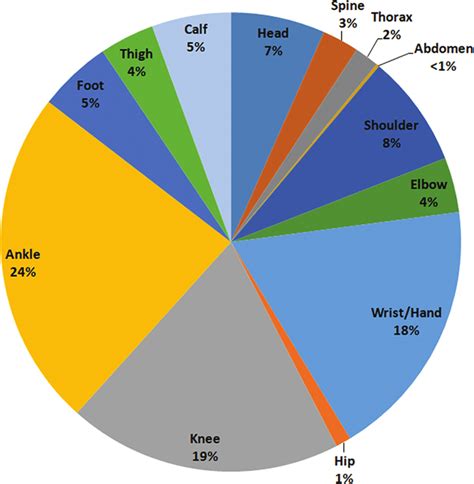
Injuries by Body Region
Studies on specific martial art disciplines reveal that striking-predominant disciplines such as boxing, karate, Muay Thai, and taekwondo have high rates of head and facial injuries whereas submission-predominant disciplines such as Brazilian jiu-jitsu, judo, and wrestling have high rates of joint injuries.
The most common body region injured was the head/neck/face (38.2%), followed by the lower extremities (30.4%), upper extremities (22.7%), torso (8.2%), and groin (0.5%). This result seems plausible since a major target area of MMA competition is the head/neck/face.
When looking at specific body region injury, the nose (6.3%), shoulder (6.3%), and toe (6.3%) were the most commonly injured followed by eye (5.8%), neck (5.8%), knee (5.8%), head (5.3%), ear (5.3%), and ankle (4.8%).
The most common type of injury reported by the participants was contusions (29.4%), followed by strains (16.2%), sprains (14.9%), abrasions (10.1%), joint trauma (9.2%), fractures (5.7%), lacerations (5.3%), other miscellaneous trauma (4.8%), dislocations (2.6%), concussions (1.8%), and internal organ trauma (0.0%).
Of these injuries, 32.4% were repeated or previous injuries, 20.1% required medical attention, and 77.9% occurred in training compared to 22.1% that occurred in competition.
The majority of an athlete’s time and energy in MMA is spent in training, and studies have repeatedly confirmed that the majority of combat sport athletes’ injuries occur during training. Few studies have evaluated the type and frequency of injuries sustained during training in MMA athletes. Understanding and preventing training injuries is important for professional MMA athletes and the UFC as well.
The most common martial art style was wrestling (36.2%), followed by jiu-jitsu (34.0%), freestyle (21.3%), kickboxing (8.5%), and boxing (0.0%). For analysis purposes, injury rates were reported for those participants who declared only one primary martial art style. Those participants who selected multiple primary martial art styles were excluded.
The injury rate among participants with a jiu-jitsu martial art style averaged 6.0 injuries (SD = 4.8) per subject, followed by 3.8 injuries (SD = 3.7) per subject for freestyle, 2.5 injuries (SD = 4.6) per subject for wrestling, and 2.0 injuries (SD = 2.8) per subject for kickboxing.
Experience level of the subjects was evaluated by accessing (a) martial art belt rank and (b) years of martial arts training. Since belt ranks are different among various martial arts, low and high belt ranks were used to distinguish experience levels. Low belt ranks are participants who possess a novice skill level. Whereas, high belt ranks are participants who possess a more seasoned skill level.
The only constant belt ranks among martial arts that use a belt rank system are white belt (beginner) and black belt (expert). There are martial arts, such as boxing, kickboxing, and wrestling, that do not use a belt rank system and these participants are designated in this study as having no belt rank.
Of the participating subjects, 62.9% held no belt rank, 16.7% held white belt rank, 9.3% held low belt ranks, 9.3% held high belt ranks, and 1.8% held black belt rank. The highest injury rate among belt ranks was low belt ranks, averaging 12.2 injuries (SD = 6.1) per subject. Low belt ranks had significantly more injuries than any other belt rank, resulting in more than two times higher injury rate. White belt rank averaged 5.2 injuries (SD = 3.1) per subject, followed by 5.0 injuries (SD = 2.8) per subject for high belt ranks, 5.0 injuries were reported by the one black belt rank, and 2.0 injuries (SD = 2.6) per subject for no belt rank. For analysis purposes, the black belt group was removed.