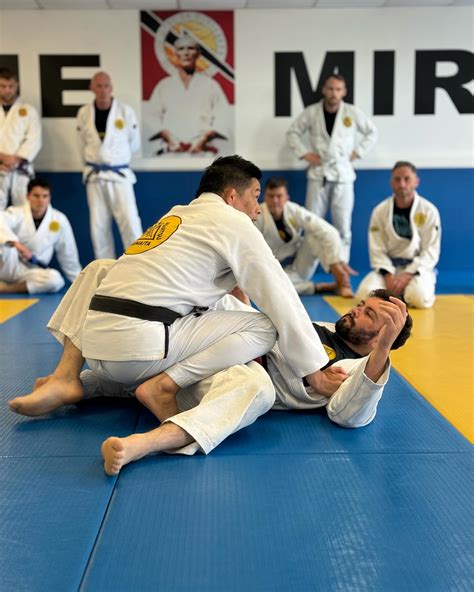
Known by many as Brazilian Jiu Jitsu, Gracie Jiu Jitsu is a time-tested system of self-defense designed to help people stay safe in a real combat situation.
The roots of Gracie Jiu Jitsu are deeply intertwined with the life and philosophy of its founder, Helio Gracie. While Helio dedicated his life to teaching self-defense and improving the well-being of his students, he also crafted one of the most realistic, efficient, and effective fighting systems ever seen.
Let’s delve into the rich history of Gracie Jiu Jitsu and the legacy of Helio Gracie.
The Origins of Gracie Jiu Jitsu
The origins of Gracie Jiu Jitsu goes all the way back to the early 1900s in Brazil where the Gracie family started to study traditional Martial Arts such as Japanese Jiu Jitsu and Judo.
It is difficult to be precise when and at what point or where exactly Jiu-Jitsu originated. When trying to understand the origins of Jiu-Jitsu, we must avoid simplifying its creation to a person, a group, or a period. But a martial art consists not only of techniques or fighting strategies.
Read also: The Rise of Impact Wrestling
When we consider the philosophical framework of Jiu-Jitsu, it is reasonable to associate Buddhist monks in India around 2,000 B.C. Wrapped by important Buddhist principles like acting in a non-harmful way or pursuing self-mastering and enlightenment, Jiu-Jitsu served well the self-defense needs of monks.
In a country fragmented by the feudal system, with each feud having its own set of warriors (the Samurai), Jiu-Jitsu became a necessary fighting skill for combat survival. But Jiu-Jitsu did not earn this name until the 17th century. Jiu-Jitsu evolved among the Samurai as a method for defeating an armed and armored opponent without weapons.
Because striking against an armored opponent proved ineffective, practitioners used their attackers’ energy against them rather than working to oppose that energy directly. The radical political, cultural, and social transformations in Japan in the 19th century made Jiu-Jitsu gravitate from a reputable art of combat to an illegal practice.
When the days of the Samurai came to an end, the gun replaced the sword, and new sportive ways to practice martial arts were developed. Eventually, in Japan many different variations of Jiu-Jitsu took shape, including Karate, Aikido, and Judo.
This lack of reality created years of confusion in the martial arts community, a confusion that legendary Bruce Lee would later refer to as the ‘classical mess’. Bruce Lee was actually a student of Judo and did many studies on grappling while he was alive. He criticized traditional martial arts as being ineffective.
Read also: Delving into Cruiserweight Boxing
It wasn’t until the sport art of Judo and the combat art of Jiu-Jitsu were introduced to the Gracie family in Brazil that the real art of Jiu-Jitsu would be brought to life again.
Japanese Jiu-Jitsu (practiced as Judo) was introduced to the Gracie family in Brazil around 1914 by Esai Maeda, who was also known as Conde Koma. Maeda was born in 1878 and became a student of Judo (Kano’s Jiu-Jitsu) in 1897. He was a champion of Jiu-Jitsu and a direct student of Kano Jigoro, at the Kodokan in Japan.
In 1914, Maeda was given the opportunity to travel to Brazil as part of a large Japanese immigration colony. In Brazil, in the northern state of Para, he befriended Gastão Gracie, an influential businessman, who helped Maeda get established. To show his gratitude, Maeda offered to teach traditional Japanese Jiu-Jitsu to Gastão’s oldest son, Carlos Gracie.
Carlos was introduced to Jiu-Jitsu at the age of 14. He became an avid student for a few years. The training under Maeda had a profound impact on him. The times with Maeda lasted for a short time, though.
Arriving in Rio de Janeiro at 20, Carlos Gracie had difficulties adapting to everyday life and working a regular job. Carlos's wild spirit would not allow him to settle down. At the beginning of the 20th century in Brazil, the martial arts instructor's profession was not exactly promising. The passion for Jiu-Jitsu, and Koma’s earlier dedication to making him a champion, allowed Carlos to discover a new meaning to his life. At 23, Carlos Gracie understood well the excellent benefits Jiu-Jitsu could bring to one's life.
Read also: Watch Canelo on DIRECTV
The Marquês de Abrantes school was not exactly what one would expect as the pioneering powerhouse of Gracie Brazilian Jiu-Jitsu. Carlos knew it would be impossible to accomplish such a gigantic task alone. With that house, however, Carlos united his brothers and engaged them in his life project. The first generation of Gracie brothers living and working in that same house forged the family spirit we still feel today.
Helio Gracie: The Innovator
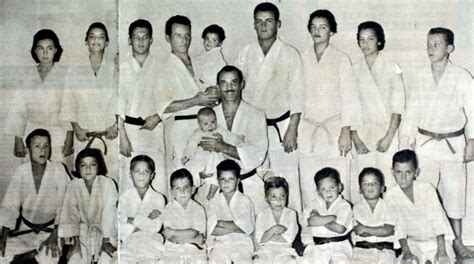
Helio Gracie, the youngest son of Gastão and Cesalina Gracie’s eight children (three were girls), was always a very physically frail child. At age fourteen, he moved in with his older brothers who lived and taught Jiu-Jitsu in a house in Botafogo, a borough of Rio de Janeiro.
One day, when Helio was 16 years old, a student showed up for class when Carlos was not around. Helio, who had memorized all the techniques from watching his brothers teach, offered to start the class. When the class was over, Carlos showed up and apologized for his delay. The student answered, “No problem.
Helio soon realized that due to his frail physique, most of the techniques he had learned from watching Carlos teach were particularly difficult for him to execute. Eager to make the techniques work for him, he began modifying them to accommodate his weak body.
Helio’s adjustments on the techniques at the time made it possible for smaller people to defeat more powerful attackers. This refined system became known as Gracie Jiu Jitsu, emphasizing efficiency and control.
In order to prove the effectiveness of his new system, Helio openly challenged all the reputable martial artists in Brazil. He fought 18 times, including matches against onetime world heavyweight wrestling champion, Wladek Zbyszko and the #2-ranked Judoka in the world at the time, Kato, whom Helio choked unconscious in six minutes. His victory against Kato qualified him to enter the ring with the world champion, Masahiko Kimura, the best Jiu-Jitsu fighter Japan has ever produced, and who outweighed Helio by almost 80 pounds.
Kimura won the match, but was so impressed with Helio’s techniques that he asked Helio to go teach in Japan claiming the techniques Helio presented during their bout did not exist in Japan.
Widely regarded as the first sports hero in Brazilian history, Helio also challenged boxing icons Primo Carnera, Joe Louis, and Ezzard Charles. A dedicated family man who exemplified a healthy life-style he was the epitome of courage, discipline, determination, and an inspiration to people everywhere.
Helio Gracie lived to be 95 years old, from October 1, 1913 to January 29, 2009. He held a 10th degree red belt (Grandmaster) in Brazilian Jiu-Jitsu and a 6th degree black belt in Judo. Helio had four sons, Royler, Rolker, Royce and Robin and two daughters, Rerika and Ricci.
Gracie vs. Kimura - October 23, 1951 (Maracanã Stadium - Rio de Janeiro, Brasil)
Helio Gracie’s Vision
Helio Gracie’s primary mission was to empower individuals through self-defense. He believed that everyone, regardless of size or physical ability, should be able to protect themselves. This philosophy drove him to develop techniques that emphasized leverage and technique over strength, making them practical and effective for real-world situations.
Beyond self-defense, Helio saw Jiu Jitsu as a means to improve lives. He taught classes to people from all walks of life, instilling values of discipline, respect, and confidence. His teaching extended beyond the physical techniques, emphasizing the importance of mental fortitude and emotional resilience.
Kano also realized Jiu-Jitsu could be used as a powerful educational tool that could support any human being's development. Complementing his updated training philosophy, Kano made an effort to adopt new training methods and remove dangerous techniques. This new philosophical and methodological approach to the practice of Jiu-Jitsu had a significant positive impact on Japanese society. It helped Jiu-Jitsu regain its social status that had been declining since the Meiji Restoration.
The Gracie Family and the UFC
To bring more notoriety and recognition to Kano Jiu-Jitsu, Jigoro Kano and the Japanese government began working towards adding it to the Olympic Games. As Kano Jiu-Jitsu evolved into the sport of Judo, many rules were introduced to redefine the focus of practice and make the sport more appealing to spectators. While the reforms of Jigoro Kano contributed tremendously to the survival of a millenary martial art tradition, the emphasis on take-downs created a fragmented martial art.
Among Kano's remarkable students, though, was Mitsuyu Maeda. After traveling to many countries, including the US, Central America, and Europe, Maeda landed in Brazil in 1914. In 1914 Maeda landed in the northern state of Para, Brazil, to help establish the Japanese colony in that region.
The UFC was created by Helio’s son, Rorion Gracie, in order to identify the best martial art/fighting discipline. The Gracie family (Portuguese: [ˈɡɾejsi]) is a family of martial artists originally from Belém, state of Pará, Brazil, whose ancestors came from Paisley, Scotland. As a family, the Gracies upheld the "Gracie Challenge", a martial arts challenge intended to showcase the effectiveness of their style of grappling against other martial arts disciplines.
Gastão Gracie from Rio de Janeiro, the grandson of George Gracie through his son Pedro, married Cesarina Pessoa Vasconcellos, the daughter of a wealthy Ceará family, in 1901 and decided to settle in Belém do Pará. Gastão became a business partner of the American Circus in Belém. Maeda's teachings were then passed on through local Rio de Janeiro coaches to Carlos and his brothers Oswaldo, Gastão Jr., George, and Hélio.
When choosing who would represent Gracie Jiu Jitsu, Rickson Gracie was an ideal candidate since he was already well versed in Vale Tudo tournaments and highly experienced. But Rorion selected Royce Gracie, his younger brother. He was small and had an average stature.
Royce Gracie won the first ever UFC 1 held in Denver, CO in November of 1993, which was a tournament style competition. He then continued his reign to UFC 2 and UFC 4. He won his last match in UFC 3, but had to forfeit before the semi-final match. He had a draw against Ken Shamrock in UFC 5.
With Royce Gracie, one of Helio’s sons, winning the 1st, 2nd, and 4th Ultimate Fighting Championships, Brazilian Jiu Jitsu’s popularity started to achieve a global reach. With the birth of UFC and what would eventually become MMA (mixed-martial arts), Royce demonstrated the effectiveness of Brazilian Jiu-Jitsu and how technique, knowledge, experience can overcome size and strength.
The Gracie Triangle is a trademark of the Gracie family jiu-jitsu heritage. The Gracie Triangle, the widely recognized symbol of the Gracie Academy, has evolved over the years. The three sides represent the mind, body, and spirit - the three components of Gracie Jiu-Jitsu mastery.
As more events were held, Royce would go on to win two more early UFC tournaments. In the early 1990s, Rorion Gracie collaborated with promoter Art Davie to create an eight-man single-elimination tournament for the purpose of showcasing the effectiveness of Gracie jiu-jitsu against other martial arts. The tournament would be no-holds-barred combat, much like the vale tudo matches the family had participated in for years in Brazil. The inaugural tournament took place on November 12, 1993.
Rorion's younger brother Royce served as a combatant in the tournament, representing the family's martial art. With the growing popularity of grappling, members of the family have distinguished themselves in international competition. Roger Gracie won the World Jiu-Jitsu Championship 10 times in various weight divisions (6 times at 100 kg, once at 100+kg, and 3 times in the Absolute division).
Gracie Jiu Jitsu Techniques
The effectiveness of Gracie Jiu Jitsu lies in its simplicity and efficiency. Techniques such as joint locks, chokes, and positional control allow a smaller person to defend against and neutralize a larger, stronger attacker.
As you don your Jiu-Jitsu Gi and sip on your Acai pre-workout, what do you reflect on? If you’re like many Jiu-Jitsu practitioners, you look forward to your rolls, drilling moves, and positions in your head. Or have you wondered about the evolution of Jiu-Jitsu?
Of course, there is a well-known answer to this question: Mitsuyu Maeda came to Brazil and captured the attention of the then-14-year-old Carlos Gracie. That story is told often and is well understood and accepted by the Global Jiu-Jitsu community. But have you ever considered what led to that meeting? What were the events that brought Mitsuyu Maeda to Brazil in the first place? How did he come to meet Carlos Gracie?
The Modern Legacy of Gracie Jiu Jitsu
Today, Gracie Jiu Jitsu is practiced worldwide, and is respected for its practicality and effectiveness. It remains a foundational martial art in MMA and is integral to the training of law enforcement and military personnel.
While the core principles of Gracie Jiu Jitsu remain unchanged, the art continues to evolve. Modern practitioners build on Helio’s legacy, adapting techniques to new challenges and integrating advancements from other martial arts disciplines.
At Griffin Jiu Jitsu Academy, we uphold Helio’s vision of empowering individuals through Jiu Jitsu. We teach not only the physical techniques but also the mindset that Helio championed-confidence, humility, and resilience. Our instructors, many of whom have trained under the direct lineage of the Gracie family, are dedicated to passing on these timeless principles.