This article delves into the multifaceted world of pool wrestling, covering various aspects from AAU (Amateur Athletic Union) guidelines to the unique underwater sport of Aquathlon. Whether you're a wrestler, coach, official, or simply a fan, this guide provides valuable insights into the rules and regulations governing these exciting competitions.
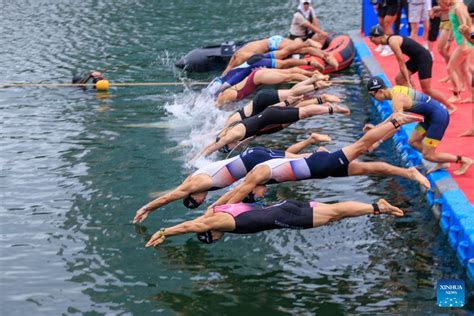
Aquathlon Competition
AAU Wrestling Guidelines
The AAU (Amateur Athletic Union) sets forth specific guidelines for wrestling events, ensuring fair play, safety, and professional conduct. These guidelines cover various aspects, including weigh-ins, officiating, protests, and tournament formats.
Weigh-Ins
For all AAU national events, weigh-ins will last for four hours and take place the day before competition begins. Satellite weigh-ins are allowed. An AAU official will be present in the weigh-in room during all scheduled weigh-ins. There will be only one weigh-in for either single or multiple day events. All wrestlers must weigh-in wearing a singlet.
During weigh-ins, the trainer or medical personnel will complete a full skin evaluation process on each athlete. All contagious skin diseases should be evaluated on site by the trainer working that event, and only then if deemed that the wrestler is unfit for participation. The Trainer has final word of participation unless medical release is provided by a licensed medical doctor. No alteration in any uniform/equipment will be permitted in order to control the spread of skin disease.
Read also: Discover the story of Casey Swiderski
Official Conduct
All AAU referees, judges, mat chairs, and pairing masters shall conduct themselves in a professional manner at all times. It is essential that each official exhibit good citizenship and high moral conduct in their relationships with athletes, parents, coaches, fans, and fellow officials. Each must, at all times, maintain the highest degree of personal integrity.
Protests
Protests must be of a technical (rule violation) nature, not of a judgmental nature. Protests must be submitted to the Tournament Technical Committee within thirty (30) minutes of the end of the alleged violation.
The protest must include:
- Names of contesting wrestlers or persons involved, including their Division and weight class.
- Mat number or its identification if the mats are not numbered.
- Names of the officials who observed the alleged violation.
- Nature of the protest, including particular rules violated.
A $50.00 refundable deposit, if protest is upheld, is required at the time of the protest filing. If the protest is denied, the deposit is retained by the Tournament Committee. An un-appealable final decision will be rendered by the Tournament Technical Committee as soon as possible, before the next round in that weight class. A written report of all protests, including their results, will be forwarded to the AAU National Wrestling Chair.
Tournament Formats
Team duals may use brackets, pools, or a combination of both. Rules for brackets & pools are found in the International Style (FILA) or the National Federation of State High School Athletic District (NFSHSAA) rulebook. AAU has modifications to both rulebooks. Contact the National Official(s) for further information.
Read also: Sectional Wrestling Tournament Details
Individual tournaments will use brackets when there are six (6) or more wrestlers. If there are only 5 or less wrestlers, the round-robin system of “one against the other” is applied. All National tournaments will be run using the number system. Brackets will not be repaired due to no-shows unless it creates a double bye.
If a wrestler is forced to withdraw from the tournament because of an injury, illness, or a reason approved by the Tournament Committee, he must officially withdraw in writing.
Pairing Procedures
In each round, the pairings and the results of each bout are recorded on a master pairing sheet. A wall pairing sheet shall also be posted for the competitors so they may be informed about the result of their matches and the next round of pairings. An order of bouts shall be posted for the competitors. In international competition, the color of the uniform is determined by the wrestler in the bracket. The top wrestler in the bracket is red.
Rules Modifications
Folkstyle, Individual, Pool, and Dual Matches will use the current High School Federation Rules with modifications. Freestyle and Greco-Roman, Individual, Pool, and Dual Matches will use the current FILA Rules with modifications.
Tie breakers for Individual tournaments will be published at each tournament. Tie breakers for Pool Play will be published at each tournament.
Read also: The story of Angelo Posada
Club/Team Competition
Local organizing committees of National AAU Wrestling events have the clearance to include club/team competition. It is the prerogative and responsibility of the tournament host to determine and announce if there will be club/team competition.
In any competition for club awards, a wrestler may represent only one AAU club/team.
- Super Clubs/Teams will consist of a roster of All-Star wrestlers.
- Level 1 Clubs/Teams will consist of a roster of less than seventeen (17) wrestlers.
Club/Team rosters will be obtained through TrackWrestling. The coach must submit a copy (proof) of the clubs/team current membership with the AAU at registration time to be eligible for club/team competition. Placement earned only by those on the point earning list will be included in club/team scoring.
Once weigh-ins close, the only changes that are allowed are changes in a wrestler’s weight class. No advancement or fall points will be awarded. Only placement points will be used to compile club/team scores:
- First place = 16 points
- Second place = 12 points
- Third place = 9 points
- Fourth place = 7 points
- Fifth place = 5 points
Women's Events
The AAU encourages the development of women’s events. Females may wrestle in all AAU wrestling events but most compete against the males in the appropriate weight, classes, and divisions. If a female division is offered, you may wrestle in this.
Female age divisions will be comparable to those of the male divisions. Similarly, weight classes will either parallel those of the males or block weights (the Madison System) may be employed.
The age categories and weight classes for women’s wrestling shall be identical to those for men’s wrestling.
Attire
The attire for women wrestlers includes:
- A leotard or a singlet specifically cut/designed for women. It is mandatory that all participants have at their disposal one singlet of any design.
- Wearing supple wrestling shoes with no heels, buckles, or metal attachments.
- Wearing a bra without metal clasps is recommended.
- Hair must be tied back with an elastic or ribbon, with no metal attachments.
- Without jewelry.
A separate area for female weigh-ins will be provided. Bouts are to be identical in length for men and women.
The RULES OF WRESTLING explained for beginners and parents
Aquathlon: Underwater Wrestling
Aquathlon, also known as underwater wrestling, is an underwater sport where two competitors wearing masks and fins wrestle underwater in an attempt to remove a ribbon from each other's ankle band in order to win the bout. The "combat" takes place in a 5-metre (16 ft) square ring within a swimming pool.
The Basics
The competition is made up of three 30-second rounds, with a fourth round played in the event of a tie. The sport originated during the 1980s in the former USSR (now Russia) and was first played at international level in 1993. It was recognised by the Confédération Mondiale des Activités Subaquatiques (CMAS) in 2008.
Competition Area
The sport is conducted in a swimming pool with a water depth between 2 metres (6.6 ft) and 6 metres (20 ft). The competition area consists of a 5 metres (16 ft) square ring and a 2.5 metres (8.2 ft) wide free area around the ring, both marked with ropes floating on the surface of the water. One side of the ring is marked with a red rope (known as the red side) while the opposite side is marked with a yellow rope (known as the yellow side).
At the bottom of the pool, a 5 metres (16 ft) square mat with a white circle in the centre (1 metre (3.3 ft) in diameter) is placed immediately underneath the competition area. At opposite sides of the mat, a red hoop and a yellow hoop, each measuring 1 metre (3.3 ft) square in diameter, are located.
Equipment
Competitors wear:
- A swimsuit
- A diving mask
- Fins made of rubber or polyurethane
- A water polo cap
- Two ankle bands (40 centimetres (16 in) long by 5 centimetres (2.0 in) wide) to which 2 coloured ribbons (20 centimetres (7.9 in) square long by 2 centimetres (0.79 in) wide) are fixed.
Competition Format
A competition which is known as a combat consists of three rounds each of 30 seconds duration, and an additional round held to establish the winner in the event of a tie.
History
The sport was created and developed during the years 1980 to 1982 by Igor Ostrovsky, an underwater sports coach at the Moscow Technological Institute. It was first officially demonstrated in April 1982 in Moscow. The first International Competition was held during August 1993 in Moscow.
During March 1996, representatives of diving federations from Russia, Ukraine, and Israel met in Moscow to establish the International Aquathlon Association (IAA). IAA's goals are to develop the sport, encourage the foundation of national federations and associations to play the sport throughout the world, ensure the adoption of international rules of competition, and authorise official international competitions.
Recognition and Expansion
The sport was presented to CMAS in 2007 at the CMAS Games in Bari, Italy. It received recognition from CMAS at the General Assembly held in May 2008, and international level competition under the auspices of CMAS commenced in late 2008.
Prior to 1990, all competition was held in the Soviet Union. The 1st Russian Open Aquathlon Championship was held in Tula in 1992. In 1993, the 1st International Aquathlon Competition was held in Moscow with national teams from Israel, Russia, and Ukraine in attendance. A series of Friendship Competitions were held between Israel and Jordan during 1997 in Aqaba, Jordan, and during 1998 in Netanya, Israel.
Key Events
- 1st European Championship held in Kazan, Russia on 25 July 2010.
- 1st World Cup was held in St.
- 1st CMAS Aquathlon International Competition was held in Sochi, Russia, from 6 to 10 November 2008.
Other Pool Wrestling Variations
Besides the formal rules and regulations, pool wrestling can also take on more informal and entertaining forms. These variations often emphasize fun and crowd engagement.
Jello Wrestling
Jello wrestling involves contestants wrestling in a pool filled with Jello. A common rule is the 3-second pin rule, where a referee counts for 3 seconds while a player is pinned. Games are usually best of 3 or 5 rounds. There are also variations like removing an opponent's shirt or sweatbands.
Crowd Support Rule
In this variation, the winner is judged by crowd support at the end of a timed round. Entertaining the crowd can be as important as wrestling skill.
Jello Tug of War
A Jello Tug of War competition involves teams pulling each other into a Jello pit. This idea has been used by schools as a fun way to raise money and promote awareness of important causes.
Tournament Systems
Wrestling tournaments employ various systems to determine the winner. Here are a few:
Knockout/Repechage
Wrestlers are drawn into brackets at random or according to their seedings and face off in direct elimination matches. The wrestlers defeated by each of the two finalists before the semis, meanwhile, enter the repechage round of their respective brackets. After playing elimination matches in the repechage, the last remaining grappler faces the losing semi-finalist of their respective bracket for the bronze medal.
Nordic System
Under the Nordic system, the wrestlers fight each other in a round-robin format. After all the matches are over, the wrestlers are ranked according to the number of victories.
Group System
In this format, the wrestlers are divided into two groups and the competitors in each group face each other in a round-robin format. After the group standings are established, the top wrestler from the first group faces the runners-up from the second group in the semi-finals. The two semi-final winners then fight for the gold medal.