Karate and Taekwondo are renowned martial arts with rich histories and structured systems for skill development and recognition. A key component of these systems is the use of colored belts to signify a practitioner's rank and expertise. While the "Black Belt" is widely recognized as representing an expert level, the meanings and order of the other colors are often less understood. This article delves into the belt ranking systems of Karate and Taekwondo, tracing their origins, explaining the significance of each color, and outlining the journey from beginner to master.

Origins of the Belt Ranking System
Karate is a Japanese martial art with a rich, ancient history. The origin of the word “Karate” breaks down into “Kara,” meaning “empty,” and “te,” meaning hand. Like various Asian martial arts, the origin of karate may be ancient, but the way individuals practice it today is modernized. Japan banned weapons in Okinawa in 1609, resulting in continued practice and refinement of empty-hand fighting techniques. Although practitioners have studied the art of Karate in varied forms for a millennium, a well-known component of the art today is relatively new: belt colors in Karate.
The first use of colored belts can be traced back to the 1880s with the founder of Judo, Dr. Jigoro Kano. The Judo belt grading system stems from the Japanese board game, Go which is similar in nature to chess. The original Judo belt system had six colors: White, Yellow, Green, Blue, Red, Black.
This system became the foundation of many martial arts, including Taekwondo. The Taekwondo belt naming system actually has its’ roots in Judo, with founding kwans (dojos) of Taekwondo such as Hong Choi, taking the concept of the Judo belt system and adapting it to Taekwondo. In truth, the colors between white and black were added in the 1930’s by Tae Kwon Do and Jiu Jitsu practitioners to give students recognition of their level of skill and knowledge. In the 21st century the colored belts are considered integral to a student’s rank and experience. These martial arts belts have no buckles or clasps. The belt colors in Karate acknowledge the expertise and rank of anyone practicing and performing the martial art.
Karate vs Taekwondo – What’s the Difference?
The Karate Belt Order and Their Meanings
From start to finish, there are nine solid color belts in Karate, from white to black. Many martial arts systems also have stripe belts that denote a higher level of that belt color which would break up the goal of Black Belt into smaller baby steps which is more conducive to learning. Each color in the Karate belt order represents a different level of skill and experience. Here's a breakdown of the typical Karate belt order and the associated meanings:
Read also: Why Choose a Purple Weightlifting Belt?
- White Belt: The absolute beginner starts without a belt. Just as the beginner has no knowledge of martial arts, they also have “no belt”. The beginner student will wear the martial arts uniform or “gi” but without a belt. A student who has no knowledge of the art but has begun the journey. The white belt represents a beginner with an open and pure mind, ready to learn. The white symbolizes that the student is new to the martial art, but also shows their level of experience.
- Yellow Belt: When a student shows proficiency at the basics they can earn their gold belt and move up to the next level. At this point of their training the student will be introduced to a more advanced curriculum often including a classical “form” or “kata”. The student has begun to amass skill. As students gain knowledge, they earn the yellow belt, which symbolizes the first rays of understanding, like sunlight bringing new growth. Yellow belt is also the first belt that begins to learn poomsae (see glossary). This belt is the 2nd belt in the beginner program and is the halfway point to the intermediate program.
- Orange Belt: Some martial arts systems will add an orange belt. Orange belt is the final belt in the beginner program. This is the 3rd rank that a student will earn in taekwondo and at this belt, students will continue to learn new techniques as well as learning their 2nd poomsae. The orange belt shows that a student is gaining energy and enthusiasm in their practice.
- Green Belt: The green belt color represents growth as students continue to grow and progress in martial arts. At this point many styles feel that the student is proficient enough to be introduced to sparring or fighting with controlled contact. Green belt is the first belt in the intermediate program. Students at this belt have been training for almost a year and have learned all of the beginner techniques. In addition to learning a new poomsae, students at this rank will also begin sparring (or self-defense) training. The green belt represents continuous growth and development in martial arts proficiency.
- Blue Belt: The fourth level, blue belt symbolizes the sky. Students holding a blue belt will start to gain advanced Karate knowledge, learning and mastering the most basic techniques. Blue belt training commonly focuses on refining learned techniques with increased speed and power while learning new moves and advancing to higher levels. Blue belt is the final belt of the intermediate program. At this belt, students will continue to learn more complex techniques and prepare to test for their brown belt. The blue belt reflects a deeper understanding and greater control of martial arts techniques.
- Purple Belt: A purple belt represents how a blue sky begins to darken and change at dawn. Karate practitioners at this level are gaining a more profound understanding and knowledge of the art and are considered “intermediate” students. Purple is one of the most difficult belts in a color belt’s journey to black belt. At this point, it has been over a year of training, and not surprisingly, this is when a lot of students begin to lose motivation. However, through engaging classes, consistent training, students are able to pass this rank and move on to the advanced program. The purple belt indicates a higher level of skill, experience, and commitment.
- Red Belt: The red belt represents the sun’s strength, as these students have mastered the basic and intermediate techniques. The red belt is a graduation into the “advanced” level of their martial arts training. Red belt is the next belt in the advanced program. This belt focuses again on more advanced techniques, and Red belts also focus on improving their technique by practicing one of the more complex Tae Geuk (see glossary) forms.
- Brown Belt: As a seed fully matures and ripens, it will turn brown. The brown belt shows a student maturing into their martial arts practice, signifying their readiness to enjoy the ripe fruits of their efforts. Brown belt is the first belt in the advanced program. As students earn this belt, there is typically a renewed interest in the martial art as they begin to learn more complex techniques and more intense poomsae. The brown belt symbolizes maturity and mastery of advanced techniques.
- Black Tip Belt: Black Tip is the final rank before a student begins preparing for their black belt test. At this point, students will have trained for just over 2 years and have learned 7 poomsae. As a Black Tip belt, students will learn the 8th and final Tae Geuk poomsae as well as the final color belt techniques. After this rank, students will earn their Recommended Black Belt and start to prepare for their black belt test.
- Recommended Black Belt: Recommended Black Belt is the final belt before a student earns their black belt. As mentioned in the white belt description, the darker a student’s belt, the more experience they have. Recommended Black Belts are half red and half black indicating that a student is extremely close to Black Belt.
- Black Belt: The Black Belt remains the highest, most coveted rank in the Karate belt order and typically takes approximately three years of training to achieve this goal. The student has obtained self-confidence and maturity. This belt denotes that a student traveled through the entire ranking system and is recognized as a very special achievement of mind and body. Black Belt holders are typically considered Karate experts with enough experience to teach other students Karate techniques and philosophy. To the true martial artist Black Belt is not considered the end of their training but rather the beginning. While earning a Black Belt may be on the bucket list of many, to the martial artist karate is a way of life and something they endeavor to do for a lifetime. The student has graduated to a degree in the Martial Arts. The black belt is a sign of proficiency, expertise, and deep understanding of the martial art.

Advanced Black Belt Degrees (Dan Ranks)
The "Black Belt" was designed as a way to show competence in the art, not mastery of it.
- Second Degree (Ni-dan): The Second-Degree black belt continues to master the art and must train for a minimum of two years as a Black Belt.
- Fifth Degree (Go-dan): After seventeen years of diligent training (3 years as a student and 14 years as a Black Belt) 5th Degree is finally the level at which the title “Master” is earned. A 5th Degree Black Belt is someone who has procured a “mastery” of the martial arts through years of training and instruction. In addition to the physical skills and knowledge, a Master of the martial arts must also be able to impart their knowledge to others. One of the tenants of the martial arts has always been that you understand the art deeper when you teach it to someone else.
- Sixth Degree (Roku-dan): This level of Black Belt is achieved six years after 5th Degree or twenty years as a Black Belt.
- Seventh Degree (Nana-dan): Achieved seven years after 6th Degree or after twenty-seven years as a Black Belt. This level is for experienced karate masters with a deep understanding of the martial art. By this time, the 7th Degree Black Belt probably has “martial arts grandchildren”. That is, their students who have achieved Black Belt have trained students that have earned Black Belt and become the original instructors “martial arts grandchildren”.
- Eighth Degree (Hachi-dan): Earned after eight years as a 7th Degree or thirty-five years as a Black Belt. This belt is reserved for Masters who have practiced the art for almost a lifetime and have made an impact on the martial arts world.
- Ninth Degree (Kyu-dan): Earned nine years after 8th Degree or forty-four years as a Black Belt.
- Tenth Degree (Ju-Dan): This is the highest and most prestigious rank, awarded to masters who have given a lifetime to the furtherance of the martial arts and have demonstrated a lifetime of significant achievement. They have poured into their students and martial arts system the life lessons of honor, respect, courage and instilled in others the indomitable spirit of the Black Belt. “It is a humbling burden that can only be born by the most deserving, the most strong, ardent and caring of humans.”(SJ) If deserving, this rank takes a minimum of fifty-four years as a Black Belt! There are probably only a dozen or so true 10th Degrees in the United States. Amazingly, the National Karate schools actually have two 10th Degree Black Belts! Grand Master John Worley and Grand Master Larry Carnahan are two of the most influential martial artists in America.
The Taekwondo Belt Order
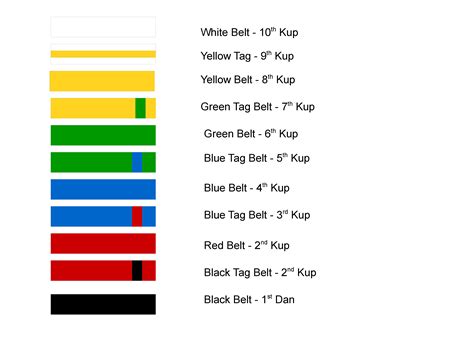
Taekwondo features a slightly different belt system, usually progressing through White, Yellow, Green, Blue, Red, and Black belts. Here is the belt order for Taekwondo:
- White Belt
- Yellow Belt
- Orange Belt
- Green Belt
- Purple Belt
- Blue Belt
- Brown Belt
- Red Belt
- Black Tip Belt
- Recommended Black Belt
- 1st Degree Black Belt
Requirements for Advancing Through Belt Levels
Advancing through belt levels requires dedication, practice, and meeting specific requirements. Most martial arts schools have a minimum training period for each belt level to ensure that students gain enough experience before moving forward. In addition to time, students must also pass skill tests where they demonstrate their techniques, forms, and sparring abilities.
Students must spend a minimum time at each belt level to ensure they get enough practice and experience before advancing. Proficiency in stances, strikes, blocks, kicks, throws, and defensive techniques is essential. Understanding of martial arts history, philosophy, and principles is required. Students must pass a belt exam, where they showcase their progress through technical demonstrations, sparring, self-defense drills, and sometimes breaking techniques.
During the testing process, instructors and senior evaluators carefully assess the student’s strengths, weaknesses, and areas for improvement. Many Martial Arts Belt Levels schools incorporate an oral or written examination as part of belt testing.
Read also: Comprehensive Taekwondo Forms
Psychological and Emotional Impact of Earning a New Belt
Earning a new belt is not just a physical achievement-it has a significant psychological and emotional impact on a student’s development. Every belt earned is a symbol of progress, dedication, and hard work. Martial Arts Belt Levels training is filled with challenges, setbacks, and moments of struggle. The belt system instills a strong sense of discipline and goal-setting. Students must commit to regular training, stay focused, and push themselves to meet the requirements for advancement. As students advance through the belt ranks, they experience a deep sense of accomplishment.
Conclusion
The Martial Arts Belt Levels is more than just a ranking structure it is a symbolic journey of growth, discipline, and mastery. Originating from Judo founder Dr. Jigoro Kano, the system has evolved across different martial arts disciplines, incorporating various belt colors to represent progression in skill, knowledge, and experience.