The Shaolin Cowboy, a character created by Geof Darrow, has carved a unique niche in the world of comic books. He is a wandering, taciturn monk who is a supernaturally gifted kung fu fighter. The cowboy wields a cool parasol sword and decapitator hat, and is the constant target of violent crime from grotesque sci-fi monsters and the like, sometimes for no real reason.
Geof Darrow's distinct style blends manic energy with incredible detail. Every page and panel is overloaded, filled with seemingly impossible levels of detail. Despite this attention to detail, Darrow is often accused of producing books that are light on story and heavy on action.
“The action is the story,” Geof Darrow said, putting an emphasis on the is. There’s something kinetic about his work, an overall sense of life and movement that few artists ever manage to capture.
Evolution of the Shaolin Cowboy
The Shaolin Cowboy saga appears to be making a long trip from the irreverence of the first series, which was basically a collection of gags and action set-pieces tied with the loosest plot justification possible, to a more politically engaged modern form.
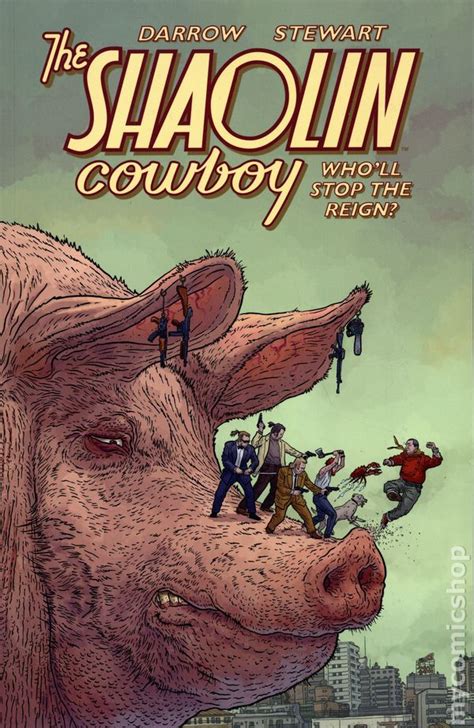
The previous Shaolin Cowboy miniseries, Who’ll Stop the Reign? by Geof Darrow, came out in early 2017. It was an obvious, and emotional, reaction by Darrow. That comic was subtle as two chainsaws attached to the sides of a large stick (a typical occurrence in Shaolin Cowboy). Not so much in the major plot, but in the residual radiation - the story’s depiction of a major American metropolis eaten by hate and racism and violence and consumerism and filth.
Read also: Learn Shaolin Self-Defense
Meanwhile, in our world, more than five years have passed. It’s both contemporary in its reference and technological presentation, as much as an intentionally idiosyncratic world like that of the Shaolin Cowboy can be “contemporary,” and already ancient. The series takes place in a ‘present’ ‘America’ with Darrow refusing to commit to any sort of world-building. Darrow, wisely, doesn’t try to make any sense of it. He draws and writes whatever catches his fancy.
Throughout the series, knowing that there is a bounty on the Shaolin Cowboy’s head has been enough for a reader to jump into any given volume, and that holds true here. While the story may seem scant, Darrow’s art creates a vivid and lush world. Talking animals, bizarre mutants, and monsters; the world Shaolin Cowboy walks through definitely has a history to it.
The Art of Geof Darrow
Darrow’s style is dependent upon the all-out assault on the page, filling out every nook and cranny with characters, background, or movement like an evil universe counterpart to Alex “Eliminate the superfluous” Toth. There is no “superfluous” to a Darrow page, from the largest of main characters to the smallest background detail, everything is given the same line weight.
Compare early and mid-career Kirby, recognizable stylist but still working in a traditional manner, to the later (and better) Kirby, whose shapes become more blocky and less dependent on ‘correct’ anatomy. Most old masters tend to simplify and become more ‘themselves’ by removing lines (like a sculptor working away at a rock, finding the piece hidden inside). Not Darrow, the more time passes, the more Darrow remains similarly indebted to his crazy overwork ethic.
“Everything matters,” he says. “It matters to me. because it adds content, and it makes it very particular. drawings, each one of those streets: they’re not generic. . . make everything its own creation so it doesn’t get boring. details, there’s much more to his craft.
Read also: Symbolism of Shaolin Haircut
Coloring
Shaolin Cowboy: Who’ll Stop the Reign? is definitely a testament to the awesomeness of Darrow’s art and writing, but it’s also a great showcase for his frequent collaborator, colorist Dave Stewart. He makes me look way better than I deserve to look,” Darrow said.
He noted part of their process involved Darrow sending over palettes and color samples, many from Japanese woodblock prints. At the very beginning, I sent him some Japanese woodblock artists. I liked the palette that they used. I said, “This is the colors that I’d like on this thing.” That was it. Then he just does it.
It’s so odd, it’s like two separate… it’s like from one extreme to the other. I barely change anything. I don’t give him any instructions. I never have. Occasionally, if he asks me, I will say something. I always let him have his hand in it because I believe he knows what he’s doing.
Themes and Influences
The Shaolin Cowboy has clawed his way out of hell and has brought a hoard of festering zombies with him. Luckily, he has a bamboo staff with a chainsaw on each end and some experience of getting out of a tight spot. This fight has been raging since issue #1. With virtually nothing in the way of dialogue, there is only the well captured sound of revving chainsaws and some wonderfully imagined and very fluid choreography.
Having a fight scene that is three issues long (at least!) is, needless to say, a bold move. No patter, no wit, no one-liners - just a double dose of death to any zombie that gets in the way. There are so many severed limbs and heads lying about and enough blood so that the desert will never be dry again.
Read also: Martial arts meets comedy in Shaolin Soccer
The Shaolin Cowboy existed in the same mode as the typical action-adventure story, yet crucially, refused to give the protagonist any positive justification for his violent actions. He’s defending himself from attack, over and over again, but he never fights for something. This is part of what made the comics work, the manner in which Darrow stripped away any notion of “morally justified” violence - this was violence for violence’s sake, which feels more “honest” than most of these stories that try to find a good reason to make the reader cheer on mass murder. We are people hungry for violence, hopefully only the fictional kind, and Darrow is going to give us what we want until we burst.
Darrow appears, to me, closer in spirit to Takashi Miike’s saying: “I don’t have any reasons. I just wanted to do these things.” From that lack of reasoning, from the pure following of artistic instincts, comes the success of so much of Shaolin Cowboy. It’s so stupid it becomes genius.
Darrow has always found stories where the history is hinted at but not explained more exciting. “It’s more interesting not knowing everything. I don’t need to know every little piece of Batman’s past to know he does the right thing.” Darrow also pointed out how the early days of the Star Wars franchise captured this feeling before its massive expansion. “Obi-Wan would talk about things and we didn’t know what they were and that was fine!
“I think Yojimbo just took the top of my head off when I saw it. still think that’s the archetype for most loner heroes,” said Darrow. can watch that thing over and over: it is so amazing. as well. And yet, it’s horrible.
He came from… I always liked Japanese samurai films like Zatoichi. I also liked spaghetti Westerns. I just combined the two of them. I mean not exactly, but he kind of is a little bit like Zatoichi. I mean he’s got the sword that’s similar. As I’ve gotten older, especially with the world we live in, he’s gotten more and more brutal. Even if you look at the first series that Burlyman [Entertainment] did, he’s a little more… as it’s gone on, he’s gotten more and more cynical about people.
Table: Shaolin Cowboy Series
| Title | Year | Notes |
|---|---|---|
| Shaolin Cowboy: Start Trek | 2005 | Collection of gags and action set-pieces |
| Shaolin Cowboy: Who’ll Stop the Reign? | 2017 | Reaction to political climate |
| Shaolin Cowboy: Shemp Buffet | N/A | Plotless, mindless violence |
| Shaolin Cowboy: Cruel to Be Kin | 2023 | Politically engaged modern form |
Geof Darrow's Shaolin Cowboy: This Is What 21 Years of Blood, Sweat & Chainsaws Looks Like
Cruel to Be Kin: A Shift in Tone?
Cruel to be Kin’ starts with the Shaolin Cowboy wandering after the long fight before encountering an old acquaintance, for once - not a person trying to kill him. From there on the story is split in half, one is a long flashback to the desert days of the original Shaolin Cowboy series, and the other is a direct continuation of Who’ll Stop the Reign? which even involves a re-match with the aforementioned ninja-pig.
On the other hand, we have the “modern” half of the story. This part involves Shaolin Cowboy befriending a group of talking lizards( just go with it) before being forced, once again, into a cycle of violence. The problem with the second half of Cruel to be Kin’ is that suddenly Darrow is insisting upon a reason, a justification, a positive moral cause. The Shaolin Cowboy wages combat after seeing that peaceful family of lizards slaughtered, his enemies are a combination of Fox News parodies and neo-Nazis.
Darrow is still Daroow, which means even something as plain as a man setting out to kill baddies for some [insert excuse here] promises to be, if nothing else, extremely breathtaking for its sheer skill on display. It’s page after page of action that would probably make other artists’ hands drop from jealousy and/or sympathy pains.
And yet, no matter how impressive it is, there’s something lacking here. The purity of Shemp Buffet or Who’ll Stop the Reign? has been replaced by something similar to a dozen other action-adventure comics you pick up from far lesser artists. It makes the whole proceeding duller than previous Darrow stories, in a manner that can never be overcome by the wild artwork. Darrow still draws, but it feels almost like someone else, some less led by his id, is writing.
A lesser Darrow is still Darrow. A Darrow who goes too far is still a Darrow. A Darrow who doesn’t go far enough is still Darrow. There’s more beauty, of the ugly kind, in any random page of Cruel to be Kin’ than in most other comics you pick up this year. This isn’t just a manner of the number of lines Darrow crams into every page, being impressive is not the same as being “good,” but the way he can always arrange them with intent. Cruel to be Kin’ is a story we’ve seen before, and a story we’ve seen performed better.