The realm of Filipino martial arts is both diverse and intriguing, weaving together shared origins and core principles. In Filipino martial arts, a trio of terms often intertwine, leading to some confusion for newcomers to these arts: Eskrima, Arnis, and Kali. These arts offer a fascinating glimpse into a rich heritage and a comprehensive approach to self-defense, whether armed or unarmed. As you embark on your journey to master these arts, you’ll be weaving your own fabric of skills, one strike at a time.
The Filipino Martial Arts (FMA) is the umbrella term for the various ancient and newer fighting methods devised in the Philippines. The most popular forms of which are known as Arnis/Eskrima/Kali. Due to the tradition of teaching FMA among family members, (often in secrecy, especially during the occupation by Spain) the FMA have been often been given various names that reflect a focus on particular skill set or family name.
Thus, among the 3 main names mentioned above, the FMA styles include Arnis de Mano, Pananandata (use of weapons), Sinawali, Sitbatan, Kabaroan, Kaliradman, Pagaradman and Kalirongan. Due to the sad state of infighting over various claims of supremecy or inauthenticity of various names of particular styles/methods, FMA has been adopted as a way to include all the different methods/styles/branches of Filipino martial artists.
Due to the geographical location of the Philippines, and the contact with nearby countries' foreign traders, and conquerors, the FMA have been influenced by various degrees by Indonesian, Malaysian, Bruenei, Chinese, India, Arab, and Spanish martial arts. The intrinsic need for self-preservation was the genesis of these systems. The approximate 7000s islands of the Philippines have a history of constant warfare between the various tribes of other islands and foreign conquerors, that has help them develop their fighting skills to a high degree.
Due to constant warfare and armed conflict, the Philippino culture has had the ability to constantly test and adapt their skills and techniques in order to protect their persons, their families, their villages, and their tribes. This desire for survival and protection, has made the FMA focus on efficientcy of movement, and ease of training. Thus, unlike other martial cultures, the FMA first trains with weapons (usually stick, sword, or knife) and then progresses to empty hands.
Read also: Arnis Sticks: A Comprehensive Guide
The Philippines is a blade culture. Due to farming and warfare, blades have always been a part of the Philippine tradition. In 1521, Portuguese explorer Ferdinand Magellan arrived in the Philippines and claimed the islands for Spain. However, colonization really began when Spanish explorer Miguel López de Legazpi arrived from Mexico in 1565 and formed the first European settlements in Cebu.
After putting down native resistance and defeating a Chinese warlord Limahong, the Spanish ruled the majority of the Philippine until 1821. In order to pacify the citizens and make rule easier, the Spanish outlawed martial arts, "disarmed" the populace, and converted the most of the lowland people to Christianity. However, the Southern Philippines with the Moros were never really conquered by the Spaniards or the Americans; nor the Northern mountains of Luzon with their feared headhunter tribes so they kept their weapons and their fighting skills.
Finally, the old FMA masters & instructors resorted to taking their art "underground," and continued to secretively teach their precious art to their family and trusted students in jungles, beaches, and wherever they could be safely out of eye of the Spaniards. Thus, even when fighting systems were outlawed by the Spaniards, Filipinos still were able to maintain their centuries-old relationships with blades and blade fighting techniques. It is often said that their are almost as many Filipino fighting styles, as there are islands in the Philippines.
Filipino martial artists are noted for their ability to fight with weapons or empty hands interchangeably and their ability turn ordinary household items into lethal weapons. Weapons-training takes precedence because they give an edge in real fights, gears students to psychologically face armed opponents, and any object that can be picked up can be used as a weapon using FMA techniques. Since the weapon is seen as simply an extension of the body, the same angles and footwork are used either with or without a weapon.
FMA students usually start their instruction by learning to fight with weapons, and only advance to empty-hand training once the stick and knife techniques have been sufficiently mastered. This is in contrast to most other well-known Asian martial arts but it is justified by the principle that bare-handed moves are acquired naturally through the same exercises as the weapon techniques, making muscle memory an important aspect of the teaching.
Read also: Differences in Filipino Martial Arts
Many systems begin training with two weapons, either a pair of sticks or a stick and a wooden knife. These styles emphasise keeping both hands full and never moving them in the same direction, and trains practitioners to become ambidextrous. For example, one stick may strike the head while the other hits the arm.
A core concept and distinct feature of Filipino martial arts is the "Live Hand." The live hand is the opposite hand of the practitioner that does not contain the main weapon. The heavy usage of the live hand is an important concept and distinguishing hallmark of Eskrima. Even (or especially) when empty, the live hand can be used as a companion weapon by FMA practitioners. The usage of the live hand is one of the most evident examples of how FMA 's method of starting with weapons training leads to effective empty hand techniques.
The techniques include headbutts, bites, pinches, eye gouges, and a variety of strikes using hands, feet, knees, and elbows. most common is a rattan stick for training, and harder denser woods like Kamagong or bahi are use for actual defense. These hardwoods are generally not used for sparring, however, as they are dense enough to cause serious injury, but traditional sparring does not include weapon to body contact.
sarong/malong (a length of fabric worn around waist or over shoulder), ekut (handkerchief), tabak-toyok (chained sticks/flail i.e. Yaw-Yan or Sayaw ng Kamatayan - closely resembles Muay Thai, but differs in the hip-torquing motion as well as the downward-cutting nature of its kicks, and the emphasis on delivering attacks from long range (while Muay Thai focuses more on clinching).
The Philippine government made the FMA a national sport in 1972, and incorporated it into the physyical education curriculum for high school and college students. Knowledge of FMA is mandatory for Philippine military and police force. Marines, and other special forces around the world. and the world due to the teaching of prominent masters like as Prof. Remy Presas, Dan Inosanto, Leo Gaje, and many more. In addition, FMA is becoming prominent in films such as I, Frankenstein, The Bourne series, The Book of Eli, The & The Hunted.
Read also: Individual Martial Arts Instruction
In the Philippines, the choice of term varies by region. Arnis is favored in the northern Philippines, while Eskrima finds prominence in the central and southern islands.
Understanding the Terms: Arnis, Eskrima, and Kali
While Eskrima, Kali, and Arnis share some similarities as Filipino martial arts, they each have distinct features that set them apart.
- Arnis: Arnis comes from arnés,[5] the Old Spanish for "armour" (harness is an archaic English term from same root). It is said to derive from the armour costumes used in traditional Moro-moro stage plays, where actors fought mock battles with wooden swords.[6][unreliable source?] Arnes is also an archaic Spanish term for weapon, used as early as 1712. Arnis is often referred to as “arnis de mano,” which translates to “harness of the hand” or “harness of the hand-to-hand combat” in Filipino. Arnis, predominantly used in the Philippines, especially in the northern regions, represents a more traditional style of stick fighting.
- Eskrima: Eskrima is often associated with stick and knife fighting, gaining recognition both in the Philippines and the United States. Eskrima is sometimes associated with “eskrima de baston,” which roughly translates to “stick fighting” in Filipino. It is also known as estoque (Spanish for rapier), estocada (Spanish for thrust or stab) and garrote (Spanish for club). The indigenous martial art that the Spanish encountered in 1610 was not yet called "eskrima" at that time. During those times, this martial art was known as paccalicali-t (pronounced as pakkali-kalî) to the Ibanags,[27] did ya (later changed to kabaroan) to the Ilokanos, sitbatan or kalirongan to Pangasinenses, sinawali ("to weave") to the Kapampangans, calis or pananandata ("use of weapons") to the Tagalogs, pagaradman to the Ilonggos and kaliradman to the Cebuanos[citation needed].
- Kali: The name kali is most likely derived from the pre-Hispanic Filipino term for blades and fencing, kalis (Spanish spelling: "calis"),[10] documented by Ferdinand Magellan's expedition chronicler Antonio Pigafetta during their journey through the Visayas and in old Spanish to Filipino Mother Tongue dictionaries and vocabulary books dating from 1612 to the late 1800s, such as in Vocabulario de Lengua Tagala by Fr. Kali serves as a comprehensive term within Filipino martial arts, encompassing not just stick and knife fighting but also various empty-hand techniques. Kali is a more complex term.
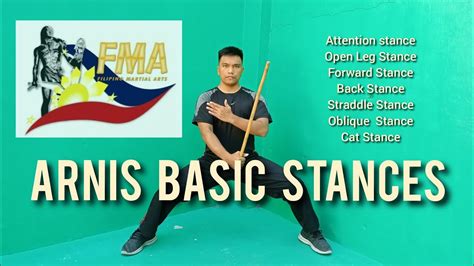
Various Arnis Styles
Note: While Eskrima, Kali, and Arnis share some similarities as Filipino martial arts, they each have distinct features that set them apart.
Beginner Escrima Stick Combo Techniques Part 1 | Kali Stick Fighting
Historical Context and Influences
Another origin of arnis can be traced back to native "Pintados" or then "Tintadus" fighting techniques during conflicts among the various Prehispanic Filipino settlements, though the current form has Spanish influence from old fencing which originated in Spain in the 15th century. It has also been theorized that the Filipino art of arnis may have roots in India and came to the Philippines via people who traveled through Indonesia and Malaysia to the Philippine islands. Silambam, a stick/staff-based ancient martial art of India influenced many martial arts in Asia like silat.
When the Spaniards first arrived in the Philippines, they already observed weapons-based martial arts practiced by the natives, which may or may not be related to present-day Arnis. The earliest written records of Filipino culture and life, including martial arts, come from the first Spanish explorers. Some early expeditions fought native tribesmen armed with sticks and knives.[31] In 1521, Ferdinand Magellan was killed in Cebu at the Battle of Mactan by the forces of Datu Lapulapu, the chief of Mactan. Some Arnisadors hold that Lapulapu's men killed Magellan in a sword-fight, though historical evidence proves otherwise.
Due to the conflict-ridden nature of the Philippine archipelago, where settlements (Kedatuans, Rajahnates and Sultanates) were often at war with one another or raiding each other, warriors were forged in the many wars in the islands, thus during the precolonial era, the geographical area acquired a reputation for its capable mercenaries, which were soon employed all across South, Southeast and East Asia. Lucoes (warriors from Luzon) aided the Burmese king in his invasion of Siam in 1547 AD.
Opinions differ on the degree to which Spanish rule in the Philippines affected Arnis. The fact that a large number of techniques and the names of the arts themselves (arnis/arnes, eskrima/esgrima, garrote, estoque, etc.) have Spanish names suggest an influence. What is certain is that the Spaniards brought with them and used their bladed weapon arts (including the system of Destreza developed by Carranza) when they started colonizing the archipelago in the 16th century.
One of the more prominent features of Arnis that point to possible Spanish influence is the Espada y Daga (Spanish for "sword and dagger") method, a term also used in Spanish fencing. Filipino espada y daga differs somewhat from European rapier and dagger techniques; the stances are different as weapons used in Arnis are typically shorter than European swords.[45] According to Grandmaster Federico Lazo† (1938-2010), unlike in European historical fencing, there is no lunging in the Northern Ilocano Kabaroan style of Arnis - it is more of an evasive art.
After the Spanish colonized the Philippines, a decree was set that prohibited civilians from carrying full-sized swords (such as the Kris and the Kampilan). Despite this, the practitioners found ways to maintain and keep the arts alive, using sticks made out of rattan rather than swords, as well as small knives wielded like swords. Some of the arts were passed down from one generation to the other. Sometimes the art took the form choreographed dances such as the Sakuting stick dance[49] or during mock battles at Moro-moro (Moros y Cristianos) stage plays.
Although Arnis combines native fighting techniques with old Spanish fencing and other influences, a degree of systematization was achieved over time, resulting in a distinguishable Philippine martial art. With time, a system for the teaching of the basics also evolved. However, with the exception of a few older and more established systems, it was previously common to pass the art from generation to generation in an informal approach.
Arnis in Modern Times
The arts had no traditional belting or grading systems as they were taught informally. It was said that to proclaim a student a "master" was considered ridiculous and a virtual death warrant as the individual would become challenged left and right to potentially lethal duels by other Arnisadores looking to make names for themselves. Belt ranking was a recent addition adopted from Japanese arts such as karate and judo, which had become more popular with Filipinos.
With regards to its spread outside the Philippines, Arnis was brought to Hawaii and California as far back as the 1920s by Filipino migrant workers.[75] Its teaching was kept strictly within Filipino communities until the late 1960s when masters such as Angel Cabales began teaching it to others. Even then, instructors teaching Arnis in the 1960s and 70s were often reprimanded by their elders for publicly teaching a part of their culture that had been preserved through secrecy.
In recent years, there has been increased interest in Arnis for its usefulness when defending against knives in street encounters. As a result, many systems of Arnis have been modified in varying degrees to make them more marketable to a worldwide audience. Usually this involves increased emphasis on locking, controls, and disarms, focusing mainly on aspects of self-defense. However, most styles follow the philosophy that the best defense is a good offense.
In the Philippines, the spread is more significant due to the efforts of Richardson "Richard" Gialogo and Aniano "Jon" Lota, Jr. through the Department of Education (DepEd) Task Force on School Sports (TFSS). Arnis was first introduced in 1969 to some public and private school teachers when Remy Presas taught his personal style of Arnis which he called "Modern Arnis". He taught his own style to the students of the National College of Physical Education (NCPE) when he was given the chance to teach there.
During the Spanish era, the practice of this martial art was outlawed by the Spaniards. It so happened that the Spanish war propaganda against the Moros encouraged the staging of various socio-religious plays called the “Moro-Moro” plays, wherein the Spanish were portrayed as victorious in battles against the Moros of Mindanao. It is a form of black propaganda to show the natives that the Spanish race and their religion is superior than that of the natives’.
Juan Luna and M.H. Even our very own National Hero, Dr, Jose P. Rizal, studied Arnis. In his memoirs in Dapitan, he taught Arnis to the children of Dapitan. The likes of Marcelo H. Point of clarification, Arnis is not the STICK, it is the indigenous Filipino system of fighting with or without using weapons. Thus during the Katipunan era, we saw the katipuneros brandishing their bolos.
The martial arts principles of Arnis is designed for self-defense against armed or unarmed attacks. It is usually done using rattan sticks or other similar implements, in three different forms: single cane, double cane of the same length, or two implements with varying length (espada y daga/ sword and dagger). Or, it could be done without canes like simply using the bare hands by following the prescribed techniques. Practitioners could also use bolos, kris, swords and other implements like knives, ballpens and bottles as substitutes.

Arnis Training
Even as a sport, its benefits include instilling discipline, character formation, and the development of skills of the practitioners. And like Karate, Judo and Kendo of Japan, or Tae Kwon Do of Korea, or Wushu and Kung Fu of China, or Muay Thai of Thailand, the Philippines can now be proud to have its own National Martial Art and National Sports that is at par with other world-class martial arts.
The Essence of Kali
More than just stick fighting, Kali emphasizes weaponry - particularly sticks and blades - but also incorporates a wide range of empty-hand techniques, grappling, joint locks, and disarming methods. Filipino warriors adapted techniques and weaponry introduced by the Spanish, and the art itself took on new names: Eskrima, derived from the Spanish word “esgrima” (meaning fencing), and Arnis, evolving from “arnes” (meaning armor).
Kali training involves a variety of key components:
- Weaponry (Sticks & Blades): Training commonly begins with rattan sticks (baston), serving as a safe and effective tool to learn angles of attack and defense. As practitioners advance, they delve into blade techniques, using training knives and swords to hone precision and control.
- Empty-Hand Techniques: While weapons are central, Kali also provides a comprehensive array of empty-hand techniques, including striking, grappling, and joint locks. These are vital for situations where weapons are unavailable or disarming an opponent is necessary.
- The Live Hand: A unique concept in Kali is the use of the “live hand” - the hand not holding a weapon.
- Angles of Attack and Defense: Kali places significant emphasis on understanding and reacting to various angles of attack.
- Flow and Adaptability: Kali is characterized by its fluid, dynamic movements, which allow for seamless transitions between techniques and ranges of combat.
- Enhanced Physical Fitness: Kali training provides a holistic workout, improving cardiovascular health, strength, agility, coordination, and flexibility.
- Improved Mental Agility and Focus: The demanding nature of Kali requires quick thinking and adaptability. Practitioners learn to assess their surroundings, anticipate opponents’ moves, and make rapid decisions under pressure, sharpening mental acuity and strategic thinking.
- Practical Self-Defense Skills: Kali provides highly practical and effective techniques adaptable to real-life situations, emphasizing awareness, adaptability, and efficiency.