Taekwondo, literally meaning Foot (Tae) Fist (Kwon) Way (Do), is a Korean martial art with ancient origins often tied to the Japanese occupation of Korea. During the occupation, the Japanese tried to erase Korean culture, forbidding the practice of native martial arts. At the end of the occupation, “modern Taekwondo” was born by combining the remnants of the native arts with Japanese techniques.
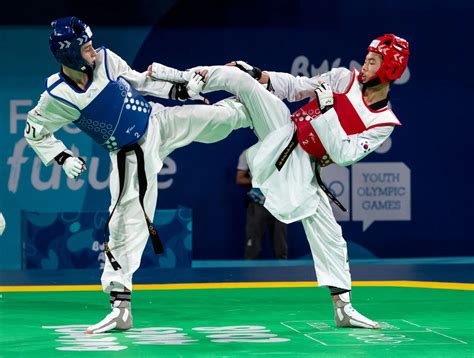
Taekwondo Sparring
General Choi-Hong-hi is considered the father of modern Taekwondo and headed the International Taekwondo Federation (I.T.F.). Up until 1973, Taekwondo was primarily taught to adults. In an effort to spread the art to a broader population, the World Taekwondo Federation was formed, and a new curriculum was developed. Shortly afterwards, teaching the new art to children and adults began, and the popularity of the art exploded.
Asian Junior Taekwondo Championships. Final male -48
Key Concepts in Taekwondo
Taekwondo involves several key concepts that are essential to its practice:
- Forms (Poomse): Patterns of kicks, blocks, and hand techniques used by students to spar against imaginary opponents. The practice of forms helps students develop their concentration, balance, speed, power, and agility.
- Sparring (Kyeo Ru Gee): The practical application of techniques learned in forms against an opponent. Students wearing protective gear try to score points on each other.
There are five tenets, or underlying principles, in the philosophy of Taekwondo. All students should know the tenets, be able to recite them, and explain them in their own words.
Read also: Read our in-depth article on Gracie Survival Tactics
The Gentle East Taekwondo Legacy
Grand Master Bernard Robinson and Grand Master Barbara Robinson started their Taekwondo journey under the tutelage of Master John Holloway at Gentle East in Bethesda, Maryland, in the mid-1980s.
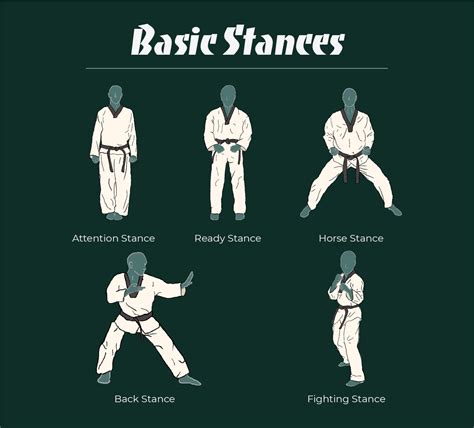
Taekwondo Stance
When they relocated to Midlothian, Virginia, they couldn't find a school that duplicated the quality of instruction and the culture that they had experienced under Master Holloway, so they commuted to Maryland several times a month to continue their training. In 1987, the Robinsons decided to open and operate a school, and Woodlake Martial Arts was born. As the school grew, the name was later changed to Gentle East Martial Arts of Virginia.
In December 2016, the Grand Masters Robinson sold the majority share of the business to Master Eric Rangel-Ribeiro and Master Joshua Fracker, and Resilient Taekwondo LLC / Gentle East Martial Arts was formed. Master Rangel-Ribeiro and Master Fracker, who have been students at Gentle East since 2004, are responsible for all aspects of the business.
Grandmaster John L. Holloway
Grandmaster John L. Holloway is an 8th Dan black belt, International Referee S Class and was inducted into the Taekwondo Hall of Fame in 2007. He has celebrated nearly four decades of ownership at Gentle East Taekwondo in Silver Spring, Maryland.
Read also: Dynamic East Bay Pro Wrestling
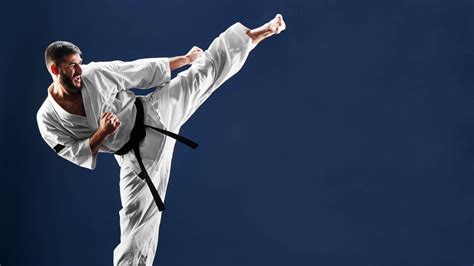
Taekwondo Kick
Grandmaster Holloway has served as the Co-Referee Chair of USA Taekwondo and as Referee Director on the USA Taekwondo Board of Directors. He was also the 1st Chair of the Athletes Advisory Council (1985-1988) and Team Leader for the 1999 Pan Am Games and the 2000 Olympic Games in Sydney, Australia.
The competitor John Holloway was the US Team Captain from 1977-1979 and was the first in the world, and the only American, to have medaled at both ITF (1974) and WTF (1977 and 1979) World Championships. Grandmaster Holloway has refereed at the national and international levels since 1980.
Training and Philosophy at Gentle East
At Gentle East Taekwondo, a strong emphasis is placed on both individual and group training. Focused solo training and constructive group training are both useful skills to cultivate, and it’s satisfying to see how well our students train when given a block of unstructured time. Over the years of teaching, students often give one another feedback during these small-group sessions.
The word “noncompetitive” distinguishes the school from others that structure their curriculum and training methods around tournament competition. Many old-school martial artists understand the distinction immediately and recognize why it’s important. It’s also an important subtext of the Second, Third, and Fourth Tenets of Jidokwan-all of which describe how to constructively train together as friendly comrades in a discipline that has the potential to be dangerous and hostile. Finally, it was an important spiritual value of Choi Bong Young, the Korean master who is the start of our lineage in the United States.
Read also: East West Tae Kwon Do Potomac
The school’s philosophy emphasizes respect, protecting the younger, and friendship among peers. This generous spirit is present in every Jidokwan school. Cooperative group learning has become universal in universities and many other educational domains.
The Double-Edged Nature of Group Work
In a traditional martial arts school, the head instructor teaches each student new concepts when they’re ready to learn. There are many criteria that contribute to this state of readiness, including: consistent class attendance, competence in previous techniques, improvement in techniques that are still works in progress, enthusiasm and focus in training, good relations with other students in the school, leadership by example, overall fitness and conditioning, and a student’s status compared to others of the same rank, to name just a few.
The decision to offer the gift of information-in a new technique, form, combination, or other insight-is the result of a complicated mental algorithm that is only really understood by an instructor with both deep martial arts experience and “a finger on the pulse” of the school as a whole.
This traditional system ensures that the head instructor authorizes the appropriate transfer of knowledge for each of the students training on the floor-that they’ve earned the knowledge they’re about to receive and are well equipped to handle it. Its hierarchical nature, martial in origin, places clear responsibility for every student’s day-by-day training within the hands of the head instructor, who has a vision for the overall trajectory of each student’s development.
Training in small groups, where any of the participants are free to offer “constructive criticism” about any other member, has the potential to undermine the centuries-old structure described above.
Respecting the Elder
The Second Tenet of Jidokwan is “Respect the Elder” and one of its obvious meanings addresses this point: only an authorized instructor should decide who gets to teach other students. This principle supersedes the otherwise appealing idea that it’s nice to share information with one’s fellow students and helpful to tell them things they may not grasp for themselves.
When a group of students trains together and each offers ideas about what others can do better, it puts each of those students in the role of teacher-a role that most have not yet earned. As such, it fails to “Respect the Elder” which includes acknowledging the leadership of those who have worked for years or decades to earn rank and authority within the school.
Our Taekwondo school is in the United States, but when we enter our dojang, we set aside many typically Western conventions within this special space, adopting instead a set of cultural norms that derive from a melange of Confucian, Taoist, Buddhist, and practical martial ideals. This is what gives the East Asian martial arts a framework that, despite many subtle or broad variations in traditions, makes the training hall feel familiar whether a student trains in Taekwondo, Kung Fu, Karate, Aikido, and so forth. More than just physical training, most martial arts ask us to follow these unusual cultural conventions in order to cultivate a new and complementary Way of living.
Guidelines for Students
Here are some guidelines to show what’s generally appropriate and what’s well-intentioned but not quite right:- IF YOU’RE A BLACK BELT Check in regularly with the head instructor of the school to make sure you’re not racing ahead with individuals’ development, but have some latitude to show students new things, especially green belts and below.
- IF YOU’RE A BROWN BELT If asked by the ranking instructor, you can teach or drill lower-ranking students in whatever capacity the black belt requests. That said, you shouldn’t seek out opportunities to teach others.
- IF YOUR RANK IS GREEN BELT OR LOWER Follow a black belt’s request if you’re asked to do something, of course, but don’t try to lead group or partner training on your own.
- IF YOU’RE WORKING AS A PARTNER AMONG EQUALS You’re working with one another, not teaching. Talking should be kept to a minimum, so you’re focused on executing technique and not on socializing or showing how much you [think you] know and understand.
- IF A JUNIOR STUDENT ASKS YOU A QUESTION Senior students should answer questions when they can easily do so to keep the junior student constructively engaged, but they should avoid long, complicated, or esoteric explanations.
- IF YOU’RE A JUNIOR STUDENT AND WANT TO OFFER ADVICE TO A SENIOR Don’t do this. It would be considered grossly inappropriate for a junior student to “correct” a senior under any circumstances, for reasons that are probably obvious by now.
The Impact of Taekwondo
Taekwondo is like a hidden pulse, an invisible layer of knowledge and training and ability that hides in plain sight in these women’s daily lives; it's a skill as important and far-reaching as a skill can be, applying its benefits to every single facet of life, not just the parts we experience while wearing a dobok. It’s a skill that supports their lives, not the other way around.
The masters taught me the "Five Tenets of Taekwondo," which are Courtesy, Integrity, Perseverance, Self-Control, and Indomitable Spirit. But there's one concept that underlies all those things. Force multiplication is a military concept. A force multiplier is anything (an object, form of training, etc.) that allows its user to achieve more than they would be able to without it.
Force Multiplication in Taekwondo
One of the key concepts taught to students is force multiplication, which enhances their ability to overcome challenges both in and out of the dojang.
Rule #1 of achieving force multiplication: The only way out is through.
It took months to get over my fear fully, and then several more months to yoke my power to my technique. But eventually one board became two, then three. There was literally nothing more satisfying in my taekwondo practice than testing myself against a stack of pine boards and hearing the wood break. Because in board-breaking practice, the strength of boards isn't additive. It's multiplicative.
Rule #2 of Force Multiplication: If you find your discipline and keep at it, you will surprise yourself.
Before the black belt can be earned, it's traditional in our school to compete in a tournament. It should be at least a regional tournament-something large, and intimidating, and preferably it should involve multiple schools that aren't our own, so that the student can test her skill against other dojangs.