Muay Thai is widely regarded as the most effective striking discipline on the planet.
In this complete beginner’s guide to Muay Thai, you’ll learn all about how you can easily start to thrive on the Muay Thai mats - even if you’ve never thrown a kick in your life - and how you can get start enjoying one of the world’s most electrifying martial arts disciplines.
The Foundation: Muay Thai Stance and Footwork
The first thing one needs when building a wall is a foundation. A strong Muay Thai stance is the first thing that you will need to learn before anything else, if you are new to this wonderful sport.
It is important that you have both heels off the floor when in your stance.
In order to ensure you are in the right stance, you can take some tape and create a cross on the floor. Use two strips of tape - both equal in length - and place the horizontal strip through the middle of the vertical strip. Your lead foot should be in the upper left square while your rear should be placed in the bottom right square.
Read also: The Significance of the Mongkol
In Muay Thai, your footwork and posture are crucial to your movement, both in attack and defense.
While standing straight and tall, you should also have a slight bend in your knees to facilitate better movement.
Your posture should be tight with your lead shoulder in line with the heel of your lead foot.
Good posture and balance will determine how smoothly you can move around the ring.
Your footwork will have a knock-on effect when it comes to the quality of certain aspects such as your overall movement, the power of your strikes, and your ability to defend yourself.
Read also: Authentic Muay Thai Training
Using the tips above, ensure that your feet are not parallel or placed in front of one another.
When stepping forward, push off the back foot and step forward with the lead foot. To retreat, step back with the rear foot pushing back with the lead foot.
Your movement should be rhythmic and as smooth as possible, with an emphasis on never crossing your feet.
As mentioned earlier, keeping your heels off the floor is crucial to your balance.
Your rear foot is the one that you will pivot on when moving or trying to generate power for strikes.
Read also: Choosing a Muay Thai Gear Bag
Ensure that you spend your time perfecting your stance by practicing your movement inside a ring.
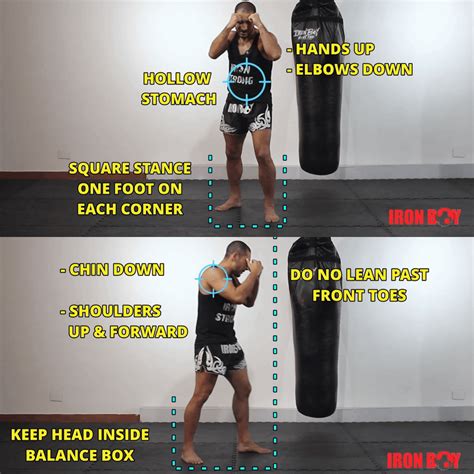
Unlike in boxing, where you usually tuck your chin into your chest at all times, your Muay Thai stance should be upright with your chin up but just slightly tilted down. Boxers only have to concern themselves with punches, whereas, in Muay Thai, a fighter has to protect themselves from kicks, knees, and also from being clinched. Some fighters prefer to keep their chins tucked in close to their chest, but this depends on the style of the fighter. No one likes to block punches with their pretty face, right? After all, we have our good looks to preserve.
Got no rhythm? Try this #muaythai footwork drill
Mastering the Punches in Muay Thai
While many of the flashy and spectacular knockouts and stoppages in the sport come via deft kicks and slicing elbows, punches are often the precursor to the final nail, so to speak.
Other than helping to set up combinations or even ending contests, fundamental boxing skills can also keep an opponent from moving into range.
As Muay Thai is a discipline that requires combatants to be proficient with more than just their fists, you are unlikely to see the next Roy Jones Jr., Sugar Ray Leonard, or Vasyl Lomachenko cleaning up at the legendary Lumpinee or Rajadamnern stadiums.
The Jab
Yes, this punch is unlikely to knock an opponent out or earn a fighter a place in the highlight reel of the year. However, the jab has numerous uses and it is essential for any budding competitor to master.
The jab takes little energy to throw and takes less time to land than any other punch. As it is closest to the target, you can use the jab to feint, disrupt your opponent’s rhythm, and measure the distance between you and the other competitor.
You can use the jab to set up another punch, such as a cross, or to draw your opponent’s attention and guard up in order to land a low kick. You can also use a jab to move your opponent into the path of a head kick.
The Cross
Also known as a “straight” punch, the cross is the second fastest punch you can throw and one of the most utilized strikes in the sport and can be powerful enough to really cause your opponent trouble.
As some combatants in Muay Thai pay more attention to kicks and knees than to punches, a cross can come in very handy in certain situations.
As a beginner, you will want to practice one-twos as much as possible before moving on to more advanced techniques. The “one” is your jab, and the “two” is your cross.
The cross can be a show-stopping punch if timed right, but can also be built into combinations that set up kicks.
The Hook
You can throw a hook with either the lead or rear hand. This punch is a little more difficult to master but is certainly not something that should cause anyone who is dedicated to their technique much trouble.
The hook is certainly one of the four main punches when it comes to Muay Thai, so you should certainly invest some time in perfecting it.
As with any technique, plenty of practice and drills are necessary when making it work for you. As a beginner, you should focus on the lead hook first.
The Uppercut
The uppercut is an excellent shot to throw when in close range. However, getting it right is key to gaining the best results from this shot.
Kicks: The Essence of Muay Thai
Even as a beginner, you may already be familiar with many Muay Thai kicks. In truth, there are fewer combat sports that can hold a torch to the spectacular nature of many kicks in the Muay Thai competitor’s arsenal of weaponry. However, when it comes to Muay Thai, a beginner should be aware that there are more to kicks than sublime attacks and highlight reel stoppages.
The Low Kick
An essential tool in any Muay Thai competitor’s arsenal, the low kick provides fighters with an exceptionally versatile tool.
In order to perfect the low kick, you will need to spend a lot of time practicing the mechanics and technique of how to throw it.
There are a number of different types of low kicks which can be thrown against the lead or rear leg.
The Body Kick
Head-hunters are often figured out very quickly in Muay Thai. As a result, going to the body is a necessary method for any fighter hoping to score points and keep their opponent guessing.
The body kick, or mid-range roundhouse kick, is a shot that every budding Nak Muay should add to their toolbox.
The Switch Kick
A switch kick is one of those beautiful little techniques that can catch an opponent cold. The kick only works when you have honed the technique and can carry it through with fluency and accuracy.
The Head Kick
There are fewer strikes in combat sports as spectacular and utterly devastating as the head kick. Of course, the price one pays for being able to pull off such an awesome strike are hours, days, months, and years in the gym, practicing to get it right.
Even when you have your technique down, landing it in a competitive environment requires skill and tact.
As your leg has to move from the floor all the way up to the opponent’s head, this kick can easily be spotted and anticipated by a smart fighter.
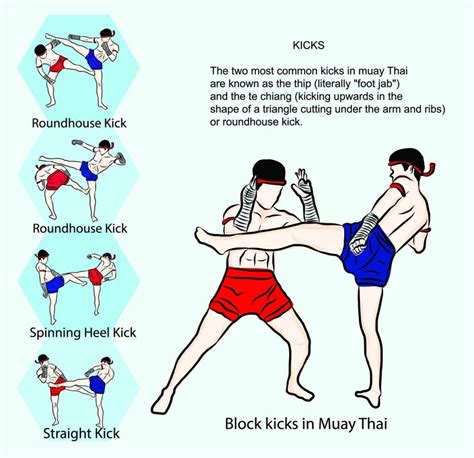
The Teep (Push Kick)
Given that it has various uses, such as pushing your opponent back, finding range, or even setting up attacks, a seasoned Nak Muay (Thai boxer) will rely on the teep heavily.
Of course, as a beginner, you should concern yourself more with the technique and execution of the kick than aiming to take your opponent’s head off. Aside from the physical gains to be made from knowing how to use teeps, they can also have a positive effect on your mental game.
Front Teep
The absolute bread and butter of push kicks, the front teep - also referred to as the straight teep - is a vital weapon in attack and defense. This kick can be thrown from either your front or rear leg, although the front teep is the more common of the two.
Lead Leg Front Teep
The lead front teep is generally the fastest kick in the arsenal of a Nak Muay (Thai boxer). As the lead leg is closest to the opponent, it is not hard to see why. There is no switch involved in the lead front teep, meaning that it can be thrown from almost any position and with lightning speed. The drawback with the lead leg teep is that generating significant power is difficult, as you will almost compromise weight in the strike for speed.
In order to generate enough power, a fighter must quickly shuffle, step, or jolt forward with their rear foot while extending the lead leg, while pushing into the strike.
Rear Leg Front Teep
The rear front teep is typically more powerful than the lead front teep. The reason for this is that there is more opportunity to generate power from the lead leg. However, you will be compromising speed for this increase in power and will also be running the risk of your opponent anticipating the kick before it has landed.
Before throwing the rear front teep, convincing your opponent to tighten up and prepare to guard against another shot can reap huge advantages. The combination of speed and power that can be generated from this kick helped the “Muhammad Ali of Muay Thai” maintain the upper hand over some of the most outstanding fighters in the “Golden Era” of Muay Thai.
Side Push Kick
While a difficult strike to perfect, the side push kick can be honed over time with the right amount of practice and drilling. In order to land this strike, you must straighten your leg out towards the target, turning your hips so that your knee cap faces out sideways. Your rear foot should start facing behind you but then pivot to the side, in order to aid your balance and generate power.
Jumping Switch Push Kick
Certainly one for the entertaining fighters, the jumping switch push kick can be an incredibly spectacular kick when the technique is nailed. This version of the push kick is arguably the most powerful, given the force that can be generated from the explosive momentum of the jump. As a beginner, it is probably best to leave this one to the side until you have your Muay Thai fundamentals down.
Slapping Push Kick
Another advanced technique that you will encounter further down the Muay Thai road is the slapping push kick. Now, this variant of the push kick is also one that is difficult to master, and as such, you will rarely see it used by fighters. This type of push kick is an excellent way to counter an opponent that approaches recklessly, as it can give them a nasty surprise on the way into range.