The Leung family has played a significant role in the history and development of Wing Chun, a martial art that has gained global recognition. From its origins in Foshan, Guangdong, to its spread across the world, the Leung family's contributions have been pivotal in shaping Wing Chun into the art form it is today.
Leung Jan: The Systematizer of Wing Chun
Leung Jan (1826-1901), born Leung Tak-wing, was a Chinese martial artist and Wing Chun practitioner from Heshan, Guangdong. He was known in Foshan as Mr. Jan. He was born Leung Tak-wing in 1826 in Heshan, Guangdong. His father later moved to Kuai Zi, Foshan and there Leung helped run a traditional Chinese medicine Dit Da clinic.
By the 1850s, he had established himself as a respected herbal doctor, earning the moniker "Dr. Leung" or "Jan Sin-Sang" (Mr. Jan). Setting up his medical practice in this environment required navigating competition from other healers and the demands of a growing urban clientele, yet he quickly gained prominence through reliable treatments.
Leung Jan's primary instructors in Wing Chun were the retired Cantonese opera performers Wong Wah-bo and Leung Yee-tai, who had preserved elements of the art amid the suppression of the troupes following the 1856 crackdown. Wong Wah-bo was renowned in legends for his expertise in the six-and-a-half-point pole and butterfly knives, complementing Leung Yee-tai's proficiency in core hand forms, providing Jan with a balanced foundation in both unarmed techniques and weapons.
His training commenced after 1856, when Jan was in his early 30s, and extended over more than a decade into the 1860s, intensifying following the troupe members' retirement and dispersal. Sessions were deliberately concealed, occurring in remote areas outside Foshan or the secluded backroom of Jan's pharmacy on Fai Jee Street, to evade surveillance by Qing authorities and protect the art's transmission from potential informants.
Read also: Individual Martial Arts Instruction
Early practice emphasized foundational elements tailored to cultivate precision and internal power. He began with the Siu Nim Tao form to build centerline structure and relaxed power, progressing to chi sao (sticky hands) drills that honed tactile sensitivity and adaptive responses without reliance on strength. Instruction also stressed qi development through coordinated breathing and structural alignment, fostering the art's efficiency in close-quarters combat.
In the 1870s and 1880s, Leung Jan successfully defended himself and the Wing Chun system against numerous challengers, including local martial artists from rival styles, in both informal street encounters and more structured matches. His prowess garnered significant respect from Foshan's merchant class, who viewed him as a reliable defender amid the era's social unrest.
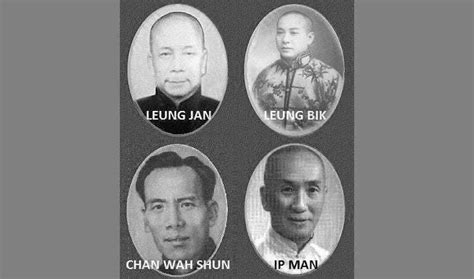
The most prominent among his direct disciples was Chan Wah-shun, nicknamed the "Money Changer" for his occupation as a moneylender and former rice shop employee in nearby Shunde. Leung Jan also instructed his two sons, Leung Chun and Leung Bik, within the family environment, providing them private lessons that emphasized core techniques and conditioning.
Transmission gaps arose from the era's cultural secrecy surrounding martial arts, with Leung Jan restricting teaching primarily to male relatives and a few male disciples, excluding women and avoiding widespread public classes due to fears of exploitation or rivalry. In his final years, Leung Jan resided in Kulo, Heshan County, Guangdong, supported by his family.
Leung Jan in Popular Culture
Leung Jan has been prominently featured in several Hong Kong martial arts films, where he is often depicted as a wise and formidable Wing Chun master from Foshan, blending historical reverence with dramatic embellishments. In the 1978 film Warriors Two, directed by Sammo Hung, actor Leung Kar-yan portrays an elderly Leung Jan as a reclusive physician who reluctantly teaches Wing Chun to a young apprentice amid local conflicts, emphasizing his role as a guardian of the art's secrets.
Read also: The Jade Fortress Martial Arts System
Leung Jan's legacy extends to the broader Ip Man film series (2008-2019), where he appears indirectly as a legendary antecedent through dramatized flashbacks and references to his son, Leung Bik. In the 2010 prequel The Legend Is Born: Ip Man, Leung Bik (played by Yuen Biao) instructs a young Ip Man in advanced Wing Chun techniques, implicitly crediting Leung Jan's foundational influence while portraying the lineage as a chain of heroic defiance against oppression.
Beyond cinema, a 2005 Hong Kong TV series titled Foshan Mr. In literature and documentaries, Leung Jan receives more measured treatment, though fictionalized elements persist to emphasize his transformative role in Wing Chun.
Critics have noted several inaccuracies in these depictions, particularly anachronistic elements that compress timelines and invent confrontations not supported by historical records. For instance, The Prodigal Son fabricates Leung Jan's early training under opera performers in a way that overlooks documented aspects of his medical career, prioritizing spectacle over chronology.
Yip Man and the Popularization of Wing Chun
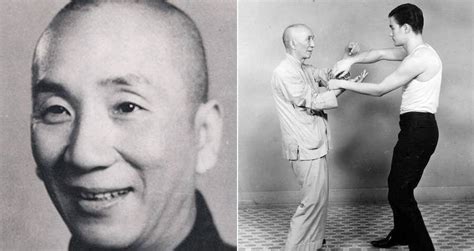
During the early fifties in Hong Kong, Chinese martial arts were very popular among young people and the working class. A young man from Foshan, China, Yip Man, was there in those days. He learned the style in China and later on furthered his training from Leung Bik. He began his teaching in the Restaurant Association. Later on he had his own little school in his house in the resettlement area with 100-150 sq. ft. of space.
Years went by and he had taught quite a few good students; therefore, the style was becoming known to the public. Early students from Yip Man like Lok Yiu and Wong Sheung Leung were the most active and did very well in all the fights. The Kowloon Motor Bus Company main service station was located only a few blocks from Yip Man’s school and the workers were first to join the school after the restaurant workers. Then the school kids from nearby St. Frances Xavier started to join including Bruce Lee and Hawkins Cheung.
Read also: Deep Dive into Court Martial Films
In 1957 another early student of Yip Man’s, William Cheung, immigrated to Australia. On the way there an incident occurred when he locked himself in the sailor’s cabin and fought more than 10 sailors. This got into all the newspapers and so Wing Chun was even known in Australia then.
After Bruce passed away, a student of Leung Sheung by the name of Leung Ting taught a student named Gainsburg in Germany and brought Wing Chun to Germany. Then Victor Kan brought Wing Chun to England. Yip Man’s nephew, Lo Man Kam, brought the art to Switzerland and to Taiwan, his home country. Wing Chun was becoming the most popular martial art in the world.
REAL Ip Man Story (Yip Man) Video [11 Minutes of Footage!]
Wong Shun Leung: The King of Talking Hands
Among the many lineages of the Chinese martial art of Wing Chun, the Wong Shun Leung lineage stands out as one of the most influential and well-known. Wong Shun Leung was one of the top students of Wing Chun grandmaster Ip Man, and helped spread Ip Man’s teachings around the world. Wong Shun Leung was born in 1935 in Hong Kong. As a teenager, he originally studied boxing, which likely contributed to his disciplined approach to martial arts. However, he then began studying Wing Chun under Ip Man in 1951.
In the 1950s, Wong Shun Leung made a name for himself by accepting challenge matches with other martial artists in Hong Kong. Wong reportedly fought in over 60 such matches against practitioners of various styles, including Western boxing, Karate, Jujitsu, Judo, Aikido, and other Kung Fu systems like Shaolin, Tai Chi, and Wushu.
Wong focused on realistic combat applications in his Wing Chun training. He emphasized sparring and chi sao (sticky hands) practice to develop timing, reflexes, and technique. The Wong Shun Leung lineage of Wing Chun is direct, efficient, and combat-focused. It is characterized by disciplined techniques and strategic movement.
Thanks to sifu Wong’s students, his particular brand of Wing Chun has spread around the world. There are Wong Shun Leung schools across Europe, North America, Australia, Asia, and beyond. Other martial arts have also incorporated Wong Shun Leung’s theories and training methods, including Jeet Kune Do (which inherited much from Wing Chun).
In conclusion, the direct and efficient techniques of Wong Shun Leung Wing Chun have made it one of the most influential lineages of the Wing Chun martial arts system. Its emphasis on combat application and sparring continues to impact martial artists and self-defense experts around the world.
Leung Sheung and His Contributions
Sifu Leung Sheung, the senior-most student of Wing Chun grandmaster Yip Man was born in 1918 in Guangdong Province, China. Without a doubt Leung Sheun played an amplifying role as one of Wing Chun’s greatest students. He saw this as integral for the protection of his beloved homeland.
At 14, Leung Sheung began his journey in traditional Chinese martial arts and over the years immersed himself in many styles, such as White Eye-Brow, Choi Lee Fut, and Wing Chun. Throughout his life he sacrificed much time to promote these valuable practices while inspiring those around him with enthusiasm for mastering them.
The Restaurant Association was playing a vital role in providing shelter for individuals escaping Communist rule by supplying lodging through their flat located in Kowloon. When a teaching position opened within the Martial Arts branch of Hong Kong’s Restaurant Workers Union, union members nominated Leung Sheung as an ideal candidate.
Leung Sheung was so impressed by Yip Man’s Wing Chun skills that he offered him a teaching position in his flat. To further show support for the martial art, Leung forsook all of his previous training to become one of Yip Man’s students and handed over his White Eyebrow class for Ip man to take over.
Leung Sheung, Lok Yiu, Chu Shong-tin, and Wong Sheng Leuang were the first generation of teachers to be trained by Wing Chun master Yip Man. Highly respected for their martial arts prowess, they are remembered not only as four of his most distinguished students but also as champions who popularized this ancient Chinese system throughout Hong Kong in 1956.
Leung Sheung had a unique teaching philosophy for Wing Chun - viewing his students as driftwood. He likened himself to someone on the banks of a wide river, picking up wood that was washed ashore from time to time in order to find pieces he could shape and mold into something much greater than its initial form.
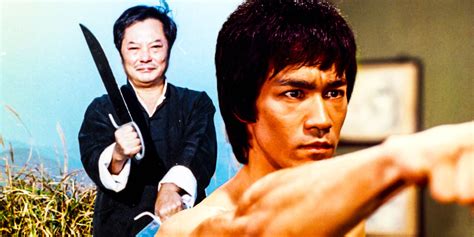
In 1968, Bruce Lee made a triumphant return to Hong Kong for the purpose of shooting an upcoming movie. During his time there, he formed a meaningful bond with Leung Sheung which was based on mutual respect and admiration; so much that both Chu Shong-tin and Bruce himself deemed him their older sibling.
Leung Sheung has made a lasting impact on martial arts worldwide, even after his untimely passing in 1978 due to declining health just eight years prior. With limited archival sources and stories left behind, Leung Sheung’s legacy continues to live through the spread of Wing Chun-the art he helped bring into the limelight during its infancy stage.
The Spread of Wing Chun
Wing Chun today is a very big family with schools all over the world. Without leadership, some begin to teach in their own way and some criticize others who do not agree with their way of teaching. Some even develop theories which Yip Man never taught.
Each one may interpret the ideas a little differently. If we could have a good leadership to unite everyone together, to exchange and to accept each other’s experience and ideas with open minds then Wing Chun could thrive. Everyone would benefit in the knowledge.
Table: Key Figures in Wing Chun History
| Name | Contribution |
|---|---|
| Leung Jan | Systematized Wing Chun |
| Yip Man | Popularized Wing Chun globally |
| Wong Shun Leung | Developed combat-focused Wing Chun lineage |
| Leung Sheung | Promoted Wing Chun, mentored students, and helped spread the art |