This article delves into the history and styles of McSweeney martial arts, with a focus on Kenpo Karate and the contributions of Grand Master John McSweeney. The Kenpo world mourned the loss of John McSweeney on February 26th, 2002, a Hall of Fame Master who dedicated his life to spreading Chinese Kenpo throughout the world.
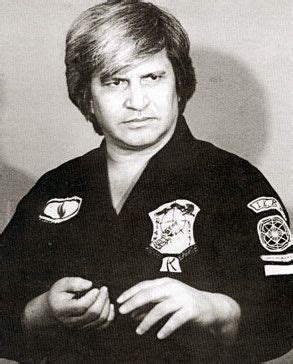
Ed Parker, a key figure in the development of Kenpo Karate.
The Early Influences and Kenpo's Beginnings
John McSweeney picked Kenpo after many years in Judo and Jujitsu. Gene Cones, who taught him Jujitsu, suggested he see Ed Parker in Pasadena for a striking art. McSweeney became one of Parker's earliest black belts after years of study. He considered Ed Parker to be the greatest master he ever worked under, praising his explosive hitting power and knowledge of the art.
McSweeney also studied Chinese Kung Fu under masters like Jimmy Lee, who was Bruce Lee's partner. He also trained with professor Lao and professor Wang in the San Francisco Chinatown area. Bruce Lee visited this area a lot and would often visit Jimmy Wu, who was McSweeney's main instructor in kung fu.
Kenpo: An Effective Street Fighting Art
Kenpo Karate - Larry Tatum - All 10 Yellow Belt Self Defence Techniques in just over 1 Minute!!
Kenpo teaches you to move in on people with tremendous power, generated by circles and the linear moves. Kenpo is an effective street fighting art, and that's why it is considered to be one the best arts to learn. The advantages of Kenpo, as Parker used to say, is that you can fight in close quarters, like in phone booth, whereas if you're in a kicking art, you can't fight in a phone booth.
Read also: Individual Martial Arts Instruction
Parker got his training from Professor K. S. Chow in Hawaii. Chow was also known as thunderbolt Chow, because he hit so hard. Professor Chow's instructor was his father, who was also well-versed in the martial arts. Parker also studied with James Mitosi, another fierce fighter. Since Chow and Mitosi both came from Japan they called it karate, which is a Japanese word meaning shell hand. They added the title of Kenpo, which means fist law, and so Kenpo Karate was born there.
Key Characteristics of Kenpo
- Its basis is in practical self defense.
- It combines the linear with circles.
- It mainly closes in on an opponent, again like boxing, it moves in.
- Its kicks are normally low to the hip, the groin, the knee cap, the shin, normally not high kicks.
- It uses a lot of elbow techniques, which are close-in fighting techniques.
- It has numerous hand strikes which contain a lot of power because they use the circular moves of the waist and the back.
Strengths and Weaknesses of Kenpo
Having studied Kenpo for so long, McSweeney identified its strong and weak points. Its weak point would be, in general, although there are many exceptions in this rule, that high kicking is lacking. Sometimes high kicks to the head with great power can be very important and effective for a quick knockout. The best of both worlds is to know both high and low kicks.
Its strong point is that it uses all the other natural weapons of the body, including head butting, all the elbow moves - forward, up, back, down. It uses all the hand moves and sophisticated finger strikes, finger pokes. It has many heel palm strikes, fist strikes, and the knee strikes, with a very big emphasis on the knees.
The Evolution of Kenpo Forms
Originally Kenpo had very few classical forms. When Parker came to America from Hawaii, he studied at Brigham Young where he got his degree in 1957, and as soon as he got his degree, he went to Pasadena, California and opened his school. He had not learned any forms and sets from Chow. He learned strictly self-defense techniques and sparring, so he was excellent in both. He created his short form one himself.
In 1961 McSweeney trained with Bob Trias, who brought Japanese-style Karate to America, even before Parker. He informed Parker that he didn't have any forms. Within a month, Jimmy Wu from San Francisco, a Kung Fu man and specialist in White Crane and Tai Chi, came to create the forms.
Read also: The Jade Fortress Martial Arts System
Wu created the forms, but Parker made his own adjustments, especially to form one, two and three. McSweeney estimated that there was 90% Jimmy Wu and 10% Parker in those forms, and forms one through three would be half and half, Parker and Wu.
McSweeney's Personalization of Kenpo
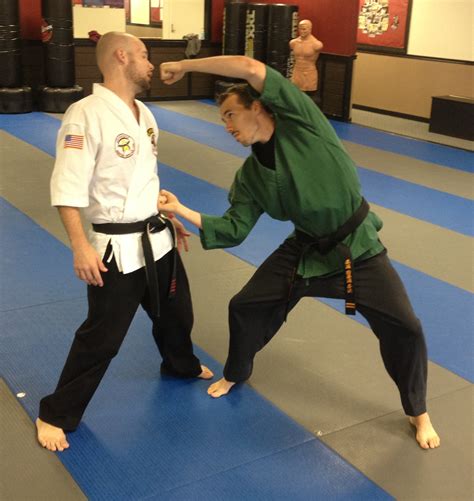
John McSweeney demonstrating Kenpo techniques.
When McSweeney left Parker and went to Ireland he taught strictly what he taught. But in his own training he went over Parkers forms sets, and from them, he picked out specific weapons, strikes that he liked and he worked on these strikes. McSweeney taught the straight Parker system. Later, he reanalyzed the strikes that he learned from Parker and Jimmy Woo, emphasizing how he could get more power from these strikes.
Parker used a double strike to the head and the groin, or a double strike to the bladder or the kidney, but McSweeney found there was no torque power in these strikes because using two hands like that just uses power from the shoulders. He changed the double moves to single moves. He changed the move striking using only one strike at a time thereby bringing in the waist action which increased the power of each strike. However, the changes he made were only in the fine points of technique. He did not change Parkers essential teaching. He emphasize power now, especially in the wide circles of the white crane, which Parker didn't believe in.
McSweeney concentrated on training people in these power strikes, and boxing techniques. As he continued to analyze the Kenpo strikes, he made more emphasis on each individual strike, improved the strikes' optimum power. He added some of his power strikes. He of course incorporated many of Parkers techniques. He emphasized breaking down the sets and the technique and getting the optimum power out of them using your physique. In essence we are all built differently, but if you use your physique properly you can create tremendous hitting power. He guessed that's what makes him different from the traditional Kenpo system.
Read also: Deep Dive into Court Martial Films
The Rise of Kenpo Associations
Since the demise of Master Ed Parker numerous Kenpo associations have arisen. When Ed died, unfortunately he didn't have a lineage of instructors to take over his system. He didn't have somebody who would be number one or two or three. So, his wife took it over, and although a very nice lady, she was not skilled in his art. She never trained with him. She took over the business end of it, and took some young fellows that were training under Ed in the Pasadena school and made a committee out of them.
This did not sit right with McSweeney as he was already a seventh degree black belt under Parker. He was with him many years, one of his original black belts. He talked to other people in the association all around the country, and we all had the same feeling. Now there are many Kenpo groups.
Qualities of a Good Student
McSweeney considered what makes a student a good potential champion, then we can start with his physique. Not that physique is the end all because, it is not. History tells us there were many who had less than perfect physiques and became great champions of the art. There are many who have optimum physique, meaning the height and weight, but can't use it to their advantage.
The next consideration is the right motivation to train. Without proper motivation there can never be progress no matter what physical characteristics you have. Next is what we call the right heart, the best fighters are not there simply to demolish people, they move from the heart, they love their art form and train with the right attitudes. Usually good fighters are some of the nicest people you will ever meet.
John McSweeney: A Life Dedicated to Martial Arts
John McSweeney was born on October 19, 1927, into a comfortable, middle-class home in the Bay Ridge section of Brooklyn. In May 1945, one week after high school graduation, the United States Navy called John to active duty. After his honorable discharge in August of 1946, he began his studies at St. John's University in Brooklyn. In 1950, after he earned a B.A. at St. Johns, he joined the Air Force Officer Candidate School.
| Year | Event |
|---|---|
| 1959 | Met Edmund Parker. |
| 1962 | Received his Black Belt from Edmund Parker and left for Dublin, Ireland. |
| 1963 | Opened the Karate School of Ireland. |
| 1979 | Opened a martial arts school in Elmhurst, Illinois, called Self Defense Unlimited. |
| February 26, 2002 | Passed away from a massive heart attack in Fort Meyers, Florida. |
In 1962, John McSweeney received his Black Belt from Edmund Parker. That same year he left for Dublin, Ireland to pursue his Masters Degree from Trinity College. It was there that he opened the Karate School of Ireland. It was also the first commercial Karate school in Ireland. Following in his instructor's footsteps, he is also considered by many to be the father of Karate in Ireland.
His love was the Martial Arts and the people in it. He has touched many lives and made history. Many of us wouldn't be where we are without him. Even more than his contribution to the martial arts, John McSweeney was an exceptional man. He was always a true gentleman. He was a man that always gave respect first and expected to receive it in return. He never looked down at anyone, no matter what his or her experience and rank was. He also never looked up to anyone, preferring to be eye to eye. He was comfortable being a teacher or a student, and continued to learn to the very end.