The "Stone Cold Stunner" is without a doubt one of the most talked about moves in professional wrestling. It is a professional wrestling move, also a common term in professional wrestling referring to the ¾ facelock jawbreaker maneuver.
It will continue to influence future WWE superstars and professional wrestlers for years to come. Wrestling fans can thank Michael Hayes for coming up with the unique finishing move, which was an important piece of the puzzle that made up the persona of “Stone Cold” Steve Austin.
The Stunner has a history that predates Austin, even though he was the one to make it iconic. The move was named for Stone Cold Steve Austin's Stone Cold Stunner finisher, a finisher suggested to him by Hayes.
The innovator of the move has been disputed, as both Mikey Whipwreck (who called it the Whippersnapper) and Michael P.S. Hayes (who called it the 9-1-1) have both claimed to be behind the origin of the move. Johnny Ace (real name: John Laurinaitis) seems to have invented the move in the early ’90s, calling it the Ace Crusher; it would become more popular as Diamond Dallas Page’s Diamond Cutter.
A few years after Johnny Ace, an ECW wrestler named Mikey Whipwreck started using a similar move, which he dubbed the Whipper-Snapper. There were clear variations in style. Ace went flying, the way Randy Orton does when he hits an RKO, while Whipwreck, who was under six feet and had a self-destructive persona, used his own body against his opponents with acrobatic slams off of turnbuckles and ropes.
Read also: Discover the story of Casey Swiderski
The 6-foot-2 Austin, though, was accustomed to staying on his feet like the brick shithouse he was (and still is). It involves an attacking wrestler applying a three-quarter facelock (reaching back and grabbing the head of an opponent, thus pulling the opponent's jaw above the wrestler's shoulder) before falling to a seated position and forcing the opponent's jaw (but predominantly the opponent's neck) to drop down on the shoulder of the attacking wrestler.
The Stunner’s true genius is in its setup. Austin’s explanation points out the necessary hook for success in pro wrestling. The audience wants to be surprised, but at the same time, the audience wants a second to process before what comes next.
Fans require a stimulus to telegraph the surprise that demands a response, and Austin developed the greatest sequence of all-a simple kick to the gut, delivered before unleashing the Stunner. Austin would set up the Stunner with a kick to the gut.
Here's how Austin described the setup:
"I needed some type of setup maneuver ala Jake “The Snake” Robert’s signature short arm clothesline that he delivered before unleashing one of the most devastating finishers of all time…The DDT. An easy, and quick solution to this was the kick to the gut, which perfectly set the victim into an effective ‘ready position’. Not only was the kick effective as a weapon to neutralize my opponent, it was also a visual ‘signal’ to the crowd that the Stunner was next…Or was it? Any kind of curveball could be worked into the equation at that point, but from a storytelling standpoint, the Stunner was ‘supposed’ to happen next."
Read also: Sectional Wrestling Tournament Details
The kick to the stomach is the appetizer, the warmup, or whatever you want to call it. Mankind put a sock on his hand before the Mandible Claw. Shawn Michaels stomped before his Sweet Chin Music. The Undertaker reached into the sky when he was ready to dish out a vicious chokeslam. The Rock took a good 30 seconds to set up the People’s Elbow. Austin found his opener with a boot to the gut.
You can see how important this is to the whole routine by comparing it to the Whipper-Snapper, which didn’t really have a single emphatic, theatrical setup, and could occur at any moment. Whipwreck’s finisher was versatile, as he’d use it off of turnbuckles, while running, or as an immediate reversal, but it didn’t give the audience a beat of anticipation before the inevitable occurred, an important and intentional adjustment Austin made.
When I first started using the Stunner as it would come to be named (I’m not sure who named it, maybe Jim Ross or someone in the office), I simply went into the maneuver without a set up. It was simply delivered with no anticipation. And I’m a little fuzzy on this, but I’m almost positive that Michael and I were talking about the move happening too fast, and that the crowd could not anticipate the action because it happened out of the blue.
Over the course of his career, Austin delivered the Stunner to practically everyone. A few of these remain unforgettable. Austin's most famous stunner was used on WWE CEO Vince McMahon on an episode of RAW on Sept. 22, 1997. McMahon had come down to the ring to lecture Austin regarding his behavior when he fell victim to the move.
Austin’s Stunner to Vince McMahon in 1997 on Monday Night Raw was unprecedented. McMahon was the untouchable chairman, who could be loathed, insulted, but never struck. Austin changed all of that two years into his WWF career, reinforcing his anti-establishment personality by telling the man in charge to kiss his ass and leaving him “motionless” on the floor in front of an overwhelmed Madison Square Garden crowd. Austin was “arrested” as one of the best wrestling rivalries of all time kicked off.
Read also: The story of Angelo Posada
Later that year, Austin wrecked Santa’s shit a few days before Christmas on Raw. To hell with your childhood; Santa got the Stunner. Austin was cast as the hero in an ECW vs. WCW vs. WWF melee in 2001, fighting his way through enemies as the most ridiculous imaginable action hero. He brawled with opponents normally at first, but the climax of the event had him stunning practically everyone in the ring.
In the main event of Wrestlemania XIV, Austin stole all the anticipation that Shawn Michaels built up with his Sweet Chin Music stomps, reversing HBK’s signature move not once but twice. When he finally hit the Stunner, the crowd lost it as guest ref Mike Tyson counted to three.
One of the most bizarre sequences came when Austin gave the Stunner to not only Vince, but to the whole damn McMahon family, one by one. Austin even delivered one to matriarch Linda McMahon. She sold it poorly, but can you really rag on her for not selling a Stunner?
One of the most important Stunners occurred at Wrestlemania 23, with future presidential candidate Donald Trump as the recipient. It’s notable, because it was perhaps the moment the Stunner fully left the realm of wrestling. (When you vote in the election this November, ask yourself: Do you really want a president who can’t sell a Stunner?)
Austin sold his finisher well in the few instances it was turned on him, showing he understood the mechanics required on both sides of the move:
There are two types of people when it comes to opinions on pro wrestling: Those who hate it for being “fake” and staged, and those who love it for what it is. The Stone Cold Stunner is one of those rare elements of the business that ought to win over both crowds. Imagine a Venn diagram of the “real”-a folding chair to the head, an eye rake, or an arm bar-and the theatrical-a piledriver, chokeslam, or aerial trick from the turnbuckle. The Stunner fits right into the overlap, like few other moves do.
The kick is painful; the jawbreaker is performance. It would absolutely never work in an actual fight, but given the internal logic of wrestling, with its Bugs Bunny physics, it worked. It felt like anyone could do it, even a Bills fan. As Austin explained, the Stunner was versatile.
There were entirely different ways to sell it that would still garner positive reaction. Wrestlers could act like they were legitimately injured; the crowd would freak out. Someone like Hall or The Rock could ham up their responses, bringing viewers to the point where they thought they were watching a cartoon; it still worked.
There is probably no other wrestling move that had as wide a range of outcomes as the Stunner. Austin’s entrance theme started with the sound of glass breaking; his entire persona was brash, a metaphorical kick to the gut. The Stunner was a perfect representation of him, and of all the things that have ever been great about wrestling.
It is currently illegal in 7 states because of the danger involved in using it.
Here are some variations of the Stunner:
- Elevated Stunner: With an opponent placed on an elevated surface, a wrestler applies a three-quarter facelock and then draws the opponent away, leaving only the opponent's feet over the elevated surface. The wrestler then falls to a seated position so that the opponent is forced to dive forward across the shoulder of the attacking wrestler.
- Piggyback Stunner: In this elevated stunner variation, the opponent is first raised up in a piggy-back position. From here, the attacking wrestler applies a three-quarter facelock and drops down to a seated position while still holding the opponent's head to force them to fall into the stunner.
- Inverted Facelock Stunner: Innovated and named by Super Delfin, this variation sees the wrestler apply an inverted facelock on an opponent, before hooking their tights and lifting them straight up in the air so that they are upside down. The wrestler then lets the opponent's body fall backwards over their shoulder and when the opponent's feet lands on the mat the wrestler drops to a seated position to force the opponent's jaw to drop down on the shoulder of the attacking wrestler.
- Total Knock Out (TKO): The Total Knock Out (TKO), popularized by Marc Mero, is an elevated stunner variation in which the opponent is first raised over the shoulders of a wrestler in the fireman's carry position.
- Shotgun Stunner: This elevated stunner first sees the attacking wrestler apply a front facelock, hook the opponent's near arm over their shoulder and lift them as for a standard vertical suplex. However, in mid-move, the attacking wrestler forces the opponent to turn 180 degrees and then apply the three-quarter facelock, forcing the opponent to drop down with their jaw across the attacking wrestler's shoulder as they fall to a seated position to hit the stunner. Innovated and popularized by Masato Tanaka as the Shotgun Stunner.
- Twist of Fate: This version sees an attacking wrestler first place an opponent (who is in front of them) in an inverted facelock before rolling themselves under the opponent, turning both wrestlers over so that the opponent can be dropped into the stunner.
Table of Key Figures and Their Stunner Variations
| Wrestler | Move Name/Variation | Notes |
|---|---|---|
| Stone Cold Steve Austin | Stone Cold Stunner | Popularized the move with a kick to the gut setup |
| Mikey Whipwreck | Whippersnapper | Original innovator of the move |
| Johnny Ace (John Laurinaitis) | Ace Crusher | Early version of the move |
| Marc Mero | TKO (Total Knock Out) | Popularized the elevated stunner variation |
| Masato Tanaka | Shotgun Stunner | Innovated and popularized this variation |
| Super Delfin | Inverted Facelock Stunner | Innovated this unique variation |
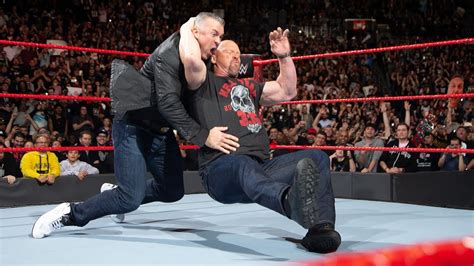
Stone Cold Steve Austin delivering the Stunner.