Steer wrestling, also known as bulldogging, is a rodeo event in which a horse-mounted rider chases a steer, drops from the horse to the steer, then wrestles the steer to the ground by grabbing its horns and pulling it off-balance so that it falls to the ground.
The need for speed and precision make steer wrestling, or "bulldogging" as it is commonly known, one of rodeo's most challenging events. The event carries a high risk of injury to the cowboy.
Historical Roots
The origins of steer wrestling or "bulldogging" date back to Ancient Greece in bull-fighting events known as taurokathápsia (ταυροκαθάψια), where bull fighters on horseback would chase a bull and jump on it, grasping its horns before wrestling it to the ground.
In The Garland of Phillip, Philippus of Thessalonica recounts how the bullfighters of Thessaly performed this feat: The well-mounted troupe of bull-fighters from Thessaly, armed against the beasts with no weapons but their hands, spur their horses to run alongside the galloping bull, bent on throwing round its neck the noose of their arms.
Historically, steer wrestling was not a part of ranch life.
Read also: An Interview with Will Lummus
Steer Wrestling 101 Jumping Dummy: Part 1
The Steer Wrestling Arena and Participants
The event features a steer and two mounted cowboys, along with a number of supporting characters.
The steers are moved through narrow pathways leading to a chute with spring-loaded doors.
A barrier rope is fastened around the steer's neck, which is used to ensure that the steer gets a head start. The rope length is determined by arena length.
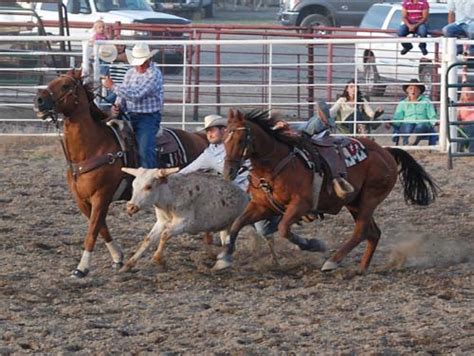
On one side of the chute is the "hazer", whose job is to ride parallel with the steer once it begins running and ensure it runs in a straight line.
Rules and Techniques
When the steer wrestler is ready, he "calls" for the steer by nodding his head and the chute man trips a lever opening the doors.
Read also: Rules of Steer Wrestling
The suddenly freed steer breaks out running, shadowed by the hazer.
When the steer reaches the end of his rope, it pops off and simultaneously releases the barrier for the steer wrestler.
The steer wrestler attempts to catch up to the running steer, lean over the side of the horse which is running flat out, and grab the horns of the running steer.
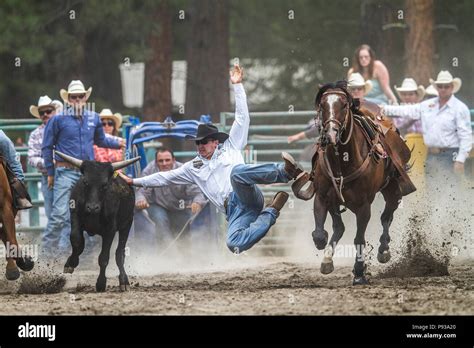
The steer wrestler then is pulled off his horse by the slowing steer and plants his heels into the dirt, further slowing the steer and himself.
He then takes one hand off the horns, reaches down and grabs the nose of the steer pulling the steer off balance and ultimately "throwing" the steer to the ground.
Read also: Learn Steer Wrestling
Once all four legs are off the ground, an official waves a flag marking the official end and a time is taken.
The bulldogger's horse must not break the rope barrier in front of it at the beginning of a run, but must wait for the animal escaping from the adjacent chute to release the rope.
As with calf ropers and team ropers, the bulldogger starts on horseback in a box.
A breakaway rope barrier is attached to the steer, then stretched across the open end of the box.
The steer gets a head start that is determined by the size of the arena.
When the steer reaches the advantage point, the barrier is released and the bulldogger takes off in pursuit.
If the bulldogger breaks the barrier before the steer reaches its head start, a 10-second penalty is assessed.
In addition to strength, timing and balance are skills cultivated by the successful steer wrestler.
When the cowboy reaches the steer, he slides down the right side of his galloping horse, hooks his right arm around the steer's right horn, grasps the left horn with his left hand and, using strength and leverage, wrestles the animal to the ground.
His work isn't complete until all four of the animal's feet face upward.
In order to catch up to the running steer, the cowboy uses a "hazer," another mounted cowboy who gallops his horse along the right side of the steer, keeping it from veering away from the bulldogger.
The hazer can make or break a steer wrestler's run, so his role is as important as the skills the bulldogger hones.
The original method of wrestling the steer to the ground is to lean from the galloping horse running beside the steer, giving the weight of the upper body to the neck to the steer with one hand on the near horn of the steer and the far horn grasped in the crook of the other elbow.
One then lets the horse carry his feet by the steer until his feet naturally fall out of the stirrups.
The steer wrestler then slides with his feet turned slightly to the left, twisting the head of the steer toward one by pushing down with the near hand and pulling up and in with the far elbow.
Typical Parameters
Typical professional times are in the range of 3.0 to 10 seconds from the gates opening to the waving of the flag.
The steers used today are generally corriente cattle or longhorns, which weigh between 450 and 650 pounds, and the human steer wrestlers typically weigh 180 to 300 pounds.
Speed is the name of the game in steer wrestling.
With its modern world record sitting at 2.4 seconds, steer wrestling is the quickest event in rodeo.
The cowboy's objective is to use strength and technique to wrestle a steer to the ground as quickly as possible.
That sounds simple enough.
But anything that sounds that easy has to have a catch to it, and that catch here is the steer generally weighs more than twice as much as the cowboy trying to throw it.
Animal Welfare Concerns
Like all other rodeo events, steer wrestling is criticised by animal-rights advocates.
Modern rodeos in the United States are closely regulated and have responded to accusations of animal cruelty by instituting a number of rules to guide how rodeo animals are to be managed.
In 1994, a survey of 28 sanctioned rodeos was conducted by on-site independent veterinarians.
Reviewing 33,991 animal runs, the injury rate was documented at 16 animals or 0.047%, less than one in 2000 animals.
A study of rodeo animals in Australia found a similar injury rate.
However, accusations of cruelty in the USA persist.
The PRCA acknowledges that they only sanction about 30% of all rodeos, while another 50% are sanctioned by other organizations and 20% are completely unsanctioned.
Several animal-rights organizations keep records of accidents and incidents of possible animal abuse.
They cite various specific incidents of injury to support their statements, and also point to examples of long-term breakdown, as well as reporting on injuries and deaths suffered by animals in nonrodeo events staged on the periphery of professional rodeo such as chuckwagon races and "suicide runs".
In terms of actual statistics on animal injury rate, no more recent independent studies are apparent on animal injury in rodeo than the 1994 study.
| Number of Animal Runs | Number of Injuries | Injury Rate |
|---|---|---|
| 33,991 | 16 | 0.047% |