Taekwondo and Hapkido are two of the most well-known Korean martial arts. While they share cultural and historical roots, they differ in techniques, philosophy, and application.
Martial arts are systems of codified practices and traditions of combat, often practiced for self-defense, competition, physical health and fitness, as well as mental and spiritual development. These disciplines encompass a wide range of techniques and philosophies, each offering unique benefits to practitioners. Martial arts training can be a valuable tool for personal growth, discipline, and self-improvement.
Both Hapkido and Taekwondo stress the importance of self-discovery, personal growth, physical fitness, and mental discipline, making them not just martial arts but also paths to holistic development.
Historical Origins
Hapkido, meaning “the way of harmonious energy,” was developed in the mid-20th century by Choi Yong-Sool. Born in 1904, Choi studied Daito-ryu Aiki-jujutsu in Japan and later combined his knowledge with traditional Korean martial arts to create “Hapkido,” a system focused on self-defense and joint manipulation.
While Choi’s claims of being adopted by Takeda Sōkaku and studying with him for 30 years are disputed, his contributions to the development of Hapkido are undeniable. Choi’s innovative approach to martial arts has left a lasting legacy, influencing countless practitioners and shaping the evolution of Hapkido into the comprehensive self-defense system it is today.
Read also: Is the Century Taekwondo Uniform Worth It?
On the other hand, Taekwondo, translating to “the way of the foot and the hand,” was formalized in the 1940s and 1950s by General Choi Hong Hi (with the name “Tae Kwon Do” officially adopted in 1955). In 1973, the South Korean government formed what is today known as the World Taekwondo to focus on its sport aspect, with an eye towards inclusion in the Olympics. This martial art emphasizes high, fast kicks and agility, making it both a sport and a method of self-defense.
Core Philosophies
Hapkido is grounded in the principles of harmony, adaptability, and efficiency. Practitioners aim to blend with an opponent’s force rather than confronting it directly.
Taekwondo’s philosophy is encapsulated in its five tenets: Courtesy, Integrity, Perseverance, Self-Control, and Indomitable Spirit.
Techniques and Training
Hapkido is renowned for its extensive repertoire of techniques, including joint locks, throws, grappling, and pressure point strikes. It incorporates both long-range and close-quarter combat techniques, making it a versatile martial art.
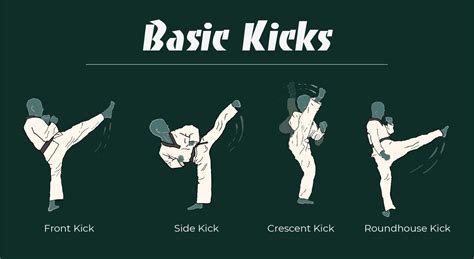
Taekwondo is characterized by its emphasis on powerful, high, and fast kicks, such as the roundhouse kick, side kick, and spinning hook kick. Hand techniques, including punches, blocks, and strikes, are also integral.
Read also: The Meaning Behind Taekwondo Belts
Hapkido training focuses on self-defense applications, emphasizing realistic and practical techniques for neutralizing threats. Practitioners train to handle various situations, including armed and unarmed attacks.
Taekwondo training often places a significant emphasis on competitive sports aspects, especially Olympic-style sparring. However, traditional Taekwondo schools also emphasize forms (poomsae), which are sequences of movements representing defensive and offensive techniques.
At KMA Taekwondo Hapkido, Sabumnim recommends practical self-defense training, even for students focused on Olympic-style Taekwondo.
Hapkido emphasizes practical self-defense techniques, equipping practitioners with adaptable combat strategies suitable for real-world encounters.
Taekwondo classes often involve sparring, poomsae (forms), and board breaking, making it a more physically demanding art. Hapkido training, on the other hand, incorporates a wider range of techniques.
Read also: Excellence in Taekwondo
3 Best Martial Arts Styles | No, It's Not Yours
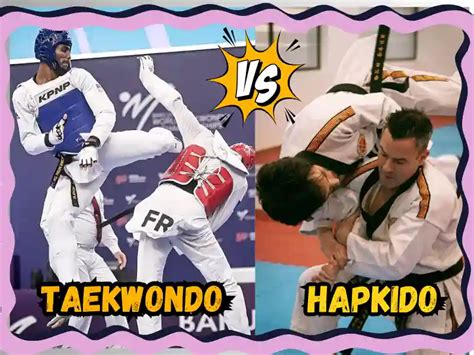
Key Differences Summarized
As anyone who has studied or researched the Korean martial arts readily understands, Tae Kwon Do and Hapkido are two very different systems of self-defense. If one were to compare these systems, the differences would be overwhelming.
The primary difference lies in their techniques. Taekwondo focuses on kicks and striking, which enhances cardiovascular fitness and flexibility.
The stance is the next highly differing element that separated Tae Kwon Do from Hapkido. The fighting stances of these arts demonstrate the differences. Whereas many hard style schools of Japanese karate use a very stiff and firm stance, Daito Ryu is just the opposite, it employs a very free flowing from of movement - with less reliance upon the firm and locked stance.
Tae Kwon Do uses a linear pattern of movement while Hapkido employs a circular structure for its defense.
Here's a table summarizing the key differences:
| Feature | Taekwondo | Hapkido |
|---|---|---|
| Focus | Kicking techniques, sport | Self-defense, joint locks |
| Techniques | Linear, direct strikes | Circular, adaptable |
| Stance | Firm, formal | Free-flowing, natural |
| Application | Competition, fitness | Real-world self-defense |
Similarities
Despite their differences, Taekwondo and Hapkido also share several similarities:
- Korean Heritage: Both Hapkido and Taekwondo share a Korean heritage, reflecting the cultural and historical influences of Korea.
- Discipline and Respect: Both martial arts place a strong emphasis on discipline, respect, and ethical behavior.
- Physical and Mental Development: Hapkido and Taekwondo both contribute to physical fitness, mental discipline, and personal growth.
Choosing the Right Martial Art for You
If you’re drawn to high-energy, competitive sports, and enjoy performing impressive kicks, Taekwondo might be the ideal choice. However, if your focus is on self-defense and you prefer a more comprehensive approach to martial arts, Hapkido might be more suitable.
Interested in competition, discipline, and fitness? Taekwondo may be the best fit. Looking for self-defense, joint locks, and real-world application?
Consider attending introductory classes for both martial arts to determine which aligns best with your interests and goals.
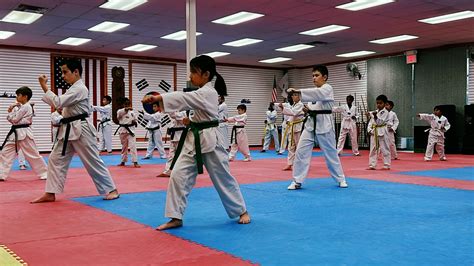
KMA Taekwondo Hapkido recognizes that both martial arts can be practiced well into one’s 60s, 70s, and 80s. At KMA Taekwondo Hapkido, we offer top-tier training in both martial arts for students of all ages.