The origins of Tai Chi Chuan are shrouded in history and legend. It's almost impossible to separate Chinese martial art history from legend. Legends hold interesting and useful messages.
Tai Chi, also known as Shadow Boxing, is one of the major branches of the traditional Chinese martial arts. The essential principles of Tai Chi are based on the ancient Chinese philosophy of Taoism, which stresses the natural balance in all things and the need for living in spiritual and physical accord with the patterns of nature.
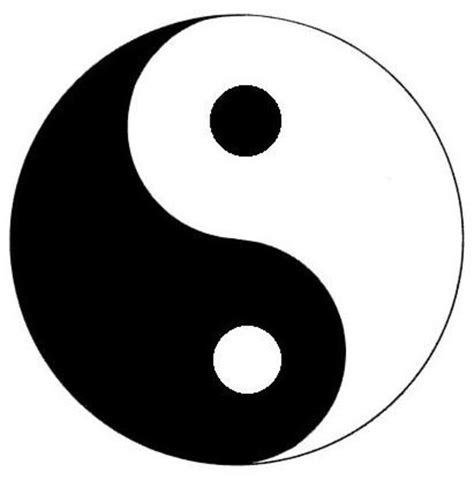
According to this philosophy, everything is composed of two opposite, but entirely complementary, elements of yin and yang, working in a relationship which is in perpetual balance. Yin and yang are polar opposites and are found in all things in life.
Concepts such as soft, pliant, yielding and feminine are associated with yin, while concepts such as hard, rigid and masculine are associated with yang. Both sides complement each other completely and together form a perfect whole. Things which are perfectly balanced and in harmony are at peace; being at peace leads naturally to longevity.
Here is a representation of the Yin and Yang philosophy:
Read also: Discover the story of Casey Swiderski
Legendary Origins
One legend has it that the semi-mythical Chinese Taoist priest Zhang Sanfeng, said to have been born either in 960, 1247 or in 1279, created the concept of internal martial arts, and created Tai Chi Chuan. According to legend, he observed a crane attacking a snake on Wudang Mountain and was greatly inspired by the snake’s defensive tactics.
The snake remained still and alert in face of the crane’s onslaught until it made a lunge and fatally bit its attacker. This inspired him to create a 72-movement Tai Chi Chaun set. The Taoist philosophy and teachings of Wudang Mountain were passed down through many generations.
No verifiable historical records can be found until about 300 years ago. These earliest records indicate that Tai Chi Chuan can be traced to Chenjiagou, a small village in Henan Province, home of the Chen clan. Since that time, 19 generations of Chen style players have maintained their strict training and high standards.
In the 1820’s Yang Luchan began studying Chen style, and did so for over 10 years. His fighting skills earned him the nickname, “Yang the Invincible,” eventually land him a job in the Forbidden City teaching the Manchu Imperial Guard. He developed Yang Family Tai Chi Chaun, which began to attract the attention of the aristocracy and as a result he and Wu Yuxiang began to slow the motions down, making them more evenly paced and reserved, suitable for more contemplative players.
From the 1840’s, the Yang Family began to teach publicly, hoping that the daily practice of Tai Chi Chuan could restore the health and downtrodden spirits of their fellow citizens. In the 1950’s, the Chinese government created the popular Simplified Yang Style Tai Chi Chuan 24 Form and propagated it widely to the masses as a health exercise. Today, estimates of Tai Chi Chuan players worldwide range in the tens of millions.
Read also: Sectional Wrestling Tournament Details
The Five Basic Styles of Traditional Tai Chi Chuan
Traditional Tai Chi Chuan has 5 basic styles:
- Chen Style: The most martial, with explosive strikes and coiling sinuous motions.
- Yang Style: The most widely practiced, with large open postures and slow, evenly paced motions.
- Wu/Hao Style: Developed by Wu Yuxiang and Li Yiyu and spread by Hao Weizhen. Hao is characterised by slow and internally loose movements, which are close-knit in outward appearance. Great emphasis is placed on internal force and correct positioning. External movements and the transference of the substantial and insubstantial are controlled by internal power.
- Wu Style: Created by Quan You and Wu Jianquan, it is characterised by softness and emphasis on redirecting incoming force. It is rich with hand techniques. Wu style tends to have a slightly forward leaning posture. The advantage of the Wu Style is that it is pleasant to look at, and is rich in techniques.
- Sun Style: It was created by Sun Lu-tang (1861-1932). Sun was a well-known exponent of the Xingyiquan and Baguaquan (two famous internal martial art styles) before he learned Tai Chi. Sun later created his own style which is characterised by agile steps. Whenever one foot moves forward or backwards the other foot follows.
Here is a table summarizing the main characteristics of each style:
| Style | Characteristics |
|---|---|
| Chen | Most martial, explosive strikes, coiling motions |
| Yang | Widely practiced, large open postures, slow and even |
| Wu/Hao | Slow and internally loose movements, emphasis on internal force |
| Wu | Softness, redirecting force, rich hand techniques |
| Sun | Agile steps, smooth flow, powerful Qigong |
Tai Chi Techniques and Shuai Jiao (Chinese Wrestling)
An interesting video has surfaced that links the guard postures used in Shuai Jiao (Chinese Wrestling) with postures in various Chinese martial arts. The premise of the video is that Shuai Jiao is the root of all the Chinese martial styles.
“Guards in traditional Chinese wrestling are meant to favor certain fighting techniques and strategies. Since Shuai Jiao is very ancient and there are precise references in these guards to the styles that exist today, traditional wrestling is at the roots of Chinese styles. My Master Yuan Zumou has clearly stated this for over thirty years. In Shuai Jiao these attitudes are not aesthetic, but are used in real combat.
It’s an interesting theory, but unfortunately I can’t agree with such a blanket statement as “traditional wrestling is at the roots of Chinese styles“. Was it a strong influence on all Chinese styles? Yes, of course. But calling it the root of all styles is a bit strong for me. I can certainly see postures in the video that resemble Tai Chi - particularly the “White Stork Cools Wings” posture and another guard that looks a little like the “Wave Hands Like Clouds”.
Read also: The story of Angelo Posada
But we only have two arms and two legs - inevitably there are going to be similarities between postures found in different martial arts. That alone doesn’t confirm a genuine historial link. Influences betweewn marital arts can flow in both directions, too. So it’s quite possible that wrestling has been influenced by local village styles.
I’d also have to take issue with the statement that “In Shuai Jiao these attitudes are not aesthetic, but are used in real combat.” Let’s not even get into the idea of what “real combat” is (Shuai Jiao matches have rules, after all) but it’s a simple fact that Shuai Jiao was enjoyed in the royal court in the Ching Dynasty (and probably all the dynasties before it) as a kind of entertainment for the nobles.
Tai Chi (Taiji) and Shuai Jiao connections? Throws in Chinese internal arts!
The same thing happened in the Japanese royal court with Sumo, just as medieval kings in Europe enjoyed watching martial games like jousting and fencing. And obviously wrestling is still enjoyed as a kind of popular entertainment in America and Mexico today. But let’s turn our attention to the contend of the video.
But I don’t think that’s a bad thing. Ever since modern Wu Shu put the emphasis on gymnastic ability over practicality, people have been searching for this false dichotomy between performance and practicality in historical martial arts, too. It’s almost like a real martial art isn’t allowed to have any ‘fun’ aspects to it.
In reality, and with several historical examples, a martial art can be both a serious, practical tool for combat, and something that can be performed for social, entertainment and cultural reasons all at the same time. Choy Li Fut schools often perform lion dance, and that doesn’t mean their kung fu won’t work in a fight. Similarly, I would contend that Shuai Jiao can be used as a form of entertainment and a practical method of self defence.
Tai Chi's path is one of developing naturalness by relaxing, attending inward, and slowing mind, body, and breath. This allows the practitioner to become less tense, to drop conditioned habits, to let go of thoughts, to allow qi to flow smoothly, and thus to flow with the Tao.
A key aspect of tai chi philosophy is to work with the flow of yin (softness) and yang (hardness) elements. When two forces push each other with equal force, neither side moves. Motion cannot occur until one side yields.
Therefore, a key principle in tai chi is to avoid using force directly against force (hardness against hardness). Laozi provided the archetype for this in the Tao Te Ching when he wrote, "The soft and the pliable will defeat the hard and strong."