Michael Gerard Tyson, born on June 30, 1966, is an American former professional boxer who competed between 1985 and 2005. Tyson won his first 19 professional fights by knockout, 12 of them in the first round. Claiming his first belt at the age of 20, Tyson holds the record as the youngest boxer ever to win a heavyweight title.
He was the first heavyweight boxer to simultaneously hold the World Boxing Association (WBA), World Boxing Council (WBC), and International Boxing Federation (IBF) titles, as well as the only heavyweight to unify them in succession. Tyson's dominant performances brought many accolades.
Tyson intimidated fighters with his strength, combined with outstanding hand speed, accuracy, coordination and timing. Tyson also possessed notable defensive abilities, holding his hands high in the peek-a-boo style taught by his mentor Cus D'Amato to slip under and weave around his opponent's punches while timing his own. Tyson's explosive punching technique was due in large part to crouching immediately prior to throwing a hook or an uppercut: this allowed the "spring" of his legs to add power to the punch. Among his signature moves was a right hook to his opponent's body followed by a right uppercut to his opponent's chin. Expectations for Tyson were extremely high, and he was the favorite to win the heavyweight unification series, a tournament designed to establish an undisputed heavyweight champion.
However, the career of "Iron Mike" wasn't without its setbacks. His decline was as fast as his rise, marked by personal turmoil, legal issues, and formidable opponents.
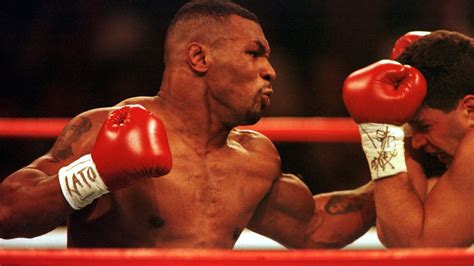
Early Life and Career
Michael Gerard Tyson was born on June 30, 1966, at Cumberland Hospital in Fort Greene, Brooklyn, New York City. Throughout his childhood, Tyson lived in and around neighborhoods with a high rate of crime. By the age of 13, he had been arrested 38 times. Tyson's emerging boxing ability was discovered there by Bobby Stewart, a juvenile detention center counselor and former boxer. Stewart noted that Tyson could bench press more than his weight, and through Stewart, Tyson met boxing manager and trainer Cus D'Amato.
Read also: Mike Tyson vs. Brock Lesnar?
As an amateur, Tyson won gold medals at the 1981 and 1982 Junior Olympic Games, defeating Joe Cortez in 1981 and beating Kelton Brown in 1982. In 1984 Tyson won the gold medal at the Nation Golden Gloves held in New York, beating Jonathan Littles.
Tyson made his professional debut as an 18-year-old on March 6, 1985, in Albany, New York. He defeated Hector Mercedes via first-round TKO. Fighting frequently, Tyson won 26 of his first 28 fights by KO or TKO; 16 of those came in the first round. Tyson's first nationally televised bout took place on February 16, 1986, at Houston Field House in Troy, New York, against journeyman heavyweight Jesse Ferguson, and was carried by ABC Sports.
On November 22, 1986, Tyson was given his first title fight against Trevor Berbick for the World Boxing Council (WBC) heavyweight championship. Tyson won the title by TKO in the second round, and at the age of 20 years and 4 months became the youngest heavyweight champion in history. He added the WBA and IBF titles after defeating James Smith and Tony Tucker in 1987.
On June 27, 1988, Tyson faced Michael Spinks. The bout was, at the time, the richest fight in history and expectations were very high.
The Loss to Buster Douglas
By 1990, Tyson seemed to have lost direction, and his personal life was in disarray amidst reports of less vigorous training prior to the Buster Douglas match. In a fight on February 11, 1990, he lost the undisputed championship to Douglas in Tokyo. Tyson was a huge betting favorite; indeed, the Mirage, the only casino to put out odds for the fight, made Tyson a 42/1 favorite.
Read also: Mike Tyson vs. Jake Paul
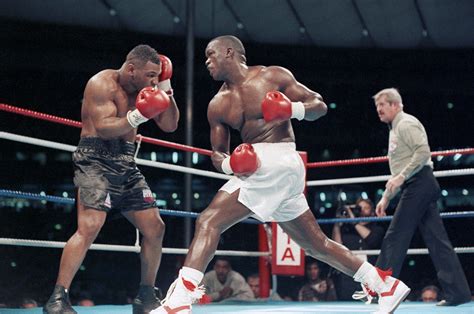
Tyson failed to find a way past Douglas's quick jab that had a 12-inch (30 cm) reach advantage over his own. Just 35 seconds into the tenth round, Douglas unleashed a brutal uppercut, followed by a four-punch combination of hooks that knocked Tyson down for the first time in his career. Despite the shocking loss, Tyson has said that losing to Douglas was the greatest moment of his career: "I needed that fight to make me a better person and fighter.
After the loss, Tyson recovered with first-round knockouts of Henry Tillman and Alex Stewart in his next two fights. Tyson's victory over Tillman, the 1984 Olympic heavyweight gold medalist, enabled Tyson to avenge his amateur losses at Tillman's hands.
Legal Troubles and Comeback
In 1992, he was convicted of rape and sentenced to six years in prison. He was released on parole after three years. After being paroled from prison, Tyson easily won his comeback bouts against Peter McNeeley and Buster Mathis Jr. Tyson's first comeback fight was marketed as "He's back!" and grossed more than US$96 million worldwide, including a United States record $63 million for PPV television.
Tyson regained one belt by easily winning the WBC title against Frank Bruno in March 1996. In 1996, Lennox Lewis turned down a $13.5 million guarantee to fight Tyson. Tyson added the WBA belt by defeating champion Bruce Seldon in the first round in September that year.
The Holyfield Fights and Disqualification
Tyson attempted to defend the WBA title against Evander Holyfield, who was in the fourth fight of his own comeback. Holyfield had retired in 1994 following the loss of his championship to Michael Moorer. On November 9, 1996, in Las Vegas, Nevada, Tyson faced Holyfield in a title bout dubbed "Finally". In a surprising turn of events, Holyfield defeated Tyson by TKO when referee Mitch Halpern stopped the bout in round eleven. Holyfield became the second boxer to win a heavyweight championship belt three times.
Read also: A Look at Tyson Sausage Patties' Nutritional Value
Holyfield's victory was marred by allegations from Tyson's camp of Holyfield's frequent headbutts during the bout. Tyson and Holyfield fought again on June 28, 1997. The highly anticipated rematch was dubbed The Sound and the Fury, and it was a lucrative event, drawing even more attention than the first bout and grossing $100 million.
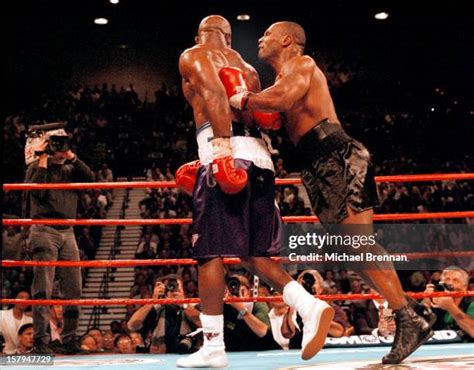
Soon to become one of the most controversial events in modern sports, the fight was stopped at the end of the third round, with Tyson disqualified for biting Holyfield on both ears. Referee Mills Lane deducted two points from Tyson and the fight resumed. However, after the match resumed, Tyson bit him again, resulting in his disqualification, and Holyfield won the match. As a fallout from the incident, US$3 million was immediately withheld from Tyson's $30-million purse by the Nevada state boxing commission.
Later Career and Final Fights
Tyson lost three of his last four fights between 2002 and 2005. In 2002, Tyson fought for the world heavyweight title, losing by knockout to Lennox Lewis.
Table of Key Fights and Losses
| Opponent | Year | Result | Reason |
|---|---|---|---|
| Buster Douglas | 1990 | Loss | Knockout |
| Evander Holyfield | 1996 | Loss | TKO |
| Evander Holyfield | 1997 | Loss | Disqualification |
| Lennox Lewis | 2002 | Loss | Knockout |
Recent Exhibition Fight
Mike Tyson lost to YouTuber boxer Jake Paul by a wide eight-round unanimous decision on Friday night in a Netflix broadcast that was rife with issues, making him appear like a terrible, wretched parody of the fighter he had once been. The 27-year-old Jake had too much youth for the about 60-year-old Tyson, as seen by the mismatch scores of 80-72, 79-73, and 79-73.
Between six and eight in the title rounds, Tyson was worn out and struggled to go around the ring on his old, tired legs.