Any time an ESPN 30 for 30 comes out, people attempt to carve out whatever amount of time is necessary to sit down and watch.
Some are brilliant and some are disappointing, but all offer a unique perspective and insight into quintessential aspects of sports lore.
Tonight’s “Chasing Tyson” feels like a throwback: like something from the series’ first season.
Director Steven Cantor brings shape and definition to the material, keeping the style simple yet effective.
Cantor has an eclectic documentary filmography, but has worked on some movies that people who keep up with popular culture might know-in particular Lucy Walker’s Amish rumspringa doc Devil’s Playground and the Pixies doc loudQUIETloud.
Read also: Mike Tyson vs. Brock Lesnar?
The smartest decision he makes with “Chasing Tyson” is to emphasize the archival footage at his disposal rather than loading up on too many talking heads or quirky animations.
With very technically strong direction from director Steven Cantor, Chasing Tyson’s only real flaw (and unavoidable one) is that it never builds to a crescendo.
It moves along with great pace and high quality footage, interviews, music, and insights covering a ton of ground in the career’s of both Tyson and Holyfield.
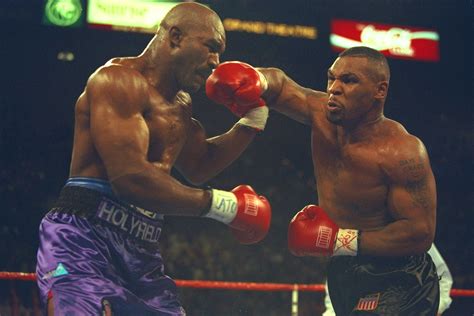
The Holyfield Narrative
This episode traces the tumultuous decade that boxer Evander Holyfield spent trying to book a heavyweight title fight with Mike Tyson, who was indisposed for various personal, legal, and business reasons.
Despite its title, Chasing Tyson is wholeheartedly a Holyfield film.
Read also: Mike Tyson vs. Jake Paul
Steven Cantor delivers a very well put together examination on the career of Holyfield.
At its core, Chasing Tyson is a study of human nature, where in a case of good (Holyfield) verses evil (Tyson), the latter continually piques fan interest.
He is painted as the anti-Tyson: a deeply religious, soft-spoken man who doesn’t smoke or drink.
The lack of proper respect for Holyfield is evident throughout the early part of his career, as he’s criticized for being boringly placid in his private life and lacking “knockout power” in the ring.
While his quiet demeanor always guaranteed a less flashy reign as the champion, he still defended his title as an underdog, and never achieved the respect he felt he deserved, and defeating Tyson was his number one goal in his obsessive attempt in gaining that respect.
Read also: A Look at Tyson Sausage Patties' Nutritional Value
The Intersection of Careers
There are two major events in the careers of Mike Tyson and Evander Holyfield that seem to intersect at pivotal times in each career path.
First is the incarceration of Tyson, which reflects on the type of person Tyson was, and allowed Holyfield to be king for a time.
Tyson v. Holyfield I happened 5 years later than it should have, in part due to Tyson’s unwillingness to recognize Holyfield as a worthy opponent, and because of his incarceration.
The decision to cover so much of the fighters’ careers (the core concept of the film) is both a bit of a blessing and a curse.
The film oozes high profile twists and turns in their careers so the film’s pace never sags and the story is never linear.
As you'd expect there's a bunch of video footage of fights Holyfield had in his early days and these are certainly fun to watch.
It's even more fun to watch the interviews where people were constantly questioning Holyfield and even up to the infamous rematch and Tyson losing it in the ring.
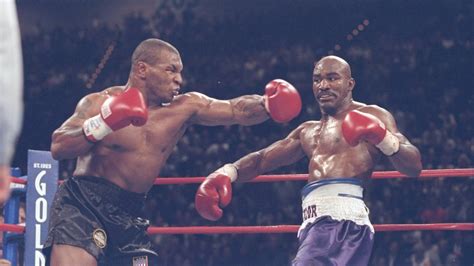
Archival Footage and Fighter Perspectives
The film doesn't use a bunch of talking heads to tell its story but instead we get archival interviews that were done as all this stuff was going on.
Given that boxing is still a sport a lot of people can’t afford to see, a lot of the clips in “Chasing Tyson” will be new to some, which is a great reason to include as many of them as possible, rather than cutting back to newer interviews.
The other advantage to this approach is that it puts the focus directly on how the docs’ subjects evolved over the course of ten-plus years.
And I’m not just talking about Holyfield and Tyson here.
Though the title of of the episode is “Chasing Tyson,” it’s really about the public perception of Holyfield, and how the media shaped Evander’s reputation as the era’s biggest also-ran.
It’s startling at times to see how brazenly reporters question both fighters right to their faces.
At a joint interview, Holyfield was asked whether he was worried that Tyson’s erratic behavior will land him in jail before they could tussle; and later, immediately after Buster Douglas upset the champ in Tokyo, Holyfield was asked ringside whether he felt like “the biggest loser,” for being deprived of a planned title fight against Tyson.
But by cutting from those old interviews and comments to the footage of the actual fights, “Chasing Tyson” undercuts the media’s indifference.
Holyfield looks ferocious in his prime, even though he wasn’t beating his opponents down to the canvas back then.
Cantor has fresh interviews with Holyfield and Tyson, but he and his editors mainly use just the audio, letting those comments serve as a narration, running under images of both at their best.
That gives Holyfield a chance to defend his steely demeanor, and Tyson a chance to set the record straight about his feelings toward Evander, whom he clearly admires-and to some extent even envies.
I’d say the film showed roughly 20-25 minutes of various fight footage or almost as compelling fight night footage (in the corner, introductions, post fight interviews, and press conferences).
Mix in Tyson interviews both old and new, the media frenzy of Tyson’s trial and incarceration, and some added perspective from our protagonist Holyfield and you have a lot of meat on the bone here.
Tyson himself adds some very thoughtful and honest commentary which was interesting when seen contrasted with the footage of him being a mad man back in the day.
And to hear Holyfield essentially say the motivation for his second act was from a quack evangelical fake miracle-working religious maniac was a little odd and disappointing.
The Climax and Restraint
“Chasing Tyson” ends with what it’s been building to all along: two of the most memorable fights of the 1990s.
In the first, Holyfield methodically wears the title-holding Tyson down; and in the second a frustrated Tyson notoriously bites a chunk out of the new champion’s ear.
Cantor resists the temptation to press on to what happened next for both men, beyond a short closing crawl.
That restraint helps keep the film clearer and more direct.
This is a story about how Holyfield was underrated for years because he didn’t get to go up against Tyson.
Once they fight?
Final Thoughts
I actually enjoyed this film more than I am letting on solely because it connects dots that I imagine a lot of sports fans who aren’t hardcore boxing fans have in their head, but can’t string together to make a more telling account.
I think many fans regardless of age can rattle off maybe two or three dozen famous boxers over the last 25 years, but the knowledge beyond the names is pretty thin.
How many fights can you (if you’re not a boxing fan) really vividly recall the particulars of for each of those fighters?
Part of this murkiness is that this is boxing, a sport that requires your plenty of your money to follow it.
For me, I knew there was no chance my parents were going to okay any type of PPV buying so almost all of these events were communicated to me second hand.
Chasing Tyson makes that connection, providing context to them all, ordering them, and accentuating the often overlooked Holyfield narrative and point of view.
Nonetheless, you do leave feeling satisfied and I thought it was well done
To use a lame boxing saying, Chasing Tyson packs a big punch.