The discipline known as martial arts has spread at an incredible speed in the West since its introduction in the 20th century from its historic roots in East Asia. Martial arts are commonly misunderstood as simply learning how to fight. Although fighting and subduing an opponent are components of martial arts training, at its core, it is much more profound. Many who practice martial arts choose it as a lifestyle. Martial arts are a mindset and embody an honorable philosophy.
Martial arts can be classified as either armed combat (including fencing and archery) or unarmed combat (such as hapkido, taekwondo, aikido, judo and karate). Martial arts teachers have passed the tradition down from generation to generation, teaching the arts of karate, kung fu, jiu-jitsu, aikido, taekwondo, judo, and others. Although many of these practices include throwing, kicking, and punching, the physical side of these skills is only one element.
Adults who study martial arts at any level experience a wealth of benefits that transform both their physical health and mental clarity. Martial arts benefit all people, and these include those with disabilities. In a 2002 study, martial arts students with physical, cognitive, and sensory disabilities responded that training in martial arts helped improve functionality and overcome obstacles of their disabilities.
Here is a list of essential benefits that come with practicing martial arts consistently over time:
1. Enhanced Physical Health and Fitness
One of the primary benefits of martial arts is improved physical health. A person’s life changes the second they place their foot onto the mat for their first training session. They get their heart pumping with striking movements and their arms and shoulders start getting sore. Grappling arts require a person to constantly use muscles they did not know existed. All of them teach a person how to remain calm and control their breathing cadences so their stamina increases, which helps with everything else they do outside of the gym.
Read also: Individual Martial Arts Instruction
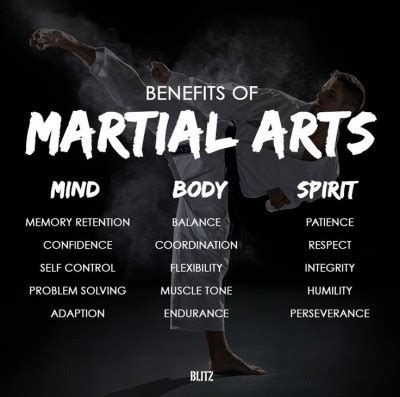
Practicing martial arts gives you complete, total body aerobic training. When you engage in this training, you are utilizing incredible physical energy. As a result, strength, balance, flexibility and stamina increase proportionally to your dedication to the discipline. Martial arts practice burns approximately 720 calories in a one-hour session, according to the Compendium of Physical Activities. What may surprise some is that martial arts are considered aerobic activity.
2. Increased Flexibility and Coordination
Practicing martial arts disciplines such as jiu jitsu, kickboxing, Muay Thai, and taekwondo can greatly improve flexibility and coordination through various means. A person engages in a lot of active and passive stretching when they participate in martial arts. Properly warming up their muscles and practicing the movements of their respective discipline increases their flexibility and circulation.
In order to perform certain martial arts tactics, like punching and kicking, increased coordination becomes tactically essential. This combination of stretching and movement helps increase the range of motion in the joints and muscles, leading to improved flexibility. In addition, the multi-directional movement of Kempo makes it a perfect martial art for those who want to improve flexibility.
3. Lower Blood Pressure and Heart Rate
Martial arts training has been found to contribute significantly to lowering blood pressure and heart rate through its impact on circulation and heart strength. The intense physical activity involved in martial arts training helps to improve blood flow and circulation throughout the body, which in turn can lead to a reduction in blood pressure. Furthermore, the connection between martial arts and high-intensity interval training is significant, as both involve bursts of intense activity followed by periods of rest or lower intensity. This type of training has been proven to have positive effects on cardiovascular health, including lowering blood pressure and heart rate.
Practicing martial arts improves circulation, which alleviates a lot of health risks that come with living a sedentary lifestyle. The heart has to work harder to pump blood when it is weak, and exercise strengthens the heart. There have been many cases where people were able to get off of their blood pressure medication after remaining dedicated to their training.
Read also: The Jade Fortress Martial Arts System
4. Enhanced Mental Well-Being
Understanding the connection of mixed martial arts & mental health
Practicing martial arts is viewed as a form of therapy to just about everyone who does it. A person’s focus completely shifts to what is happening in class and all of life’s problems are put on hold for a couple of hours. They learn early that there is an infinite amount of knowledge to pursue, which means they never stop improving and adapting. Self improvement always leads to a happier mindset, and martial arts training is all about focusing on just that.
Claims of improved mental and physical health are typical of those practicing martial arts because martial arts are unique in that they require the engagement of the mind to be able to perform physical moves successfully. Contrary to what some believe, martial arts have been shown to directly correlate to less aggressive behavior and stronger emotional well-being. Martial arts promote spiritual and mental growth.
5. Reduced Stress Levels
Students report that martial arts practices dissolve stress. The awareness and control of breathing that you develop allow an easy escape route for stress. Since martial artists are trained to focus on the present task, distractions melt away into the background, also helping to significantly lessen the stress accumulated throughout the day.
A good thing, though, is that physical exercise reduces the negative effects that stress has on the body. Martial arts help reduce stress and anxiety in many ways. It is a full-body workout that releases feel-good endorphins throughout the body. Punching the heavy bag or sparring with a partner is a great way to channel frustrations.
Read also: Deep Dive into Court Martial Films
6. Enhanced Focus and Concentration
Martial arts training can significantly improve your concentration through various aspects of the practice. When learning new moves and sequences, you are required to actively listen to your instructors and observe their techniques carefully. This process not only enhances your ability to focus on specific instructions but also trains your mind to be fully present in the moment. Additionally, martial arts emphasize the importance of remaining calm and focused, especially during high-speed and intense situations.
Practicing martial arts trains a person’s mind to remain calm and focused during tense and high-speed situations. Building these attributes play a vital role in being able to remain focused for longer periods of time and are helpful with multitasking. A person is usually able to concentrate a lot more and focus a lot better on their daily tasks and responsibilities. Furthermore, the physical exhaustion that comes after a rigorous martial arts training session can lead to better quality sleep. Quality sleep is essential for optimizing your potential, as it allows your body and mind to fully recover and recharge.
7. Increased Self-Confidence
Continual training and overcoming adversity in martial arts plays a vital role in the growth of self-confidence and self-esteem. As a martial arts trainee, the goals you set, the respect you give to the incredible history of the discipline and the positive encouragement you receive lead to greater feelings of self-confidence in your daily life. When you progress through the ranks and master new techniques, you will experience a sense of accomplishment and pride, ultimately improving your confidence.
Training in martial arts builds a person’s self-confidence levels in ways that no other activity is able to. The lowering of stress and anxiety leads to an overall increase in self confidence. A person’s mind is strengthened, which helps them to more easily deal with adversity.
8. Improved Coordination and Reflexes
Students who practice martial arts report that their reflexes are substantially improved. A person’s coordination skills develop significantly once they begin training in martial arts and learning how the human body functions. Doing so allows a person to build up to more complex movements and combinations. Their brain and body start to become synchronized and muscle memory begins to develop, which improves their spatial awareness so they are more aware of their surroundings.
Practicing those moves not only keeps a person’s reflexes sharp, but it corrects any muscle imbalances that they have. All of these factors ensure that their reflexes remain sharp and muscle memory is retained.
9. Improved Self-Defense Skills
During classes, students practice strategic kicks and punches. These powerful martial arts moves give you a valuable repertoire of self-defense skills. By learning self-defense techniques, you can improve your reaction time, situational awareness, and physical preparation for real-life situations. There are also a number of martial arts benefits for women specifically.
Martial arts exist so that a person learns how to properly control and defend themselves if they ever encounter an attacker. Their reaction time starts to improve immensely once they have been training for even a short amount of time. They develop toughness and a sense of fortitude and their stamina starts to increase.
10. Increased Self-Discipline
A person’s lifestyle choices start changing once they begin taking their martial arts training seriously, especially if they decide to take the next step and start competing. It is much easier to stay in shape than it is to get in shape, and self-discipline is required for a person to stay in shape. They begin making healthier choices with their diet and their alcohol intake decreases.
11. Opportunities for Socialization
Joining a martial arts gym is a great way to socialize and make new friends. Martial arts gyms are filled with like-minded individuals who share similar goals and come from all walks of life. They provide people with golden opportunities to build trustworthy relationships with people much easier than in many other social settings.
12. Cultivation of Respect and Humility
Fighters and martial arts practitioners are some of the nicest people around despite the violent nature of competition. It is largely because everyone has been humbled in the gym throughout their years of training. There’s a mutual amount of respect between people in the gym even if they do not have much in common with each other.
Martial Arts and Children's Physical Fitness
Applying well-organized martial arts programs to children can lead to an increase in physical fitness, although the test results are not unequivocal [2]. Many studies have explored the application of various martial arts programs in children in order to improve their motor skills and physical fitness [1,2,3,4,5]. Positive effects could sometimes be visible, especially in children who have been practicing martial arts since childhood.
Regarding motor abilities, the development of explosive power, speed of movement, agility, strength, balance, and precision could be noticed [6,7], while on the other hand, in addition to specific physical fitness, aerobic and anaerobic endurance were developed [8,9,10]. In addition, the link between positive socio-psychological responses and involvement in martial arts has also been reported in children. Specifically, increased social skills and self-confidence, along with less aggressiveness, were evident among young martial artists [11].
The existing literature reveals the positive impact of various martial arts and combat sports on children’s well-being. The available evidence demonstrates a positive impact on the physiological and physical development of children who practice judo and meet the recommended standards of health-related physical activity [19]. Moreover, Lee and Kim [20] used 16-week taekwondo training in their work and found that children in the the experimental group showed increases in maximum strength and balance. Wasik et al. [21] reported positive effects on body posture; the number of occurrences of body asymmetry was reduced in children and adolescents following a taekwondo training program.
This review aimed to determine the effects and influence that martial arts program intervention has on children’s physical fitness, which includes motor skills and the aerobic and anaerobic abilities of children. Based on the main findings, karate, judo, taekwondo, and aikido programs showed positive effects on physical fitness components. According to the results, the effects of these programs showed significant differences between the initial and final measurements of most of the examined experimental programs, but also when compared to the control groups.
Cardiorespiratory fitness as a parameter of physical fitness was represented in only three studies [18,28,32]. After a 24-month karate program, Kyrpenko et al. [18] found a large statistically significant improvement (p < 0.01) in the cardiorespiratory endurance parameter in the EG of karatekas, while in inactive children in the CG, this was not the case.
The shuttle run agility test has been the main tool to test this motor ability in many studies in which agility as a parameter of physical fitness was presented [7,18,23,24,29,31]. Specifically, using the nine-month judo program, Sekulic et al. [23] found statistically significant differences (p < 0.05) in the final measurements of the 4 × 1.98 m shuttle run agility test in an experimental group of subjects composed of boys. This was in correlation with the findings of Krstulović et al. [24], who also found statistically significant differences using the same test as the judo program of the same duration in female participants.
| Martial Art | Benefits |
|---|---|
| Karate | Improved bone density, muscle strength, cardiovascular function |
| Judo | Positive impact on physiological and physical development |
| Taekwondo | Increases in maximum strength and balance, positive effects on body posture |
| Kung Fu | Improved cardiovascular function |
| Kickboxing | Improved cardiovascular function |