This article delves into the rules that apply to the type of wrestling done in the United States in College, High School, Junior High, Middle School, and most youth wrestling. This type of wrestling is often referred to as "scholastic" wrestling. The rules for "freestyle" and "greco-roman" wrestling, as is done in the Olympics and internationally, are a little different.
The Objective of Wrestling
The object of the sport of wrestling is to put your opponent on his back -- to pin your opponent. A pin (or fall) is when you put your opponent on his/her back with any part of both shoulders or both shoulder blades of your opponent in contact with the mat for two seconds. When you pin your opponent, the match is over and you are the winner. If nobody gets pinned, the winner is the wrestler who has scored the most points during the match.
Scoring Points
In wrestling, points are awarded for various actions during the match:
- Takedown - (2 points): To set up a takedown, the wrestlers must be working from the neutral or standing position; a situation where neither wrestler has control. Then a takedown is scored when one of the wrestlers gains control over the other, causing his opponent's supporting points (the area or areas in which most of the body weight is placed) to be the knees, thighs, buttocks, or hands. A wrestler can be awarded a takedown as long as he or his adversary is in-bounds. A takedown can be awarded if the scoring wrestler's feet are in-bounds and touching the mat. The offensive man receives two match points.
- Escape - (1 point): You score one point for getting away or getting to a neutral position when your opponent has you down on the mat. For the bottom man to secure an escape, he must place himself in the neutral position, causing his opponent to lose control. The defensive wrestler may also be awarded an escape going out-of-bounds if his adversary is in-bounds at the completion of the move. The official will indicate one point for the wrestler who earns an escape.
- Reversal - (2 points): You score two points when your opponent has you down on the mat and you come from underneath and gain control of your opponent. The defensive wrestler may procure a reversal by moving from the bottom position to the top position, gaining control of his opponent either on the mat or on their feet. Like the escape, a reversal can be obtained crossing the out-of-bounds line if one of the wrestlers is in-bounds. The referee will designate two points for a reversal.
- Near Fall (Back Points) - (2 or 3 points): You get near fall points when you almost but not quite get your opponent pinned. A near fall (near pin) is when... the wrestler is held in a high bridge or back on both elbows. If a near fall lasts for two seconds, you get 2 points. If a near fall lasts for 5 seconds, you get 3 points. The top wrestler can score two points by holding (for two seconds) the bottom wrestler in any of the above noted positions. Furthermore, if the offensive wrestler can secure a near fall for a continuous five-second period, he would then be awarded three match points for the maneuver. In reference to the out-of-bounds line, if both shoulders are partially in-bounds or one shoulder is completely in-bounds, a near fall can be scored.
- Penalty Points - (1 or 2 points): Your opponent is awarded points if you commit the following infractions.
Penalty Points and Infractions
Your opponent is awarded points if you commit infractions such as:
- Illegal Holds - There are several holds that the referee will penalize you for without warning.
- Locked or overlapped hands: If you are down on the mat in control of your opponent, you cannot lock or overlap your hands, fingers or arms around your opponent's body or both legs unless you have met criteria for a near pin of your opponent, or your opponent stands up and has all his/her weight on two feet, or you have lifted the opponent off the mat.
- Unnecessary roughness
- Unsportsmanlike conduct
- Flagrant Misconduct (ejection, the match is over)
- Stalling (you get one warning before you are penalized and points are awarded).
- Incorrect starting position or false start (You get two cautions before points are awarded).
The first and second time you are penalized, your opponent is awarded one point. The third time you are penalized, your opponent is awarded two points. The fourth time you are penalized, you are disqualified. (Except for illegal starting position or false start - you are cautioned twice, then one point awarded for each infraction, but you will not be disqualified. In the event of Flagrant Misconduct, you are ejected from the match on the first offense, you lose the match, and 3 team points are deducted).
Read also: High School Wrestling in NC
Technical Violations
There are six technical violations in wrestling and all are penalized in the following manner: First Offense - 1 penalty point (for opponent); Second Offense - 1 penalty point; Third Offense - 2 penalty points; Fourth Offense - Disqualification.
- "Leaving the Mat Proper" -- No wrestler may completely step off the wrestling mat without permission of the referee.
- "Intentionally Going Out-Of-Bounds" -- If either wrestler goes out-of-bounds to avoid wrestling his opponent for any reason (except when near-fall points are scored), this technical violation will be enforced.
- "Grasping of Clothing" -- A contestant may grab nothing but his opponent while wrestling or this encroachment will be called.
- "Interlocking or Overlapping Hands" -- The offensive (or top) wrestler may only lock or touch hands around his opponent's body or both legs when he is scoring near-fall points or his antagonist stands up.
- "The Figure-4 Head Scissors" -- The figure-4 head scissors is a technical violation in the neutral position.
- "Improperly Equipped" -- Reporting to the scorer's table, not properly equipped, or not ready to wrestle or any equipment that is detected as being illegal after the match has started is a technical violation (e.g, no headgear, no mouthguard with braces).
Unsportsmanlike Conduct
The unsportsmanlike rule for contestants covers two situations in which the penalty is administered differently. First Offense - 1 point; Second Offense - 1 point; Third Offense - 2 points; Fourth Offense - Disqualification from the match. If an unsportsmanlike act occurs prior to the first period or after the third period (or fall), the offending wrestler's squad would lose one team point. On the second offense, he would be asked to leave the premises and his squad would lose another team point.
No coach can be disrespectful during competition. If such were the case, the official would deduct one point from the violator's team. On the second offense, the perpetrator would be removed from the premises for the duration of the dual meet or tournament session. When a coach's initial action is "flagrant" in nature, he would be expelled immediately (with the loss of two team points) for the duration of the dual meet or the tournament.
No fan may react in an unsportsmanlike manner toward the referee or the opposing coach or wrestlers. This unbecoming response can result in removal from the gym, fieldhouse or arena on the official's comment. Important point, neither team would be penalized for misconduct of an over-zealous spectator, and it is up to the home management to remove the offender.
The lowering of shoulder straps while on the mat is considered an act of unsportsmanlike conduct. The only time it would not be penalized is if the wrestler received permission from the official to do so. Should this infraction occur before wrestling has started or after the completion of wrestling, it would be a deduction of one team-point from the offender's squad.
Read also: Buchanan High Wrestling: A closer look
Overtime Rules
During tournament and dual meet action, when the wrestlers are tied at the end of the three regular periods, they will then wrestle an overtime period which will be one minute in length with no rest between the regular match and the overtime. The overtime period will begin with both matmen in the neutral position. The wrestler who scores the first point(s) will be declared the winner. If no winner is determined by the end of the one minute overtime period, 30-second tie-breakers in the referee's position will be wrestled.
The disk is tossed to determine the wrestler who has choice. The wrestler who wins the toss may choose top, bottom, or defer (Neutral cannot be chosen). The Ultimate Tiebreaker winner is determined the same as in the past. The wrestler who scores the first point(s) in this 30-second tie-breaker will be declared the winner. A wrestler will not be warned or penalized for stalling when he controls his opponent with a traditional riding maneuver.
Team Scoring in Tournaments
2 team advancement points shall be scored for each match won in the championship bracket, except for the final first-place match. If a wrestler receives a bye in a round where at least one match is wrestled, he shall be awarded 2 advancement points for that bye if he wins his next match after the bye. 1 team advancement point shall be scored for each match won in the consolation elimination, except for the final third and fifth place matches. Individual placement points shall be awarded as soon as earned.
Advancement and 1 1/2 points for a technical fall.
How to Score Wrestling Points and Win Matches @RollOutMat
Tournament Structure
High schools in the United States often compete in a tournament, which allows many schools to establish their rankings, not only for individual wrestlers and high school teams as a whole. Tournaments are often sponsored by a high school or a state high school association and are held on Friday, Saturday, Sunday, or over any two days during the weekend. Admission is often charged to cover costs and make a small profit for the host. A tournament committee usually administers the event and after individual and team entries have been verified, the officials then determine the order of the matches, called a drawing, by certain brackets usually including eight and up to 16 individual wrestlers. The tournament officials when doing this drawing take into account each wrestler's winâloss record, previous tournament placements, and other factors that indicate the wrestler's ability. With that in mind, wrestlers who are noticed as having the most superior records are bracketed so that two top-ranked superior wrestlers in each weight class do not compete against each other in an early round. This is called "seeding".
Read also: High School Wrestling Achievements of Nick Feldman
A tournament begins with weigh-ins, shoulder-to-shoulder, starting two hours or less before competition begins. With the drawing and weigh-ins completed, wrestlers then compete in two brackets in each of the 14 weight classes. Often, a tournament host will field a "house team" composed of junior varsity wrestlers from competing schools when there are open slots in the brackets. Tournaments are usually either varsity or junior varsity competitions. If there are not enough wrestlers to fill up the bracket in a weight class in the first round, a bye will be awarded to a wrestler who does not have to compete against another wrestler in his pairing. After taking account the number of byes, the first round in each weight class then begins.
Most high school wrestling tournaments are in double elimination format. The last two wrestlers in the upper championship bracket wrestle for first place in the finals, with the loser winning second place. Depending on how many places are scored, the consolation rounds would then commence, beginning among all of the wrestlers who lost to the winners of a certain round. After the championship semifinals, the losers in the semifinals would be cross-bracketed into the consolation semifinals. The winner of the consolation finals would then win third place, with the loser winning fourth place. In tournaments where six places are awarded, the losers of the consolation semifinals would wrestle for fifth place, with the loser winning sixth place. If eight places are awarded, the losers of the consolation quarterfinals would wrestle for seventh place, with the loser winning eighth place, and so on. After the championships finals, the awards ceremony usually takes place with plaques, medals, trophies, or other awards given to the individual and team winners with the highest placements.
For tournaments too large to properly accommodate all wrestlers, some host schools will implement a "carry-over" bracket system in order to finish a tournament within the standard time restrictions of a few days. In said tournament, a wrestler will advance into the consolation bracket only if the winning opponent successfully advances into the finals. In the first few rounds of the tournament, a single-elimination-type method is implemented.
Types of Tournaments
- Youth Tournament: A local area tournament that is hosted by a local club or school connected to the Ohio Athletic Committee.
- Novice Tournaments: Tournaments in which only wrestlers with 3 or less yearsâ experience (no state experience) may compete. They are designed to match up wrestlers with similar experience and skill level. Some Novice tournaments take place during Point Series Tournaments while other Novice Tournaments may be held during a youth tournament.
- Grade School District Tournament: A tournament that a wrestler must compete in to qualify for the Grade School State Tournament. A wrestler must finish in the top 4 of their district weight class to qualify and advance to the State Tournament.
- Jr. High District Tournament: A tournament that a wrestler must compete in to qualify for the Jr. High State Tournament. No wrestler can enter the State Tournament without competing at a District. For the Jr. High District/State a wrestler must finish in the top 6 of his/her weight class at the District to qualify and advance to the State Tournament.
Wrestling Mat Dimensions
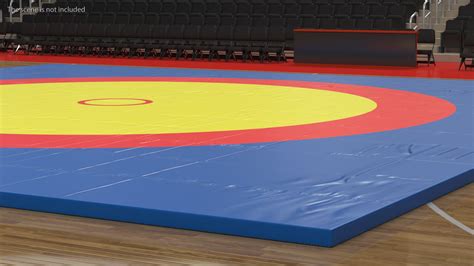
The match takes place on a thick rubber mat that is shock-absorbing to ensure safety. A large outer circle at least 28 feet in diameter that designates the wrestling area is marked on the mat. The circumference line of that circle is called the boundary line. The wrestling area is surrounded by a safety mat area (or protection area) that is at least five feet in width. The mat area is designated by the use of contrasting colors or a 2-inch-wide (51 mm) line, which is in bounds as of the 2023-2024 scholastic season. The mat can be no thicker than four inches nor thinner than a mat which has the shock-absorbing qualities of at least 1-inch (2.5 cm) PVC vinyl-covered foam. Inside the outer circle is usually an inner circle about 10 feet (3m) in diameter, designated by the use of contrasting colors or a 2-inch-wide (51 mm) line. Wrestlers are encouraged to stay within this inner circle or else they risk being penalized for "stalling," which is deliberately attempting to exhaust the match's clock without meaningful wrestling acts or maneuvers. Each wrestler begins action at a starting line inside the inner circle that is three feet long.