There is no question that Kyokushin is a Budo, with a focus on bettering oneself and character, cultivating an indomitable spirit, through hard training and overcoming personal obstacles. As a result, Kyokushin Karate evolved into one of the most formidable martial arts styles in Japan, and the world.
The Evolution of Kyokushin
The early days also incorporated grabs, throws, clinching, grappling, joint locks and much more. One of his close students, Shihan Bobby Lowe was a big proponent of this type of training, developing video learning. Recently I have noticed an increase in popularity for authentic scenario based training again and resurgence in traditional training methods.
Mas Oyama believed that if you wanted to use karate effectively for self-defense, you had to train hard and fight hard. Mas Oyama wrote dozens of books in Japanese (a few translated to English), and most had a focus on self-defense, utilizing the same components that make Kyokushin a formable force in sport full-contact knock-down tournament kumite.
Today however, there tends to be mostly a focus on the sport aspect of full-contact, or knock-down, fighting. Which of course is great! And Kyokushin is famous for it, but not everyone will compete, and for those who do, many won’t compete beyond an amateur level, and the others can only compete for so long before age catches up. Kyokushin isn’t just a sport, and I don’t believe it was meant to be. Knockdown fighting is the sport side of it but not the only focus.
Shihan Cameron Quinn alluded to Sosai Oyama working on the new direction of Kyokushin before his passing. Shin so seiki, the “New Genesis” of Kyokushin. They had focused on and conquered the full-contact sport side, but what about the people who don’t fight tournaments, or those who are aging past tournament kumite, or those looking for something more in their training.
Read also: Self-Defense: Karate or Taekwondo?
Kyokushin Karate Goshin-Jitsu training offers you concepts and skills found in your kata and kihon designed to develop self-protection strategies including blocks, strikes, and take-downs that will help you to defend yourself in a real conflict situation.
The Role of Kihon and Kata
Kihon and kata by themselves won’t make you a good fighter and we know that. However they do have use. They develop focus, muscle and strength, muscle memory, proper breathing, and coordination, plus much more. And that’s if we put aside the bunkai aspect of kata, which can be very good…. IF and ONLY ….
For example doing a kata in horse stance develops very powerful and strong legs and doing the basic blocks and punches as drills develop strength, as the same muscle groups are used as in sparring. Kyokushin as a system has more kata than many, combing many from the Shuri systems (Shotokan) as well as Naha systems (Goju-ryu). Why would Sosai Oyama have included all of these kata? Was it just to hang onto the roots, cultural significance?
There are a lot of opinions of whether Kata and traditional martial arts are worth practicing, mostly because of MMA, Muay Thai, BJJ and other combat sports having such popularity. I realize there are many people, including those in Kyokushin, who think Kata training is a complete waste of time and training should be spent on more functional drills and sparring, and that if you train kata it’s only because it is part of their heritage and a “must”, without a clear understanding of the meaning of the movements.
So, why even have the kata? What many fail to realize is that kata can be considered entire protection art all to its own. In the old days of karate training in Okinawa the masters of old studied one kata for a minimum of 3 years to become proficient.
Read also: Kenpo Karate Maryland
It is important not to look at the kata in it’s full sequence. They were arranged like this only to be used a mental memory tool to log all of the various movements. Each and every move is a technique all to its own that can be used in conjunction with any other movement.
Self-Defense Applications and Bunkai
Bunkai is rarely trained in Kyokushin, and other styles of karate. Realistic bunkai is even rarer. How I was taught (which I know was the way it was taught in Okinawa, and still is by traditionalist) was first the self-defense application, practiced on opponents until it is completely natural to you. Then the next technique, and so forth. Then, and only then, the kata would be taught, just so you could use it as memory tool for solo training.
Another person who has gained great notoriety for Karate Jutsu is Sensei Vinicio Antony, of ABKJ (Brazilian Association of Karate Jutsu). He is an instructor to MMA legend Vitor Belfort, with a strong focus on traditional karate application in self-defense and applied mma fighting, with a long record to prove his philosophy.
Many of the moves you see in mma are not exclusive to one martial art. There are techniques you see in BJJ, Sambo, Muay Thai, etc., that can be found in the traditional syllabus of Okinawan Karate.
Choki Motobu, a prominent Okinawan Karate, and very famous for his abilities, was born in Shuri, the old capital of Okinawa, in 1871. What brought Motobu to the attention of the Japanese was his victory over a western boxer in a kind of all-comers challenge match. Think UFC. In the earlier part of this century such bouts were occasionally held in Japan pitting western boxers against judo or jujutsu men, (karate was unknown in Japan around this time). They were, however, most effective against someone who had no idea of the strategy being used to counter their aggressive behavior. In other words, Karate was not designed for fighting a in a ring or cage. Nothing is more harmful to the world than a martial art that is not effective in actual self-defense.
Read also: Transform Your Life with Martial Arts
Another interesting note to consider is that karate is known as a “striking” martial art. However, the opposite is in fact true. Karate was, and still is, made up mostly of grappling / joint manipulation, rather then strikes.
Kyokushin in the Modern Era
Amateur MMA Fighter & Bodybuilder vs Kyokushin Karate Master
MMA has become the “complete” martial art. However, Karate has always been a ‘mixed martial art’. It just isn’t practiced much that way any more. It is the modern karate movement. Karate is much more than kicks and punches. Throws, trips, locks, sweeps, takedowns, strangles, chokes, grappling… it’s all there. I truly believe Karate is making a comeback. But if karate is going to be relevant in the modern era it has to keep up with the times, even if that means having to step back in time a little. I personally believe to do this the first thing that has to happen is the removal of the ego.
My own personal background included many years training in a purely self-defense system. Kenpo. An offshoot of the system Shihan Bobby Lowe was doing before his switch to Kyokushin. Now having trained for a few years in Kyokushin I see that it can be an ultimate form of martial art, because it does have those components as well.
I am certain there are many opinions about this, and I am certainly not saying my views or ideas are correct, or the only way. There are just my thoughts….
Kyokushin Training
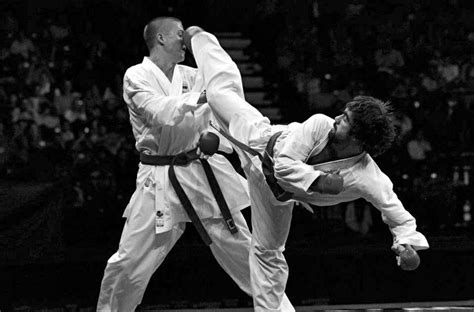
Kyokushin Karate is famous for being one of the “harder” substyles of Karate. This style of Karate allows full contact sparring (kumite) and does not use any protective gear, except for a mouth guard and groin protection. They do not even use gloves or protective headgear during tournament sparring events. Kyokushin does not practice Olympic-style “sports” sparring. Kyokushin kumite allows kicks against an opponent’s head, body and legs.
This focus on more realistic unarmed combat is exemplified by the “spirit” of Kyokushin which states “The heart of our karate is real fighting. There can be no proof without real fighting. Without proof there is no trust. Without trust there is no respect.
This style of Karate is also famous for the “100 man kumite“. This grueling sparring match consists of one man or woman fighting 100 rounds of kumite against 100 similar or higher level opponents (although some opponents may go multiple times if the match does not have significant numbers of participants). The participant will fight each of the 100 opponents separately and one after another.
Kyokushin Terminology
- Kyokushin Dojo Kun - 7 rules for the Kyokushin dojo and everyday life.
- Full Contact Karate - Those Karate styles that practice full contact sparring