The cervical spine is a very complex structure, more subject to injury than any other portion of the vertebral column. Understanding the biomechanics of backward head movement is crucial for preventing injuries, especially in scenarios like falls and rear-end collisions.
This article delves into the forces and accelerations experienced by the head and neck during backward falls and whiplash events, highlighting the potential for injury and the factors that influence its severity.
Whiplash Animation
Whiplash and Hyper-extension/Flexion Injuries
In a rear-end collision, the head, being a mass at rest, remains at rest until acted upon by the force of the collision. As the body is accelerated forward, there is a forceful hyper-extension of the neck. As the cervical spine hyper-extends, the head snaps back, striking the back of the seat or headrest. The reflex contraction of the neck muscles, with the sudden impact to the back of the head, suddenly throws the head forward.
A hyper-extension/flexion injury most often impacts the cervical spine between the C4-C7 vertebrae. According to Dr. Ruth Jackson, the C4-C5 region receives the greatest stress and strain upon hyper-extension, and the C5-C6 area sustains the greatest stress during the hyperflexion stage.
Yet other researchers, such as Clemens and Burow, studied cadavers subjected to whiplash and found that most injuries occurred at C5-C6 and C6-C7.
Read also: Rejecting Societal Norms: The 4B Movement
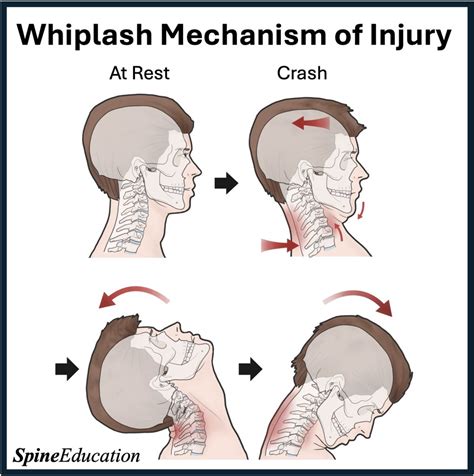
Whiplash mechanism during a rear-end collision.
Factors Influencing Acceleration and Injury Severity
The insurance industry commonly predicts the nature and extent of soft tissue injuries solely on the extent of damage to the rear-ended vehicle. This practice is misleading and inaccurate. It fails to take into account significant variables such as road surface conditions, degree of velocity and acceleration of the vehicles, size and weight of the vehicles, position of head restrains, age of the occupants, element of surprise, and position of the body and head at the time of impact.
Road Surface Conditions
The acceleration of a car struck from behind can be measured in a simplistic manner by utilizing a physics mathematical formula to determine the amount of G-forces produced during a collision. However, G-forces by themselves do not measure the true acceleration. For example, the ability of a car to roll or slide after impact will directly affect acceleration. If the brakes are on at the time of impact, it will accelerate less; however, if the car is on ice, it will accelerate rapidly and the corresponding soft tissue injury will be greater.
Velocity
As previously discussed, when a vehicle is rear-ended it is accelerated forward. About one-tenth (1/10) of a second later, as the car slows, the torso begins to accelerate, hyper-extending the cervical spine. At two-tenths (2/10) of a second, the head is launched forward from it pre-stretched position and is stopped by the ligaments, steering wheel, windshield, or the chin lifting the chest. It is a well-established principle that sudden acceleration caused by a rear-end impact exerts even greater G-forces on the head and the cervical spine than on the struck vehicle.
Croft calculates that the forces on the head and neck are 2 to 2.5 times greater, and Ewing estimates that they are up to five times greater.
Read also: Profound Benefits Explained
This graph is based upon data obtained in rear-end impact collisions of like-sized vehicles, during which the struck vehicle’s brakes were not applied. This graph indicates that a 10 m.p.h. rear-end collision results in approximately 5-Gs of acceleration force. This 5-G force is the equivalent of catching a two-hundred (200) pound sack of cement tossed from a first-story window. A 25 m.p.h. rear-end collision results in approximately 10-Gs of acceleration force.
Size of Vehicle
The relative size of colliding vehicles is also an important variable in determining the extent of injury. For example, a streetcar traveling at a speed of 3 m.p.h. will produce the same amount of damage and acceleration force as a compact car traveling at 40 m.p.h.
Head Restraints
Head restraints are designed to limit the backward displacement of the head during the acceleration phase of whiplash. Head restraints should be adjusted so that the center is level with the ears. This is about the center point of gravity for the head.
However, during the acceleration phase of the whiplash, the torso is forced backward against the seat back and at the same time, may undergo some upward vertical displacement as well, depending upon the degree of inclination of the seat back and the amount of friction between seat back and driver. Another important parameter regarding head restraints is the distance at the time of impact between the occupant’s head and the restraint. This distance can be affected by the posture of the occupant and by the degree of seat back inclination.
Age
Range of motion in the cervical spine decreases with age, along with a concurrent decrease in the elasticity of the supporting tissues. Strength of the neck musculature also diminishes with age. Over the adult life span, cervical range of motion is reduced by an average of nearly forty percent (40%), cervical muscle reflexes slow by twenty-three percent (23%), and voluntary strength capability diminishes by twenty-five percent (25%). This loss of flexibility and strength significantly increases the potential for serious injury.
Read also: Wrestling Community on Twitter
Rotated Head
The likelihood of a severe injury is greater when non-symmetrical loads are applied to the spine. This can occur when a vehicle is struck in the left-rear corner as it is turning left. This type of collision may also occur when the occupant’s head is turned to the side while gazing out a window or talking to another occupant. When the head is rotated 45°, the spine’s extension capability is decreased by fifty percent (50%). This results in an increased compressive load at the facet joint and articular pillar on the ipsilateral side, and an increased tensile load at the facet joint on the contralateral side.
Relationship between the forces acting when the buttocks hit the ground and the accelerations indicated by the sensor placed on the participant’s head.
Biomechanical Analysis of Backward Falls
The formation of large accelerations on the head and cervical spine during a backward fall is particularly dangerous due to the possibility of affecting the central nervous system (CNS). It may eventually lead to serious injuries and even death.
Researchers emphasize that school education should be involved in shaping appropriate motor habits that are useful during falls. However, as is evident from scientific reports, most school education does not adequately address this issue. Such skills, however, are shaped by some extracurricular activities in sports clubs. Classes in martial arts such as aikido, jujitsu, aikijitsu, and judo deserve a special mention here. The condition for being admitted to sports competitions or performing self-defence techniques in these disciplines is mastering appropriate fall techniques by the participants.
In terms of the direction of a fall, falling backwards is generally classified as more dangerous. Oftentimes, hitting one’s head against the ground as a result of such a fall may lead to serious damage or even death. Falls may also lead to severe injuries of the cervical spine, which is closely linked to the head in the biokinematic chain.
Scientists attempt to create the conditions suitable for diagnosing movement habits during a fall. As a fall in real conditions may be detrimental to health, it is necessary to create conditions under which motor habits could be tested without exposing subjects to injuries. This is why non-apparatus tests were developed to study movement habits when falling backwards. Previously designed tests were developed for a fall technique similar to a gymnastic backward roll. They are relatively uncomplicated to carry out, but the disadvantage is that the tested falls are not induced by an external force. The use of a rotating training simulator (RTS), forcing a fall using inertia, seems to be a better solution. The device is capable of inducing various types of falls.
As shown by scientific reports in which there is no significant division of the type of fall, trauma to the cervical spine is much more likely to occur with a pelvic injury than with a head injury. These somewhat surprising reports are explained, for example, by the fact that the head may act as a cushion and buffer, effectively dissipating the energy that would otherwise have been transferred to the cervical spine, thus reducing the risk of injury. However, a more plausible explanation is that the cause of the injury is due to the inertial forces generated during pelvic injury due to the head-torso connection. Such an explanation would be biomechanically justified when analysing the impact of the buttocks against the ground in the case of a backward fall.
Generating large inertial forces on the cervical spine is particularly dangerous due to the possibility of affecting the central nervous system (CNS). This risk is particularly high in people with Arnold-Chiari disease or the elderly. Falls are the most common cause of cervical spine fractures in the elderly.
The biomechanical analysis of the backward fall shows that the moment of contact with the ground during a backward fall with an inappropriate fall technique may cause the head to hit the ground as well as generate large forces acting on the head. The acceleration achieved by the head in the sagittal plane is mainly responsible for the backward or forward motion of the head when falling backward, revealing more about the forces acting horizontally towards the head.
The above analysis suggests that vector X’ will be closest to the direction of linear acceleration in the sagittal plane aS, and vector N will be closest for the transverse plane aT. This analysis shows that the indications of aT acceleration are the most informative in terms of the risk of the head, neck, spine, and pelvic injury as a result of the connection with the N force. On the other hand, the as indicates the risk of hitting the head during a fall due to the connection with the X’ force.
The biomechanical analysis presented in Figure 1 shows that, when the buttocks hit the ground, the main component of the force acting on the pelvis during the injury is pointed upwards (Y), with the smaller component (X) directed forwards or backwards. In the Young-Burgess classification of pelvic fractures, it is the vs. (Vertical Shear) type. The age group particularly at risk of fractures, including pelvic fractures, are the elderly, who suffer from a decrease in bone mineral density and weakening of the mechanical strength of the bones associated with osteoporosis. Pelvic fractures due to a backward fall can be classified as low-energy fractures, particularly characteristic of the elderly population.