Wing Chun is a traditional Southern Chinese martial art known for its close-range combat techniques and emphasis on practicality. The Sil Lim Tao is the first form in the Wing Chun system and serves as the foundation for all subsequent techniques and forms. It consists of a series of movements that teach the practitioner the principles of structure, relaxation, proper posture, and the importance of balance and sensitivity.
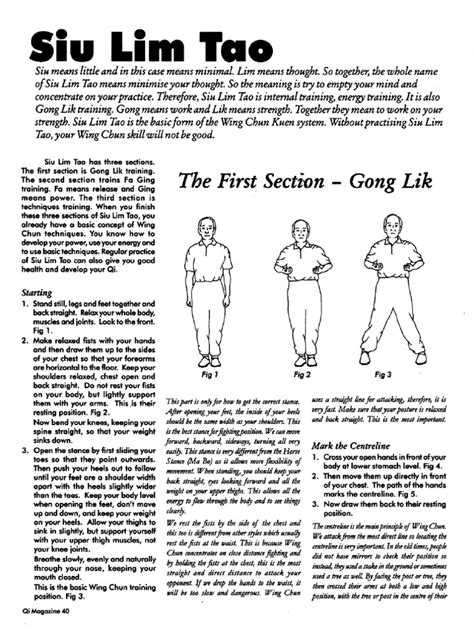
The name Siu Lim Tao means ‘minimize thought’. Another explanation for the naming of Siu Lim Tao is that it encapsulates the “ideas” of the art within its movements. Which is the first empty-hand form and the essence of Wing Chun. From the name [Siu Nim Tao] (In Chinese means “sense from the brain”), it can be seen that the form is based on idea or mind.
As the first form in Wing Chun, Siu Nim Tao is the foundation for learning the correct stance, hand positions and fundamental techniques. Since Siu Nim Tao is the first form, many people mistakenly believe that it is only for the beginning student. Instead, Siu Nim Tao is intended to be practiced throughout your entire lifetime. Each stage of your development brings a new level of insight, meaning, emphasis and refinement.
The History of Sil Lim Tao
The history of Sil Lim Tao can be traced back to the origins of Wing Chun itself, which is believed to have been developed in the 18th century by a Buddhist nun named Ng Mui. According to legend, Ng Mui created Wing Chun as a means for women to defend themselves against stronger opponents, emphasizing efficiency and speed over brute strength.
Yim Wing Chun
Read also: Contributions to Wing Chun
The name “Sil Lim Tao” translates to “little idea” or “small thought,” reflecting the focus on developing mental clarity and foundational skills.
Why Training the Wing Chun Sil Lim Tao Form is Essential
Training the Wing Chun Sil Lim Tao Form is essential for several reasons:
- Foundation of Techniques: Sil Lim Tao serves as the foundational form in Wing Chun, teaching the basic techniques and principles that are crucial for the rest of the system.
- Body Mechanics: It emphasizes proper body mechanics, including stance, balance, and movement. Practicing this form helps practitioners develop efficiency in their movements.
- Mindfulness and Focus: Training the form encourages mental focus and mindfulness, allowing practitioners to connect their mind and body, which is vital for effective martial arts practice.
- Energy Flow: The form helps in understanding the flow of energy (Chi) within the body, promoting relaxation and fluidity in movements.
- Self-Defense Principles: It instills important self-defense concepts, such as distance management, timing, and sensitivity to an opponent's movements.
- Progression: Mastery of the Sil Lim Tao form is often a prerequisite for advancing to more complex techniques and forms within Wing Chun, making it a critical step in a practitioner's journey.
- Personal Development: Beyond martial arts, training this form can cultivate discipline, patience, and perseverance, contributing to personal growth.
- Structure and Alignment: Sil Lim Tao emphasizes the importance of maintaining proper structure and alignment. This focus helps practitioners execute techniques with maximum effectiveness while minimizing the risk of injury.
- Relaxation and Tension: One of the core principles taught in Sil Lim Tao is to maintain relaxation while executing movements. This balance between relaxation and tension is crucial for generating power without unnecessary effort, allowing for quick and efficient responses in combat.
- Hand Techniques: The form introduces various hand techniques, including punches, palm strikes, and blocking movements. Practitioners learn how to effectively use their hands for both offensive and defensive purposes, establishing a solid foundation for later stages of training.
- Breathing and Rhythm: Proper breathing is integrated into the practice of Sil Lim Tao. Learning to coordinate breath with movement enhances endurance and helps maintain a calm state of mind, which is essential in high-pressure situations.
- Application of Principles: While Sil Lim Tao is a solo form, the principles learned can be applied in sparring and real-life scenarios. Practitioners gain insights into concepts like intercepting an opponent’s attack, controlling distance, and utilizing angles to their advantage.
- Cultivation of Chi: The practice of Sil Lim Tao is also a method for cultivating and refining internal energy (Chi). As practitioners become more attuned to their bodies, they can learn to channel this energy effectively in both training and combat.
- Building Confidence: Mastery of the Sil Lim Tao form can boost a practitioner’s confidence in their abilities. As they become proficient in the basics, they gain the assurance needed to face more advanced techniques and situations.
- Tradition and Lineage: Sil Lim Tao is steeped in the history and philosophy of Wing Chun. Practicing this form connects students to the lineage of their martial art, instilling a sense of tradition and respect for the masters who have come before them.
In summary, the Sil Lim Tao form is a comprehensive training tool that covers a wide range of physical and mental aspects of martial arts. Its importance cannot be overstated, as it lays the groundwork for all future development in Wing Chun.
Siu Nim Tao Sections
Siu Nim Tao is taught in three sections. The first third concentrates on developing good structure, relaxation and Gung Lik or “Elbow Energy.” This section is performed slowly and without muscle tension. Many consider this part to be almost like a preparatory meditation. The second section of Siu Nim Tao begins to develop Fajing, or the “release of power.” You begin to use both hands simultaneously while maintaining a solid stance. The third and final section of Siu Nim Tao teaches the basic techniques of Wing Chun.
Note in particular Moy Yat’s use of the term play when referring to forms practice. This was a very specific word selection, not to demean or make training seem less serious, but to emphasize the emotional content of training. You cannot force the benefits out of Siu Nim Tao any more than you can force grass to grow. You must also have an energetic, alert and playful mind when training Siu Nim Tao. If your heart is not in it, if your mind is elsewhere, or if you are “just going through the motions,” your time is being wasted. We lose ourselves in the things we love.
Read also: Maximize Your Wing Chun with the Dummy
Siu Nim Tao is the seed that begins the growth of certain attributes necessary in Wing Chun Kung Fu. An important development is the training of “inside power.” Since economy of movement and energy are mainstays of Wing Chun Kung Fu, it is important that each action be smooth and effective. The body must respond without hesitation and be able to protect itself with a minimal amount of expression.
We explored Centerline Theory in an earlier section, but theory comes into practice while training the form. Specifically, the hands move with exacting precision forward and back along the centerline in order to train them to occupy and control it instinctively. You learn to move in economical lines, minimizing movement and effort. Siu Nim Tao also prepares the student to use energy at different angles and distances.
Wing Chun Kuen Kuit are “Words of Wisdom” which capture - often in poetic terms - the finer attributes of Wing Chun Kung Fu. There are one hundred and eight movements, all practical and real. Each movement must be clear and crisp.
Here is a breakdown of the key components and movements within the Siu Nim Tao form:
1. Sam Pai Fut (Praying Thrice to the Buddha)
The first third of the Siu Lim Tao Form cleverly contains Qi Gong within its Sam Pai Fut (Praying Thrice to the Buddha) section. This, combined with the proper focus and positioning of the body, allows for the development of the Qi and its circulation through the energy channels of the body and then, into specific points that the practitioner focuses on. This develops Jarn Dai Lik (elbow energy) and cultivation of grounding in the root stance, as well as the ability to focus and direct power to specific points of the body.
Read also: Wing Chun Pak Sao Basics
This section should be practiced slowly and with focus and intent.
2. Frontal Stance and Kwan-Sao
We start the Siu Nim Tau Form off, like every other form, every other basic drill in Wing Chun. We start at the frontal stance. So, you’re going to go ahead and set the stance like this. So, your partner is going to cross, the left hand is on top, from there you’re going to chop straight down, in a very relaxed manner and then you’re going to do the internal rotation, or the Kwan-Sao and you come right back to the position you started.
3. Left Punch and Huen-Sao
The second set of the form, we’re going to start with the left punch. So, you bring your fist to the center. Now, you want to keep your elbow low and your shoulder low here, because this is where the power comes from. We say in Wing Chun, fist comes from the heart, the force comes from the elbow. After that, you’re going to open the hand and you’re going to do the Huen-Sao. When you do the Huen-Sao, you want to bring this all the way back and all the way down. When you get to the bottom position, you close the fists and you’re going to bring it up and in and then you retract in a straight line as if you’re doing an elbow strike, behind you. And then, you repeat the process on the right side. Put the fist in the center, launch from the elbow, open the hands, do a full circle, all the way down, trying to keep your elbow in place and circle it in, and then you withdraw in a straight line.
4. Tan-Sao and Fuk-Sao
Now the third set, we start with the Tan-Sao. The third set, we normally do a little bit slower because we’re focusing on what we call, elbow force here, alright? But, we’re going to speed it up a little bit, for the video today. You’re going to bring your Tan So, right to the center here, this is the mid Tan So. When it gets close enough to the body, you’re going to drop the hand and you’re going to start the Fuk-Sao. Now, in the form, we do the Fuk-Sao, a total of three times. Then he’s going to circle and then back. And this is again, to work on the elbow force, that’s very important for our Chi-So practice and our overall body mechanics and structure, in Wing Chun.
5. Side Palm and Straight Palm
Then we go to the side palm, then you go back and then you’re going to launch the direct straight palm and then open and circle. And that’s one side and then we’re going to go ahead and repeat on the right side. So, we start with the Tan-Sao, drawing out slowly. Normally, you would do it a little bit slower than this, then you’re going to circle, Wu-Sao and back. And again, very important while you’re practicing this, is to keep the body mechanics in mind, upright structure, head back and shoulders in a stable position, and drop.
While you practice the Siu Nim Tau Form, you want to keep your breathing nice and even, you don’t want to expel your breath, when you’re punching or holding your breath at any moment. You actually want to keep your breathing, in a nice even rhythm because when you’re fighting explosively, you need to keep your breath in check, you don’t want to hold your breath or expel, just when you’re punching.
The “Two Adduction Stance” (Yee Chi Kim Yeung Ma) fully reflects the skill in concentrating the force of impact. Because of its posture, it can concentrate the force of impact at the centerline. Or, even to the center point so that every move contains the weight of the whole body. Since the knees are slightly bent and springy, one can transfer the striking force from the wrist of the opponent to one’s knees.
The basic concept is to utilize the rotation of a circle to generate the force. Furthermore, to tolerate any force applied externally. This is due to the fact that anything of the same mass when in a circular shape can tolerate heavier force applied externally and generate greater driving force with minimum energy than in any other shape. The ‘Tan Sau’, ‘Bong Sau’ and ‘Fook Sau’ of Siu Nim Tao are the obvious examples of applying the principle of circular motion. The practical use is to let the opponent’s wrist contact on the internal side or external side of the circle. From Tan Sau to Bong Sau is to let the opponent’s wrist from the internal side of the circle go to the external side of the circle go to the internal side of the circle.
To use the straight line as the base of exerting force during attack. The motto of Wing Chun “A straight line is the shortest distance between two points” is actually applying the principle of the straight line. This is the application of speed and force of impact. In real fighting, speed and great force of impact is of prime importance. The short distance is to reduce the attacking time whilst attacking on a straight line is to increase the striking force.
The centerline of any object is the center point of that object. It is also the perpendicular line from the center of gravity of that object. Also, by supporting at the center of gravity is actually supporting the weight of that object. Hence, if that object moves to any direction, and if one touches the center of gravity of that object in the direction it is moving, he will have to suffer the whole weight and impact of the object.
The basic moves of Siu Nim Tao is founded basing on the center of gravity of a person together with the principle of the centerline. The Tan Sau and Fook Sau moves forward from one’s center point. This is to use the center of gravity of a person to move forward. Thus concentrating the whole body weight of the person to attack. Bong Sau, which is moving up from below, is using the centre of gravity of the person moving sloping forward and upwards. Garn Sau and lower cut down is using the center of gravity of the person moving sloping forward and downwards. For this reason, if one can master the principle of the center of gravity, the opponent has to tolerate your attack with your whole body weight.
The above is just the basic theory of Wing Chun’s Siu Nim Tao. It does not consist of any particular skill. Hence, if you practice Siu Nim Tao in accordance with the above theory and achieve the described level, you will be able to tolerate heavy force. Also, you will generate enormous power without exerting muscular force. You cannot imagine this unless you have personally experienced it.
A physical fight or encounter demands our awareness in the present. Any strategic thinking must happen outside of the actual encounter and focus becomes paramount in one’s ability to survive.
The entire time he’s going through this process, he’s going to keep his head back, posture straight, knees in together. So, it’s not solely focusing on the hands, the knee pressure has to be engaged the whole time.
Grandmaster Chu Shong Tin trained in Ip Man’s school for 14 years and was the main teacher there, teaching for up to 12 hours on some days. The major focus in the early years of his training was the practice of “Siu Nim Tao” (meaning “Tiny Idea”).
Forms don’t teach you anything about timing and power and dealing with an opponent, who’s resisting, but they are very, very important for laying the ground work for body mechanics. Again, forms are about fundamentals and forms are about body mechanics.
Here is a list of all the motions in order. Execute the following on the Left Side first. Each movement must be clear and crisp.
Siu Lim Tao Step by Step
Hawkins Cheung used to visit Gary Lam’s school in LA all the time and would share his experiences. Hawkins said that Yip Man believed that you had to train for skill to get the answers. Yip Man never gave any of his students the solutions to their problems right away, he wanted them to search by developing the system. When students had questions, he would often tell them where in the system to look. Hawkins went on to say that Yip Man taught by showing, not telling. He did this by choice, and as a result, to some degree most first generation students made the most profound discoveries by means of their own hard work.