Taking karate or martial arts lessons is hard work. Earning each belt takes dedication and determination. So, this project was inspired through the rabbit hole that is Pinterest.
Many martial arts practitioners face the question of what to do with their old belts as they progress to higher ranks. Some may be discarded, while others are kept as mementos of past achievements. Displaying these belts can be a way to honor the hard work and dedication that went into earning them.
One of the most common ways to display martial arts belts is on a dedicated display rack. These racks can be purchased or made at home and come in various designs to suit different preferences and spaces.
My niece just achieved her Black Belt at the ripe age of 10 and my sister-in-law kept asking if I could build something to help organize her room that displays her medals and belts. Thus, a Christmas gift idea and the subsequent Pinterest search for inspiration was put in motion.
This specific build can be modified in so many ways; stain colour, hooks, hardware, joinery, etc. So feel free to explore, modify, and try it for your little taekwondo/karate enthusiast.
Read also: Is the Century Taekwondo Uniform Worth It?
Want to make your own?
Creative Martial Arts Belt Display!
DIY Belt Holder
Here's a detailed guide on how to create your own taekwondo belt display using simple materials and tools.
Materials/Plan/Tools
My favourite part of this project is that it is built with ONE BOARD of 1x12x8' pine (see picture) that is a stock item at most big box stores. When picking it out, be sure to look for the straightest and least knotted board.
The rest of the materials truly depends on the hooks, the joinery method you choose and the colour/finish you desire at the end. For me, I used black decorative hooks that I had lying around, pocket holes and brad nails for joinery, a mix of Minwax Provincial and Grey stains, and a basic satin varathane spray finish to protect the final piece.
The tools I used for this include:
Read also: The Meaning Behind Taekwondo Belts
- Table saw
- Miter saw
- Kreg jig + screws (1 1/4")
- Clamps
- Wood glue
- Nail gun and compressor
- 16 ga 1 1/2" nails
- Standard measuring and marking tools
My plan of execution was quite simple:
- Cut all the pieces of wood (outlined in next step)
- Sand all pieces
- Partially build the belt holding part and sides
- Stain all pieces
- Finish putting everything together
- Hang up on wall
Cut List and Procedure
Start by cutting 2 full size pieces of your 1x12 to 28 1/4". One of these will be used as the back of the display. The other will be ripped into two and used as the top and bottom of the belt holder.
Next, take one of the full 28 1/4" pieces you just cut and take it to the table saw. All the other pieces of this build (aside from the back) needs to be ripped to 4". Rip the 28 1/4" piece to 4". With the left over material (28 1/4" long by about 7" wide), rip it down to 4" as well.
Discard the waste and take the 28 1/4" piece to the miter saw and cut it down to 26 3/4". At this point you have:
Read also: Excellence in Taekwondo
- The back of the display (1" x 12" [actually 11 1/4"] x 28 14")
- The top of the display (1" x 4" [actually 4"] x 28 1/4")
- The bottom of the belt (1" x 4" [actually 4"] x 26 3/4")
- Leftover 1"x12"x39 1/2" [approx]
Next, take the leftover 1x12x15 1/2 and rip it down to 4" on the table saw. This should give you approximately two 39 1/2" pieces each 4" wide. With the first piece, head back to the miter saw to cut the two side pieces of the display. They are both irregular quadrilaterals with a 90 degree on one side and a 45 degree on the opposite. Set the saw to a 45 degree angle.
Measure 9 3/4" and cut. Be sure that the 9 3/4" is the measurement on the long side of the irregular quadrilateral (see pictures). Set the saw back to 90 because the off cut should already have a nice 45 degree. Measure the 9 3/4" on the long side to match and cut.
With the leftover pieces, you need to cut 10 pieces to 1" x 4" x 5". These will be your spacers between each belt. ***You will have scrap left over. I suggest cutting as many as you can down to 1 3/4" thick to use as spacers for where the belts will go. If you can get 11-22 pieces you will make that future step easier.***
The last cut you need to make is a 45 degree bevel on the back piece. This will take some set up with your table saw and needs to match up perfectly with the side pieces (see pictures). I set my table saw so that bevel began at 10 1/2" (again see picture). The math makes sense with the side miter ending at 9 3/4" + 3/4" thickness of the top piece = 10 1/2". Make this cut and then you have all your pieces ready for assembly, staining, and finishing.
Sand, Partially Assemble, Stain
Start by making your Pocket Holes in the various pieces. As you can tell by the pictures, I drilled pocket holes in the top, bottom, and two side pieces. Follow the measurements as they matter when you try to assemble. Furthermore, each pocket hole is spaced specifically so that they will not be seen once everything is put together and belts placed inside.
The top piece will attach to the back with pocket holes. The side pieces will be attached to the back piece and the top piece. The bottom piece will be attached to the back and the side pieces.
Once all your pocket holes are drilled, it is time to sand everything down to 220 grit. Because it is sold already sanded, I only used 220 grit. It has about a 150 grit finish when purchased.
Using clamps, take your time to dry fit everything together. Once you are happy with the fit, get out your glue and screws to put it together.
NOTE: each edge was glued before being pocket holed together, so to save me having to say "glue the edge" each time, just know that you should glue each edge before screwing.
Start by attaching the sides to the top piece.
Next, attach the bottom piece to the sides
Then, attach all four pieces to the back
If you follow this order, you should be able to access each pocket hole easily with your drill and bit.
Now that the back, top, sides, and bottom are put together it is time to choose your stain/paint. So, choose the colour, follow the instructions on the can/bottle, and do it!
Once you're all finished and dried, continue to the next step.
Finish Assembly and Hang
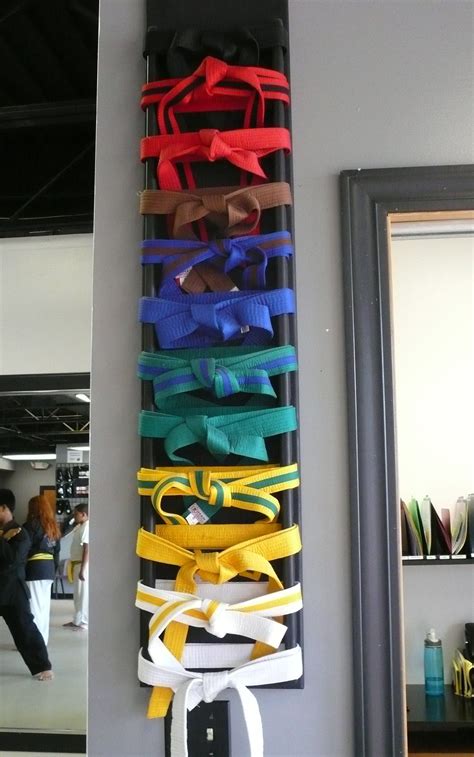
Now that the top, bottom, back, and sides are put together and everything is stained/painted it is time to attach the spacers that make the "cubbies" for the belts. You have all the pieces cut, so it is just a matter of placing each in the correct spot and then shooting brad nails in from the top and bottom.
In earlier steps I told you to cut your leftover lumber into 1 3/4" spacers. The process is simple:
With the carcass lying on a table, put a spacer against the top and side and a spacer against the bottom and side pieces, slide the cubby separating piece in and shoot two brad nails through the top and through the bottom to hold it in place. Repeat this process alternating from the left side to the right side until you have all 11 belt cubbies built.
Now that your cubbies are all built, it is time to figure out your hooks. Mess around a bit by dry fitting different hooks in different order until you get your desired look. Once you got that, screw them in.
Now you can hang the finished product up! The design is larger than 16" on purpose. This means you can simply find the studs on the wall. Attach the whole structure to the studs by screwing through the cubby holes and back piece.
I made one for my son. I used black hair bands ("scrunchies"?) that are meant to hold pony tails for the belts. The ones I used were about 1/8" thick, so they don't look like fashion accessories. Just thick black rubber bands. One on each side. Then the belts are chained together vertically just using S-hooks. I like how it turned out.
And I wanted to display all that hard work my son was doing. So I made a DIY belt holder for all his karate belts.
I kept them in a bag, but the kids would always get them out to play with. This is a project that is not hard at all, but it took me a while to complete. I cut out the main pieces before Christmas. They've been sitting in my pantry all that time.
Once your pieces are cut, drill 3/4 inch holes in two of the boards. Measure 1" from the end. On the other two boards, you'll want to make some kind of design. Using my silhouette, I cut out a bracket onto paper, then traced it onto the boards.
Next, using my Kreg drill set, I made some pocket holes and screwed the two pieces together. You could also use a brad nails to attach the pieces.
To assemble, place some wood glue on each end of the dowels and insert into the holes. Before the glue dries, measure to make sure it's the same distance between the shelves on both ends.
Stain or paint the belt rack as desired. If you prefer to leave the wood it's natural color, I recommend applying a lacquer to help protect it. I prefer using lacquer in a spray can.
Lastly, wrap the belts around the dowels.
The best part about this project is that I used scraps and tools I had on hand.
If you have kids in martial arts, one of the things they learn is how to break boards. It's pretty cool, and they come home with these broken boards. My son broke board below one right at the edge, so they used the same board and had him break it again. It made for a pretty cool display.
I think, from what she's told me, she's looking for something that displays 12" to 18" of the belt, horizontally or vertically.
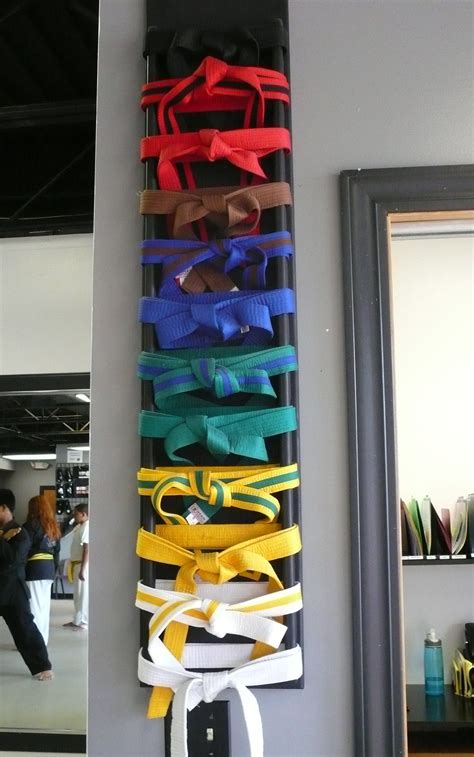
The ones I remember liking did not fasten the belt across the front, but rather from behind such as in this picture (appears to be a black zip-tie):
Additionally, and from a personal perspective, I feel that a knotted belt looks nicer and honors the achievement more so than the flat, folded belts you see most often.
I'm also partial to the country of origin for this style of defense ... thus incorporating that style into the overall design fits well such as below.
These belts could be slid over a couple of vertical posts.