Tyson Gay, born on August 9, 1982, in Lexington, Kentucky, is a retired American track and field sprinter who specialized in the 100 meters and 200 meters events. Throughout his career, Gay achieved remarkable success, setting records and winning medals in major international competitions. Despite facing challenges, including injuries and a doping suspension, Gay left an indelible mark on the world of athletics.
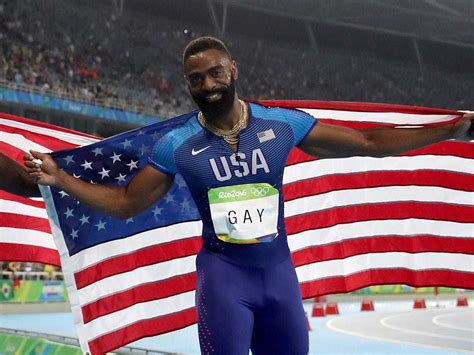
Tyson Gay at the 2015 World Athletics Championships in Beijing.
Early Life and Education
Born to parents Daisy Gay and Greg Mitchell, Tyson Gay grew up in a family with a strong athletic background. His grandmother competed in track for Eastern Kentucky University, and his mother also participated in running during her school years. This environment instilled in Gay a love for running from a young age.
Gay attended Lafayette High School in Lexington, Kentucky, where he excelled in sprint events. He captured three consecutive 100-meter titles at the Kentucky Class 3A state championships, setting a state record of 10.46 seconds in 2001, which remains unbroken. Additionally, he set the Lafayette High School stadium record in the 200-meter event with a time of 20.89 seconds.
Collegiate Career
After graduating from high school, Tyson Gay enrolled at Barton Community College in Great Bend, Kansas, in 2001. Under the guidance of coach Lance Brauman, Gay quickly developed his skills in the 100m and 200m events. In 2002, he achieved breakthrough success at the NJCAA Outdoor Championships, winning the 100m title in 10.08 seconds and running 20.21 seconds in the 200m, helping Barton secure the team championship.
Read also: Mike Tyson vs. Brock Lesnar?
Following his junior college success, Gay transferred to the University of Arkansas in late 2003, continuing under Brauman. During his two seasons with Arkansas (2004-2005), Gay earned seven All-American honors and five Southeastern Conference titles. His times progressed markedly, culminating in a 100m win at the 2004 NCAA Outdoor Championships in 10.06 seconds-the first for an Arkansas athlete in the event-and contributing to the team's 4x100m relay victory in 2005.
Professional Career
After winning the NCAA 100m title in 2004, Gay turned professional, marking the beginning of his transition from college athletics to the international circuit. The 2005 season represented a breakthrough for Gay, as he achieved his first sub-10-second performance in the 100m and focused primarily on the 200m event. In 2006, Gay made significant improvements in both sprints, solidifying his status as one of the top American sprinters. He set a personal best of 9.88 seconds in the 100m to win gold at the IAAF World Cup in Athens, establishing himself as a legitimate contender in the shorter event.
In 2007, Tyson Gay reached the pinnacle of his sprinting career at the World Championships in Osaka, Japan, where he achieved a historic triple gold medal sweep. 4x100m relay team to victory in 37.78 seconds, becoming only the second athlete after Maurice Greene in 1999 to claim gold in all three sprint events at a single World Championships.
The following year at the 2008 Beijing Olympics, Gay entered as the reigning world champion and heavy favorite, but faced setbacks.
Gay rebounded strongly in 2009, marking a resurgence during his peak period. At the World Championships in Berlin, he earned silver in the 100m with a personal best of 9.71 seconds, finishing behind Bolt's world record of 9.58 but ahead of the field. Later that season, at the Shanghai Golden Grand Prix, Gay set the American record in the 100m with 9.69 seconds (wind: +2.0 m/s), tying Bolt's then-second-fastest time ever and establishing himself as a direct challenger.
Read also: Mike Tyson vs. Jake Paul
Entering the 2010 season, Tyson Gay faced early setbacks from an ankle injury that sidelined him until July, limiting his training and early competitions. Despite the disruption, he mounted a strong comeback, remaining undefeated in the 100 m and capturing the inaugural Diamond League overall title in the event with a season-best of 9.78 seconds at the London meeting. Key highlights included his upset victory over Usain Bolt in Stockholm, where Gay clocked 9.84 seconds to edge Bolt's 9.86, marking Bolt's only loss in a major 100 m since 2008.
Olympic Trials, Gay achieved a personal best of 9.75 seconds to win the 100 m, securing his spot in London despite ongoing concerns about his injury history.
4 × 100 m relay team, which initially won silver but was later stripped due to Gay's doping violation.
In June 2013, Tyson Gay won the men's 100 m at the USA Outdoor Track & Field Championships in Des Moines, Iowa, clocking a world-leading time of 9.75 seconds. However, a sample collected from him on June 23, 2013, at the event tested positive for oxilofrine, a prohibited stimulant. Gay publicly announced the positive test on July 14, 2013, stating he had never intentionally used performance-enhancing substances, and he was provisionally suspended by the United States Anti-Doping Agency (USADA).
On May 2, 2014, USADA imposed a one-year suspension on Gay, backdated to June 23, 2013, making it effective until June 23, 2014; as part of the sanction, all his results from July 15, 2013, onward were disqualified, including his silver medal from the 2012 Olympic 4 × 100 m relay.
Read also: A Look at Tyson Sausage Patties' Nutritional Value
Gay returned to competition on July 3, 2014, at the Athletissima Diamond League meeting in Lausanne, Switzerland, where he finished second in the 100 m with a time of 9.93 seconds behind Justin Gatlin's 9.80 seconds. Five days later, he secured his first victory post-suspension at a meet in Montreuil, France, winning the 100 m in 10.04 seconds amid rainy conditions.
At the 2015 USA Outdoor Championships in Eugene, Oregon, Gay reclaimed the national 100 m title with a time of 9.87 seconds, qualifying for the World Championships in Beijing. There, he advanced to the 100 m final but finished sixth with 10.00 seconds, behind winner Usain Bolt and silver medalist Justin Gatlin, both at 9.80 seconds.
Olympic Trials with 10.03 seconds, missing individual qualification but earning a spot on the 4 × 100 m relay pool. At the Rio Olympics, prior injuries from his career compounded by the doping suspension's aftermath limited his training, and personal struggles further impacted his form.
In 2017, Gay shifted his focus to relay events amid ongoing injury challenges, contributing to the United States team's qualification for the men's 4 × 100 m relay final at the World Championships in London. Running the second leg in the heats alongside Ronnie Harris, Mike Rodgers, and Christian Coleman, the team posted a time of 38.13 seconds to advance, ultimately earning silver in the final with a national season-best of 37.62 seconds behind Great Britain. Gay did not advance to the individual 100 m final, finishing third in his semi-final heat with 10.05 seconds, marking a season limited by physical setbacks.
The 2018 season saw Gay, then 35, make limited appearances due to age-related wear and persistent injuries, competing sparingly on the Diamond League circuit. At the USATF Outdoor Championships in Des Moines, he ran 10.11 seconds in the semi-finals, failing to reach the final and highlighting his declining competitiveness.
Gay's 2019 campaign represented his farewell to elite competition, with appearances in domestic meets leading to selection for the World Championships in Doha. Although not running in the final, he supported the US team's bronze medal in the men's 4 × 100 m relay (37.84 seconds), closing out his international career on the relay stage where he had previously excelled.
Tyson Gay was raised in a family with deep roots in athletics, which shaped his commitment to discipline and perseverance from an early age.
Gay shares a close bond with his family, particularly his children, who have been central to his personal life outside of athletics. He is the father of daughter Trinity Gay, born December 12, 2000, to Shoshana Boyd, and son Tyson Jr. Throughout his career peaks, including the 2007 World Championships and 2008 Olympics, Gay's family offered unwavering support, often traveling with him to competitions and joining public celebrations of his achievements.
The loss deeply affected Gay's mental health, leading to periods of depression and emotional withdrawal in the weeks following the shooting, as he described pushing through training while grappling with overwhelming sorrow. To cope, Gay sought counseling, building on prior therapy experiences for career setbacks, which helped him process the grief and continue honoring Trinity's memory through his actions. Family support played a key role in his resilience during this time, providing a foundation for navigating the long-term psychological impact.
Achievements and Awards
Tyson Gay achieved significant success in major international competitions, particularly at the World Athletics Championships, where he secured multiple gold medals during his peak years. His standout performance came in 2007 at the Osaka championships, where he became only the third man in history to win gold in both the 100 m and 200 m individual events as well as the 4 × 100 m relay at a single edition, emulating the feats of Carl Lewis (1983) and Maurice Greene (1999). This triple marked a career highlight and established Gay as one of the world's premier sprinters.
At the Olympic Games, Gay competed in three editions but did not secure any podium finishes. team's silver medal in the relay. Gay's 2009 silvers in the 100 m (national record 9.71 seconds) and 200 m at the Berlin World Championships underscored his continued competitiveness despite injury setbacks, while his relay bronze there and golds in 2015 highlighted his role in team successes post-suspension.
As he crossed the line with the lead in the 100-meter final at the 2008 Olympic Trials in Eugene, Ore, Tyson Gay looked up and saw a time of 9.68 seconds light up the scoreboards around Hayward Field. The time was the fastest ever, but a 9.1 mph tailwind nullified the performance’s chances of shattering the world record (9.72).
During his two-year career at Arkansas, Gay was a two-time NCAA Champion and seven-time All-American.
Gay continued to improve throughout the 2006 season, running times of 9.84 at 100 meters and 19.68 at 200 meters.
In 2007, Gay swept the two sprint events at the USA Track and Field Championships in Indianapolis, Ind. One month later at the IAAF World Championships in Osaska, Japan, Gay defeated world record-holder Asafa Powell at 100 meters to become the new world champion.
Tyson Gay (born August 9, 1982) is a retired American track and field sprinter. He competed in the 100 and 200 meters races. His best time in the 100 m is 9.69 seconds. This is the American record. Gay has won many medals in big international competitions. He earned three gold medals at the 2007 Osaka World Championships. These were for the 100 m, 200 m, and 4 × 100 m relay. He was only the second man to win all three events at the same World Championships. Maurice Greene did it first, and Usain Bolt did it two years later.
Tyson Gay - All Sub 10 second Races in Career
Table of Key Achievements
| Event | Achievement | Year |
|---|---|---|
| World Championships, Osaka | Gold Medal (100m, 200m, 4x100m) | 2007 |
| US Olympic Trials | 9.68 seconds (wind-assisted) | 2008 |
| World Championships, Berlin | Silver Medal (100m) | 2009 |
| Shanghai Golden Grand Prix | American Record (9.69 seconds) | 2009 |
| DN Galan Meeting, Stockholm | Victory over Usain Bolt (100m) | 2010 |
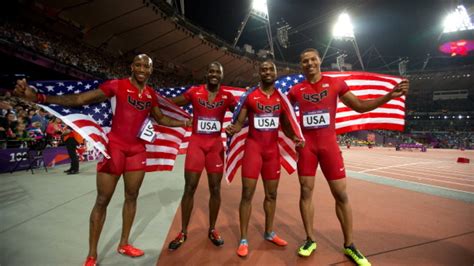
Tyson Gay celebrating one of his victories.