Wing Chun is a unique and effective martial art that emphasizes efficiency, directness, and close-range combat. A correct Wing Chun stance is like a piece of bamboo, firm but flexible, rooted but yielding.
The Wing Chun combat stance is a crucial element in this martial art, providing the foundation for balance, structure, and powerful strikes. This article delves into the intricacies of the Wing Chun stance, exploring its principles, techniques, and benefits.
Many Wing Chun lineages emphasize fighting on the outside of the opponent rather than facing them head on. Such a position could be described as standing at an angle where the Wing Chun practitioner can strike with both their arms, while their opponent can only strike with one of their own arms due to poor positioning. Some Wing Chun practitioners believe that the person with better body structure will win.
Here's what you need to know:
* Balance and Structure: Balance is related to structure because a well-balanced body recovers more quickly from stalled attacks and structure is maintained.* Proprioception: Wing Chun trains the awareness of one's own body movement derived from muscular, tendon, and articular sources. Performing Wing Chun's forms such as Chum Kiu or the Wooden Dummy form greatly improve proprioception.* High, Narrow Stance: Wing Chun favors a high, narrow stance with the elbows kept close to the body. Within the stance, arms are generally positioned across the vitals of the centerline with hands in a vertical wu sau position to readily placed block fast moving blows to one's vital striking points down the centerline of the body--neck, chest, belly and groin.* Footwork: Shifting or turning within a stance is carried out variantly on the heels, balls, or middle of the foot depending on lineage.* Stable Base: All attacks and counter-attacks are initiated from this firm, stable base.* Structure over Power: Wing Chun rarely compromises structure for more powerful attacks because this is believed to create defensive openings which may be exploited. As described more below, some Wing Chun styles discourage the use high of kicks, since this creates an opportunity for counter-attacks to the groin.* Rootedness: When the practitioner is effectively "rooted", or aligned so as to be braced against the ground, the force of the hit is believed to be far more devastating.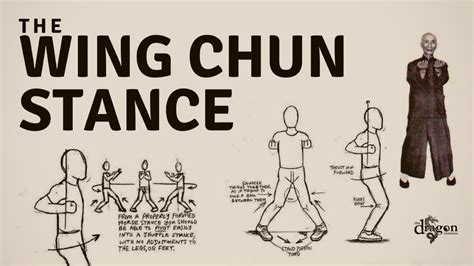
Key Principles of the Wing Chun Stance
The Wing Chun stance is built upon several fundamental principles that enhance its effectiveness in combat:
Read also: Contributions to Wing Chun
Relaxation and Focus
Tension reduces punching speed and power. Muscles act in pairs in opposition to each other. If the arm is tensed, maximum punching speed cannot be achieved as the biceps will be opposing the extension of the arm. A relaxed, but focused, limb affords the ability to feel "holes" or weaknesses in the opponent's structure. Muscular struggle reduces a fight to who is stronger.
Centerline Theory
While the existence of a "central axis" concept is unified in Wing Chun, the interpretation of the centerline concept itself is not. Many variations exist, with some lineages defining anywhere from a single "centerline" to multiple lines of interaction and definition. Traditionally the centerline is considered to be the vertical axis from the top of a human's head to the groin. Wing Chun techniques are generally "closed", with the limbs drawn in to protect the central area and also to maintain balance. In most circumstances, the hands do not move beyond the vertical circle that is described by swinging the arms in front, with the hands crossed at the wrists. To reach outside this area, footwork is used. A large emphasis and time investment in training Chi Sau exercise emphasizes positioning to dominate this centerline. Wing Chun practitioners attack within this central area to transmit force more effectively, since it targets the "core center". For example, striking an opponent's shoulder will twist the body, dispelling some of the force and weakening the strike, as well as compromising the striker's position.
Simultaneous Attack and Defense
Due to the emphasis on the centerline, the straight punch (straight left / straight right) is the most common strike in Wing Chun. However, the principle of simultaneous attack and defense suggests that all blocking movements should be accompanied with a simultaneous strike when possible. This allows for the opponent to be put on the defensive faster, and thus allowing the Wing Chun practitioner to defeat the opponent quicker by countering as soon as possible.
Striking Techniques
The Wing Chun stance supports a variety of striking techniques, each designed for efficiency and impact.
The Punch
The punch is the most basic and fundamental in Wing Chun and is usually thrown with the elbow down and in front of the body. Depending on the lineage, the fist is held anywhere from vertical to horizontal. The contact points also vary from the top two knuckles, to the middle two knuckles, to the bottom three knuckles. When executing the punch, one must relax and not use the shoulders or activate the trapezius muscles. The punch comes from the center, Kyun Yau Sam Faat.
Read also: Maximize Your Wing Chun with the Dummy
Wing Chun primarily encourages using both "low elbow power", along with "hip power".
- Directness: The punch is not "loaded" by pulling the elbow behind the body.
- Protection: The elbow is kept low to cover the front midsection of the body. It is more difficult for an opponent to execute an elbow lock/break when the elbow occupies this position.
- Strength and Impact: Wing Chun practitioners believe that because the elbow is behind the fist during the strike, it is thereby supported by the strength of the entire body rather than just a swinging fist, and therefore has more impact.
A common analogy is a baseball bat being swung at someone's head, as opposed to the butt end of the bat being thrust forward into the opponent's face, which would cause far more damage than a glancing hit and is not as easy to evade. Many skilled practitioners pride themselves on being able to generate "short power" or large amount of power in a short space. A common demonstration of this is the "one-inch punch", a punch that starts only an inch away from the target yet delivers an explosive amount of force. This is a principle example of a coiled strike in which multiple abdominal muscles can contribute to the punching power while being imperceptible to the attacker.
Alignment and Structure: because of Wing Chun's usage of stance, the vertical punch is thus more suitable. The limb directly in front of the chest, elbow down, vertical nature of the punch coupled with a snap twisting of the waist requires a practitioner's body to naturally untwist or release before the rebound of the punch. This effectively demonstrates an understanding of the equal and opposite force reactions attributed to Newtonian Physics.
Kicks
Kicks can be explicitly found in the Chum Kiu and Muk Jong forms, though some have made interpretations of small leg movements in the Siu Nim Tau and Biu Ji to contain information on kicking as well. Depending on lineage, a beginner is often introduced to basic kicking before learning the appropriate form. Traditionally, kicks are kept below the waist. Kicks in Wing Chun are mostly directed at the lower half of the body.
Variations on a front kick are performed striking with the heel. The body may be square and the knee and foot are vertical on contact (Chum Kiu), or a pivot may be involved with the foot and knee on a plane at an angle (Muk Jong). At short distances this can become a knee. A roundhouse kick is performed striking with the shin in a similar manner to the Muay Thai version with most of the power coming from the body pivot. This kick is usually used as a finisher at closer range, targeting anywhere between the ribs and the back of the knee, this kick can also become a knee at close range. Every kick is both an attack and defence, with legs being used to check incoming kicks or to take the initiative in striking through before a more circular kick can land.
Read also: Understanding Siu Lim Tao
Elbow Strikes
Wing Chun relies heavily on elbow strikes at close range. Common targets for elbows include the chest, chin, head, and face. Elbows can also be used, at a more advanced stage, to control and restrict the opponent's range of movement by exerting forward elbow pressure on his elbows and forearms.
Uncommitted Techniques and Chain Attacks
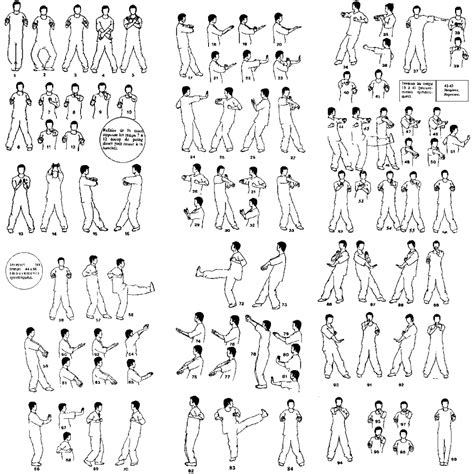
Wing Chun techniques are uncommitted. This means that if the technique fails to connect, the practitioner's position or balance is less affected. If the attack fails, the practitioner is able to "flow" easily into a follow-up attack. All Wing Chun techniques permit this. Any punches or kicks can be strung together to form a "chain" of attacks. According to Wing Chun theory, these attacks, in contrast to one big attack, break down the opponent gradually causing internal damage.
Sensitivity and Trapping
The Wing Chun practitioner develops reflexes within the searching of unsecured defenses through use of sensitivity. Training through Chi Sau with a training partner, one practices the trapping of hands.
Close-Range Combat
Wing Chun teaches practitioners to advance quickly and strike at close range. While the Wing Chun forward kick can be considered a long range technique, many Wing Chun practitioners practice "entry techniques": getting past an opponent's kicks and punches to bring them within range of Wing Chun's close range repertoire.
Rooting: The Foundation of Stability and Power
âBe like water my friend.â This quote by Bruce Lee has become famous around the world. But not as famous is the concept of becoming like a tree. This concept is summed up in one word, rooting. But what does Wing Chun rooting in martial arts do with your effectiveness? Rooting is the capability to with stand the force of your opponent from moving you unwillingly. But also the force to redirect, block, attack, sweep and takedown your Opponent. All of this and more in fighting needs rooting and structure, but it also must be dynamic and not static.
Sifu Och Wing Chun trains the mentality that dynamic stand up structure and mobility is better for fighitng than on the ground. WHY? what if there are multiple opponents? or someone has a weapon? or what if they are more trained, skilled, or stronger than you. The topic of Wing Chun rooting is really any martial art your training from Tae Kwon Do, Muai Thai, Silat, Northern Style Praying Mantis, its essencial.
Wing Chun stance and structure should be overwhelming dynamicly capable not stiff and solitary. If you are fighting someone more resourceful, or stronger than you are, a stiff stucture may only secure your defeat. When that power is being delivered into another body it can only do one of two things. Overcome causing a loss of structure and balance.
| Level | Description | Benefit |
|---|---|---|
| Level One | Non-rooting position | Enhances redirection and quick mobility |
| Level Two | Bending at the knees and sinking down into your root, keeping your back straight and your tailbone tucked in. | Increased stability and potential for power generation |
| Level Three | Sinking further, knees open, tailbone tucked. | Vigorous and free movement in any direction while still being able to kick, strike, and block and attack simultaneously. |
At Sifu Och Wing Chun, students actively engage in rooting drills and pressure training, specifically collaborating with partners to enhance their skills and responsiveness even further. That way you ingrain it into your body and make it as capable as possible.
If there is little to no structure, a martial artist can be easily overtaken, much like a tree without roots that can be easily blown over. In Wing Chun, rooting is achieved through the heels, which provides the necessary stability and strength for effective movement. Similar to the form of a squat, driving through the heels is the correct way to line up the skeletal structure for the most power. When practitioners successfully accomplish rooting in Wing Chun, they establish a solid foundation from which they can execute any desired attack.
Conversely, one can say that by supporting through the heels and then distributing weight through the rest of the foot, individuals can effectively root their weight. Think about it, to root with a deadlift, or if someone was to throw a 100lb medicine ball at you. Would you rather be on the balls of your feet to catch it, or on your heels?
The answer is straightforward; however, it becomes complicated when one engages in philosophical discussions that require proof or reasoning. Heels are designed for rooting, while the balls of the feet facilitate escape and quick backward movements. Yes you will use the entire foot but which part of your foot is your first focus, that is the key.
Reverting to the squat example, when you have 300 lbs. on your shoulders you have two options, toes or heels. WIth the weight on your toes you now have to utilize your Calves and Tibialis Anterior to attempt to keep your legs underneath the weight. Shifting to the heels aligns the bones so that the structural integrity of the system remains intact. This alignment allows weight to be directly transmitted into the ground.
Get your rooting right in Wing Chun, and you can stand strong, redirect an opponentâs attack energy, and fight stronger.